
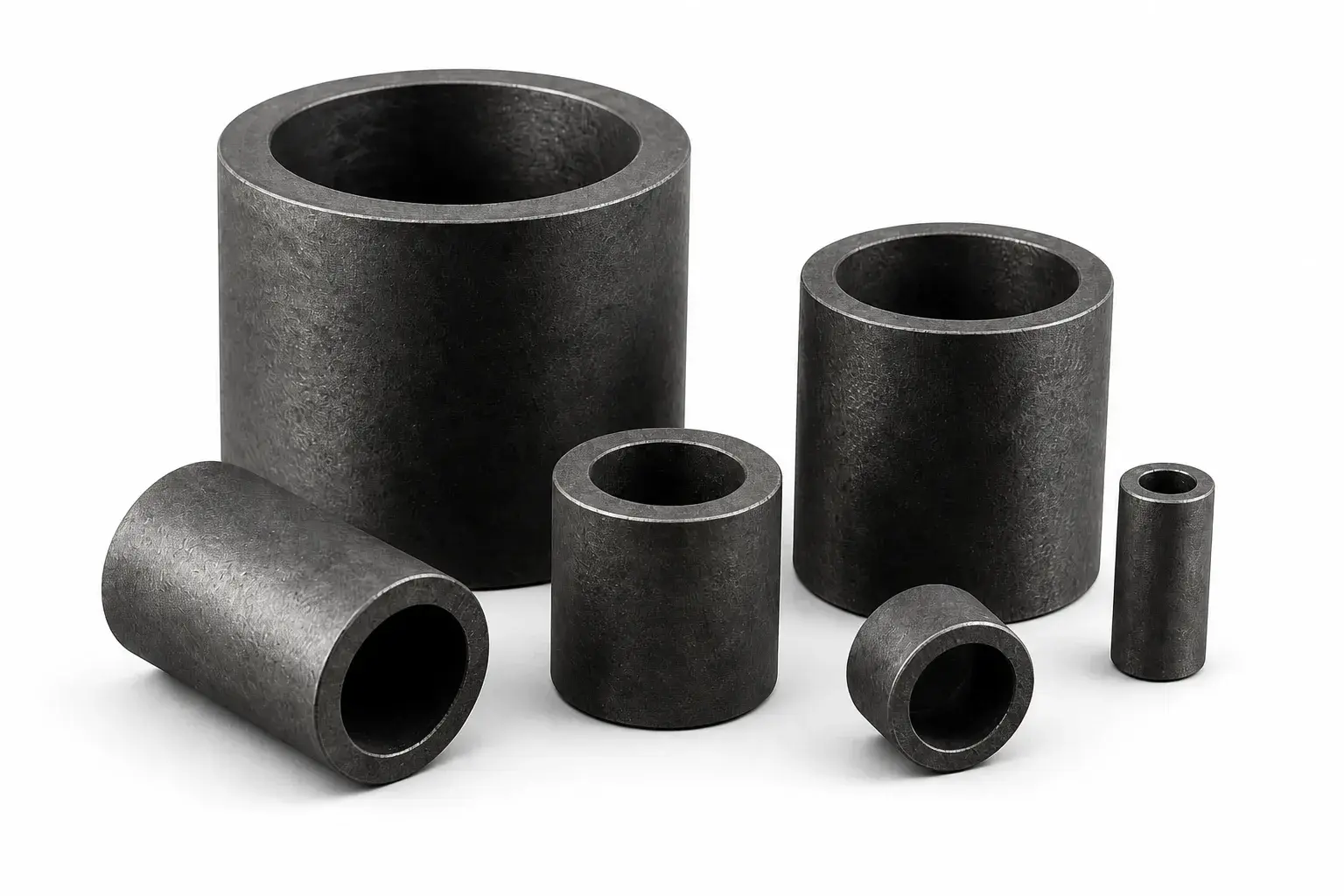
Machine bushings and spacers
Mechanical sliding component
Also known as: Graphite bushings · Graphite sleeves · Graphite bearings · Graphite journal bearings · Carbon-graphite bushings · Graphite spacers
[ Technical summary ]
Graphite bushings, sleeves, and journal bearings are sliding elements that carry a shaft or guide relative motion without external lubrication. Graphite provides a low dry coefficient of friction, dimensional stability against temperature, and compatibility with atmospheres where oil degrades or contaminates the process. They appear in industrial machinery, furnaces, pumps, and equipment working in vacuum or controlled atmosphere.
[ Problem it solves ]
Allow relative motion between components without depending on oil or grease lubrication, when the conventional lubricant degrades with temperature, outgasses under vacuum, cannot be replenished often enough, or contaminates the product or the process atmosphere.
Processes
- Dry sliding
- Self-lubrication
- Shaft guiding and support
Operating conditions
- Dry operation, without oil or grease
- High temperature
- Vacuum
- Controlled or inert atmosphere
- Environments where lubricant contamination is not acceptable
When it is suitable
- Oil or grease lubrication cannot be used
- There is sustained or cyclic high-temperature exposure
- The equipment operates in vacuum or in a controlled atmosphere
- Product or process contamination must be minimized
- Loads are steady and free of impact
- Relubrication or maintenance is hard to schedule
When it may not be suitable
- There are impact or repeated shock loads
- The design requires ductility or plastic deformation of the element
- There is severe oxidation in air at high temperature without protection or impregnation
- The counterface is abrasive or significantly misaligned
- Mechanical strength equivalent to a structural metal is required
Process challenges
- Wear from metal-to-metal friction
- Oil contamination
- Thermal deformation
- Seizing on dry start
Advantages
- Low dry coefficient of friction
- Dimensional stability at temperature
- Does not require external lubrication
- Machinable to tight tolerances
Limitations
- Oxidation in air at high temperature without protection
- Lower mechanical strength than structural metals
- Requires grade selection by load and environment
[ Critical selection variables ]
These variables define the grade and the geometry. Actual values are confirmed against the grade datasheet.
- Operating temperatureDecisive
- Atmosphere (air, inert, vacuum)Decisive
- Load and its distributionDecisive
- Sliding speedDecisive
- Clearance and type of fitDecisive
- Counterface material and finishRelevant
- Geometry and tolerances (OD, ID, length)Relevant
- Alignment and mounting stiffnessRelevant
[ Required material properties ]
Properties that guide selection. Numerical values come from each grade's datasheet.
Critical properties
- Friction coefficient
- Wear resistance
- Compressive strength
- Flexural strength
Secondary properties
- Thermal expansion
- Self-lubrication
- Oxidation resistance
- Dimensional stability
[ Related ]
Related applications
[ Frequently asked questions ]
View all FAQsTechnical content reviewed by ESGRAF — Last reviewed: September 8, 2026
[ Quote ]
Need the right specification—not just material?
Tell us your application. Engineering response in under 24 hours.