
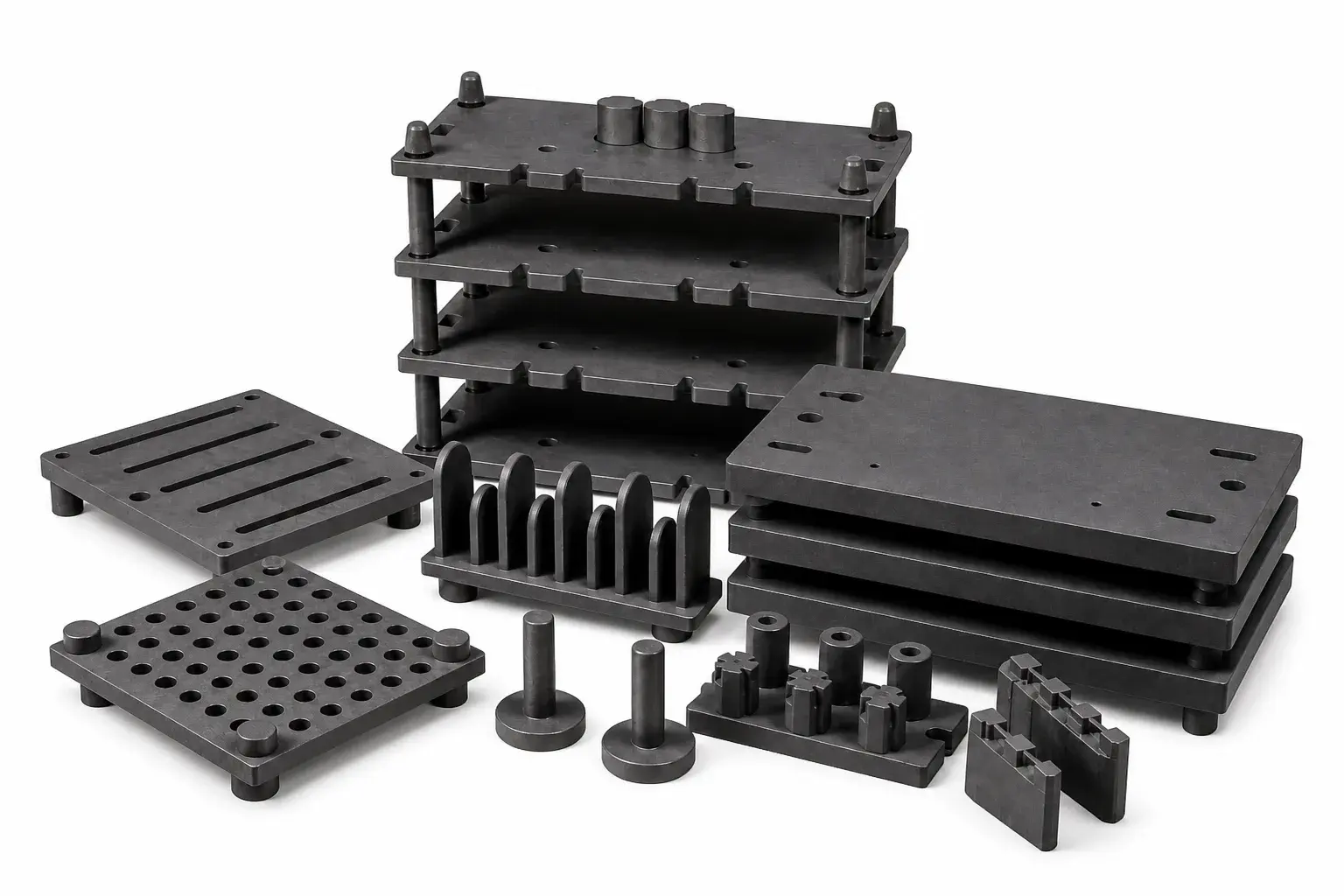
Furnace load fixtures and rigs
Load support element
Also known as: Graphite furnace supports · Graphite trays · Graphite load bases · Graphite grids and racks
Graphite fixtures and supports for loads in vacuum, controlled atmosphere, and high temperature.
[ Technical summary ]
Graphite supports, bases, and trays carry the weight of the load inside the furnace and transfer it to the chamber structure. They sit at process temperature for the whole cycle, so the critical variable is not only strength but the absence of creep: a tray that sags changes load position and heating uniformity. Graphite keeps its geometry at temperature and is machined into plates, grids, and stackable bases.
Load supports and fixtures are graphite parts that hold or position components inside the furnace. The application location may be a vacuum or controlled-atmosphere furnace; the documented application is the support/fixture itself.
[ Problem it solves ]
Carry the weight of the load at process temperature without progressive sagging, keeping part position from drifting between cycles and avoiding frequent tray replacement.
Processes
- Furnace load support
- Heat treatment
- Brazing and annealing
Operating conditions
- Vacuum and controlled atmosphere
When it is suitable
- Metal trays sag under load at temperature
- The load is stacked and needs supports of stable height
- The furnace runs in vacuum or controlled atmosphere
- The thermal mass heated along with the load must be reduced
When it may not be suitable
- The process runs in air at high temperature without a protective atmosphere
- The load is dropped or set down with impact onto the support
- The part tolerates no carbon pickup from contact
Process challenges
- Deformation of metal fixtures
- Part contamination
- Uneven heat transfer
Advantages
- Dimensional stability at temperature
- Relatively low thermal mass
- Machining to part geometry
Limitations
- Oxidation in air at high temperature without protection
- Design must account for shrinkage and cycles
- Part contact may require a low-contamination grade
[ Critical selection variables ]
These variables define the grade and the geometry. Actual values are confirmed against the grade datasheet.
- Load and its distributionDecisive
- Operating temperatureDecisive
- Geometry and tolerancesDecisive
- Atmosphere (air, inert, vacuum)Relevant
- Thermal and duty cyclingRelevant
- Direct contact with the partRelevant
[ Required material properties ]
Properties that guide selection. Numerical values come from each grade's datasheet.
Critical properties
- Flexural strength
- Compressive strength
- Dimensional stability
- Thermal stability
Secondary properties
- Bulk density
- Machinability
[ Related ]
[ Frequently asked questions ]
View all FAQsTechnical content reviewed by ESGRAF — Last reviewed: September 8, 2026
[ Quote ]
Need the right specification—not just material?
Tell us your application. Engineering response in under 24 hours.