
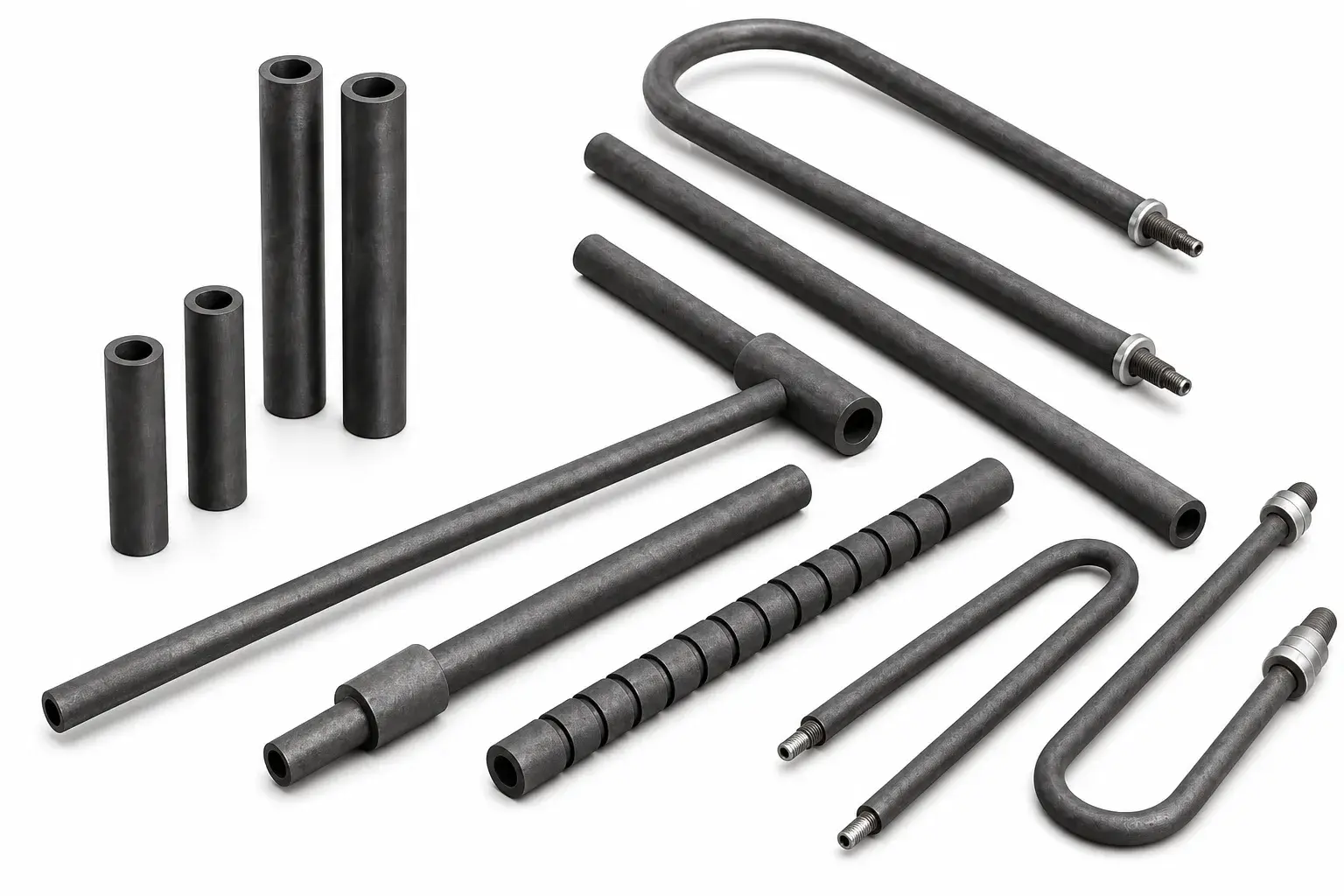
Furnace heating elements
Resistive heating element
Also known as: Graphite resistors · Graphite heating elements · Vacuum furnace heaters · Hot-zone heating elements
Graphite heating resistors and elements for furnaces and thermal chambers.
[ Technical summary ]
A graphite heating element heats by Joule effect: current passes through the part and the dissipated power depends on its resistivity and cross-section. In vacuum and inert atmosphere, graphite sustains temperatures where metallic elements embrittle or evaporate, and its geometry — rods, tubes, curved plates, or cut elements — is machined to distribute power inside the chamber. It is used in vacuum and controlled-atmosphere furnaces and in high-temperature process equipment.
Graphite heating elements are used when stable high-temperature heating is needed in vacuum or controlled atmosphere. They are not the furnace itself: they are the component that converts current into heat inside that environment.
Selection depends on maximum temperature, atmosphere, element geometry, power and how the element is supported and connected. Grades with suitable purity and low vapor pressure are preferred for vacuum service.
ESGRAF supplies blanks and machined elements. Share power, temperature, atmosphere and a drawing via quote or contact so applications engineering can recommend a grade family and manufacturable geometry.
[ Problem it solves ]
Deliver heating power inside a hot chamber with an element that neither evaporates nor embrittles at working temperature, and whose cross-section can be designed to spread heat evenly over the load.
Processes
- Resistance heating
- Vacuum furnaces
Operating conditions
- Inert or reducing atmosphere
- High-temperature cycles
When it is suitable
- Heating takes place in vacuum or in inert or reducing atmosphere
- Metallic elements fail prematurely because of temperature
- Power distribution must be tailored to the chamber geometry
- Elements of an existing furnace need replacing
When it may not be suitable
- The process runs in air at high temperature without a protective atmosphere
- The process atmosphere does not tolerate carbon
- The electrical and fixturing design has not been validated by engineering
Process challenges
- Premature failure of metallic elements
- Chamber contamination
- Uneven heat distribution
Advantages
- Stability at high temperature
- Low vapor pressure in vacuum (suitable grades)
- Custom machinable geometries
Limitations
- Oxidation in air above roughly 400–500 °C
- Requires controlled atmosphere or vacuum at high temperature
- Electrical and fixturing design must be validated by engineering
[ Critical selection variables ]
These variables define the grade and the geometry. Actual values are confirmed against the grade datasheet.
- Operating temperatureDecisive
- Electrical power and connectionDecisive
- Atmosphere (air, inert, vacuum)Decisive
- Geometry and tolerancesDecisive
- Current densityDecisive
- Thermal and duty cyclingRelevant
- Required purity and allowable contaminationRelevant
- Fastening system and jointsRelevant
[ Required material properties ]
Properties that guide selection. Numerical values come from each grade's datasheet.
Critical properties
- Thermal shock resistance
- Purity
- Electrical resistivity
- Thermal stability
Secondary properties
- Dimensional stability
- Flexural strength
- Machinability
[ Related ]
[ Frequently asked questions ]
View all FAQsTechnical content reviewed by ESGRAF — Last reviewed: September 8, 2026
[ Quote ]
Need the right specification—not just material?
Tell us your application. Engineering response in under 24 hours.