
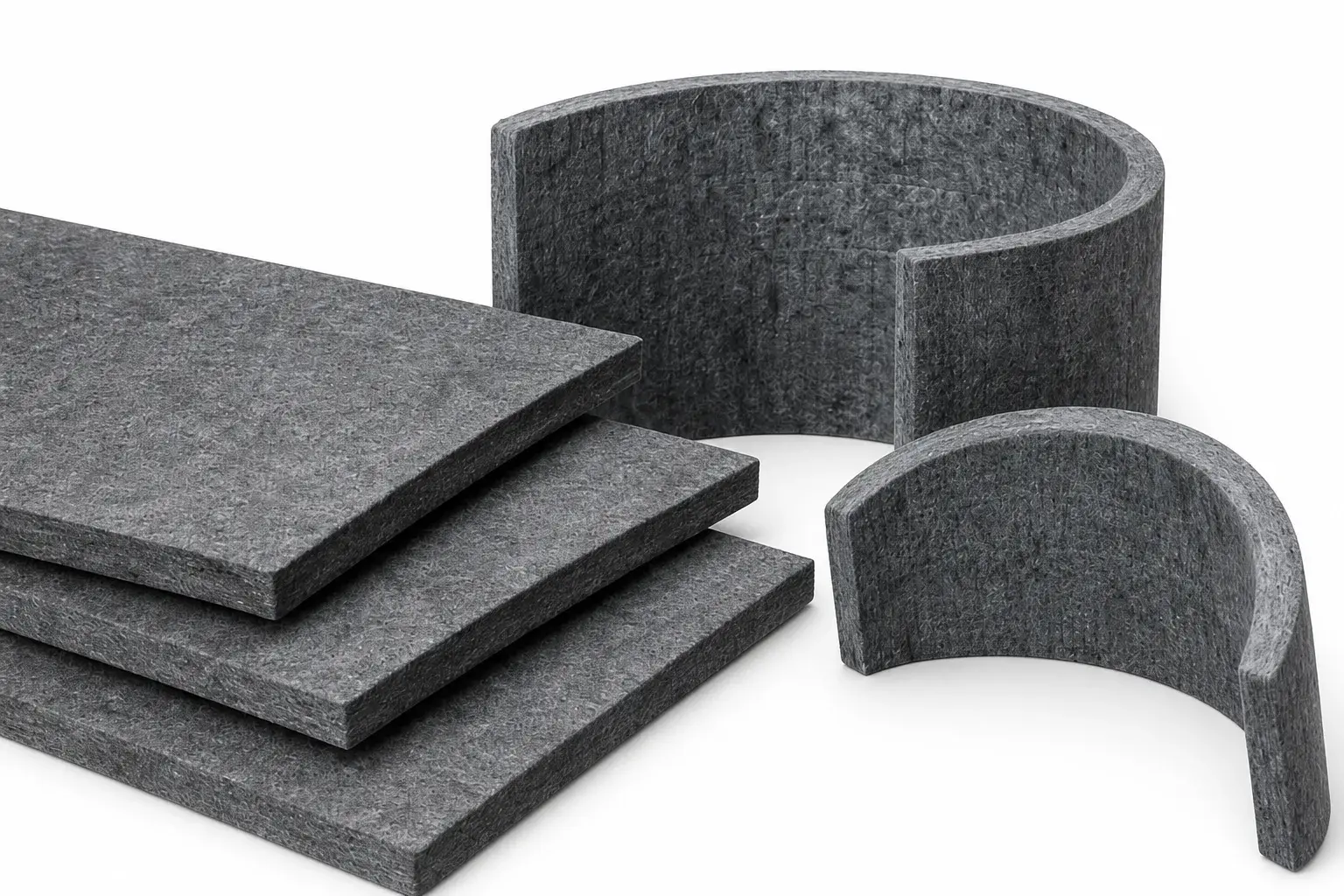
Furnace rigid felt liners
Rigid structural insulation
Also known as: Rigid carbon felt · Graphite insulation panels · Rigid felt board · Self-supporting furnace liners
Rigid felt panels and liners for insulation with structural support in high-temperature chambers.
[ Technical summary ]
Rigid felt is a carbon-fibre insulation consolidated with a carbonized binder, which gives it enough stiffness to be self-supporting and to be machined into panels, discs, and liners. Compared with soft felt, it holds shape and assembly clearances without continuous fastening, and presents a more closed face that reduces fibre shedding into the chamber. It is used as the primary insulation in vacuum and controlled-atmosphere furnaces.
Rigid felt liners and panels provide shape-stable insulation in heat-treatment furnaces and vacuum chambers. They are used as walls, roofs, disks, and low-conductivity structural elements.
They are often combined with soft felt: the rigid grade provides support and geometry; the soft grade fills gaps and improves the chamber’s thermal seal.
[ Problem it solves ]
Insulate large surfaces with a material that keeps its shape and assembly clearances, avoiding the compaction and open joints that appear when flexible insulation works without support.
Processes
- Structural insulation of furnace chambers
- Self-supporting liners and panels
- Die-cut or machined disks and parts
Operating conditions
- Vacuum and controlled atmosphere
When it is suitable
- The insulation must be self-supporting or form the hot-zone wall
- Fibre shedding toward the load has to be reduced
- The zone has a large area and regular geometry
- Installation uses panels replaceable section by section
When it may not be suitable
- The process runs in air at high temperature without a protective atmosphere
- The zone has irregular voids that call for a flexible material
- The panel will take impact or direct mechanical load
Process challenges
- Heat losses in large-area zones
- Need for shape-stable insulation
- Thermal shock during startups and shutdowns
- Panel installation with controlled clearances
Advantages
- Greater stiffness and dimensional stability than soft felt
- Low thermal conductivity in vacuum
- Machinable plates, blocks, and geometries
- Combinable with soft felt liners
Limitations
- Oxidation in air at high temperature
- Less flexible for irregular voids (complement with soft felt)
- Gasket and fastening design must account for shrinkage
[ Critical selection variables ]
These variables define the grade and the geometry. Actual values are confirmed against the grade datasheet.
- Operating temperatureDecisive
- Atmosphere (air, inert, vacuum)Decisive
- Thickness and number of layersDecisive
- Felt densityDecisive
- Geometry and tolerancesRelevant
- Fastening system and jointsRelevant
- Required purity and allowable contaminationRelevant
[ Required material properties ]
Properties that guide selection. Numerical values come from each grade's datasheet.
Critical properties
- Thermal conductivity
- Purity
- Thermal stability
- Dimensional stability
Secondary properties
- Bulk density
- Machinability
[ Related ]
[ Frequently asked questions ]
View all FAQsTechnical content reviewed by ESGRAF — Last reviewed: September 8, 2026
[ Quote ]
Need the right specification—not just material?
Tell us your application. Engineering response in under 24 hours.