
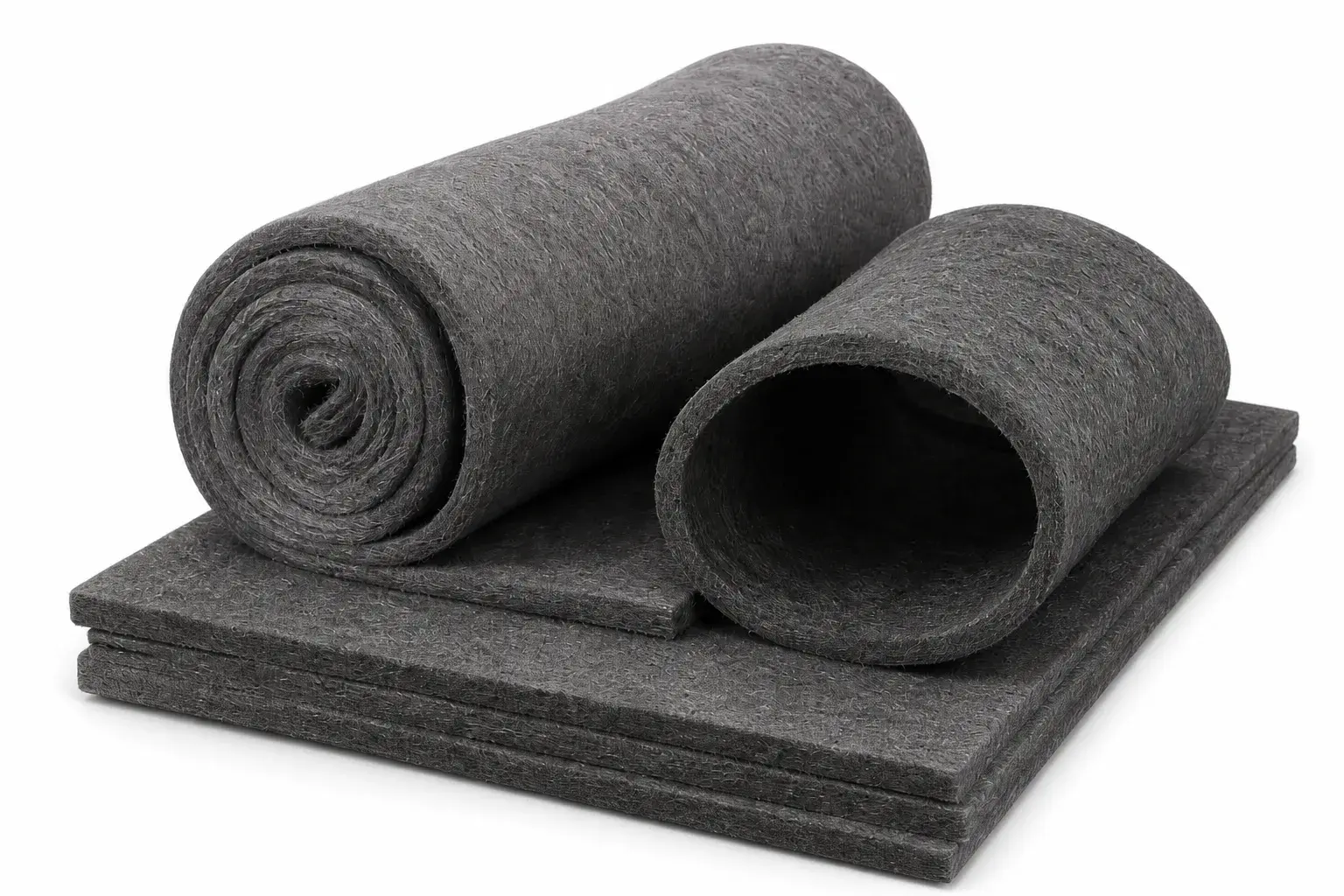
Furnace soft felt liners
Flexible layered insulation
Also known as: Carbon soft felt · Graphite felt blanket · Flexible furnace liners · PAN felt and rayon felt
Flexible soft felt liners (PAN or rayon) for furnace chambers and high-temperature insulation.
[ Technical summary ]
Carbon or graphite soft felt is a flexible insulation installed in layers over chamber walls, roofs, and doors. Having no stiffness of its own, it follows curves, corners, and penetrations where a panel would leave gaps — and those poorly closed joints are the main path for heat loss. It is supplied in rolls or sheets and cut to the developed size of each zone.
Soft felt liners are the specific flexible-insulation application in heat-treatment furnaces (and vacuum or controlled-atmosphere chambers). The location is the furnace; the application is lining with soft felt blankets or sheets.
They are supplied in rolls or sheets, with cut-to-size options. Choice between PAN and rayon precursors, thickness, and number of layers depends on temperature, vacuum, purity, and chamber geometry.
When to use it
- Lining chambers that need conformity to irregular shapes.
- Primary or secondary insulation layers alongside rigid panels.
- Partial replacements without redesigning the entire chamber.
[ Problem it solves ]
Close heat losses in irregular geometry where rigid insulation does not fit, adding layers up to the required thickness without manufacturing shaped parts.
Processes
- Insulation of heat-treatment furnace chambers
- Lining of walls, roofs, and doors
- Multiple soft felt layers
Operating conditions
- Vacuum and inert or reducing atmosphere
When it is suitable
- The zone to insulate has curves, corners, or penetrations
- An existing insulation needs completing or reinforcing
- Installation is done in layers and on site
- The furnace works in vacuum or in inert or reducing atmosphere
When it may not be suitable
- The process runs in air at high temperature without a protective atmosphere
- The insulation must carry load or hold its shape unaided
- There is direct gas flow that would carry fibre onto the load
Process challenges
- Heat losses and high energy consumption
- Poor fit to chamber geometry
- Fiber contamination on the load
- Difficulty replacing full rigid insulation
Advantages
- Flexibility to fit curves and voids
- Low thermal conductivity
- Vacuum stability up to elevated temperatures (grade-dependent)
- Cut-to-size from rolls and sheets
- PAN and rayon grades by purity and process
Limitations
- Oxidation in air above ~400–500 °C
- Lower structural capacity than rigid felt
- Requires fastening or extra layers in load zones
- PAN vs rayon selection must be validated for contamination and vacuum
[ Critical selection variables ]
These variables define the grade and the geometry. Actual values are confirmed against the grade datasheet.
- Operating temperatureDecisive
- Atmosphere (air, inert, vacuum)Decisive
- Thickness and number of layersDecisive
- Fiber precursor (PAN or rayon)Decisive
- Required purity and allowable contaminationRelevant
- Geometry and tolerancesRelevant
- Fastening system and jointsRelevant
[ Required material properties ]
Properties that guide selection. Numerical values come from each grade's datasheet.
Critical properties
- Thermal conductivity
- Thermal shock resistance
- Purity
- Thermal stability
Secondary properties
- Dimensional stability
[ Related ]
Related applications
Related processes and equipment
[ Frequently asked questions ]
View all FAQsTechnical content reviewed by ESGRAF — Last reviewed: September 8, 2026
[ Quote ]
Need the right specification—not just material?
Tell us your application. Engineering response in under 24 hours.