
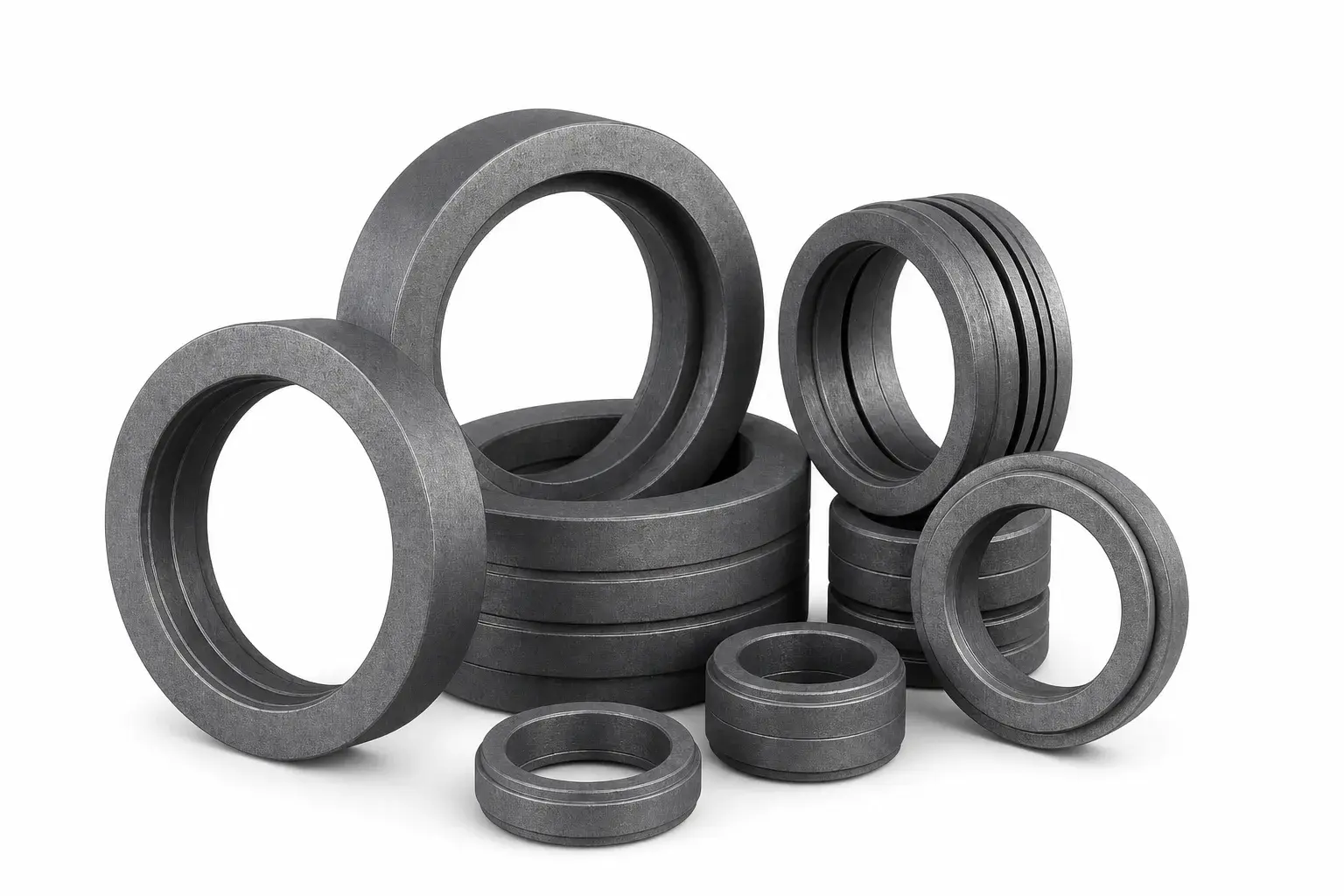
Machine seal rings
Machined seal ring
Also known as: Carbon-graphite rings · Segmented graphite rings · Shaft seal rings · Carbon seal segments
[ Technical summary ]
Graphite and carbon-graphite seal rings close the gap between a shaft and its housing, in rotating as well as static service. They are machined to precise flatness and diameter, sometimes in segments, and use the low friction and thermal stability of the material to seal without added lubricant. They are used in pumps, turbomachinery, industrial machinery, and chemical-process equipment.
[ Problem it solves ]
Limit leakage at a shaft-to-housing interface where an elastomeric ring cannot take the temperature or the medium, and where adding grease or oil is not acceptable.
Operating conditions
- Rotary sealing
- Static sealing
- Face-to-face contact
When it is suitable
- Temperature is outside the range of an elastomeric ring
- The medium chemically attacks polymeric seals
- Grease or oil cannot be added at the interface
- Stable flatness and concentricity are required in service
- The assembly accepts a rigid ring instead of an elastic one
When it may not be suitable
- The seal must deform elastically to absorb wide tolerances
- There are impact or repeated shock loads
- The counterface is misaligned or carries abrasives
- There is severe oxidation in air at high temperature without protection or impregnation
Process challenges
- Leaks from wear
- Ovalization and loss of flatness
- Process contamination
Advantages
- Machinable flatness and finish
- Low dry friction
- Compatibility with wide thermal ranges
Limitations
- Oxidation in air at high temperature without protection
- Lower mechanical strength than structural metals
- Requires grade selection by load and environment
[ Critical selection variables ]
These variables define the grade and the geometry. Actual values are confirmed against the grade datasheet.
- Operating temperatureDecisive
- Differential pressureDecisive
- Flatness and surface finishDecisive
- Geometry and tolerancesDecisive
- Fluid or medium in contactRelevant
- Rotational speedRelevant
- Counterface material and finishRelevant
- Thermal and duty cyclingRelevant
[ Required material properties ]
Properties that guide selection. Numerical values come from each grade's datasheet.
Critical properties
- Friction coefficient
- Compressive strength
- Flexural strength
- Thermal expansion
Secondary properties
- Impermeability
- Self-lubrication
- Dimensional stability
- Machinability
[ Related ]
[ Frequently asked questions ]
View all FAQsTechnical content reviewed by ESGRAF — Last reviewed: September 8, 2026
[ Quote ]
Need the right specification—not just material?
Tell us your application. Engineering response in under 24 hours.