
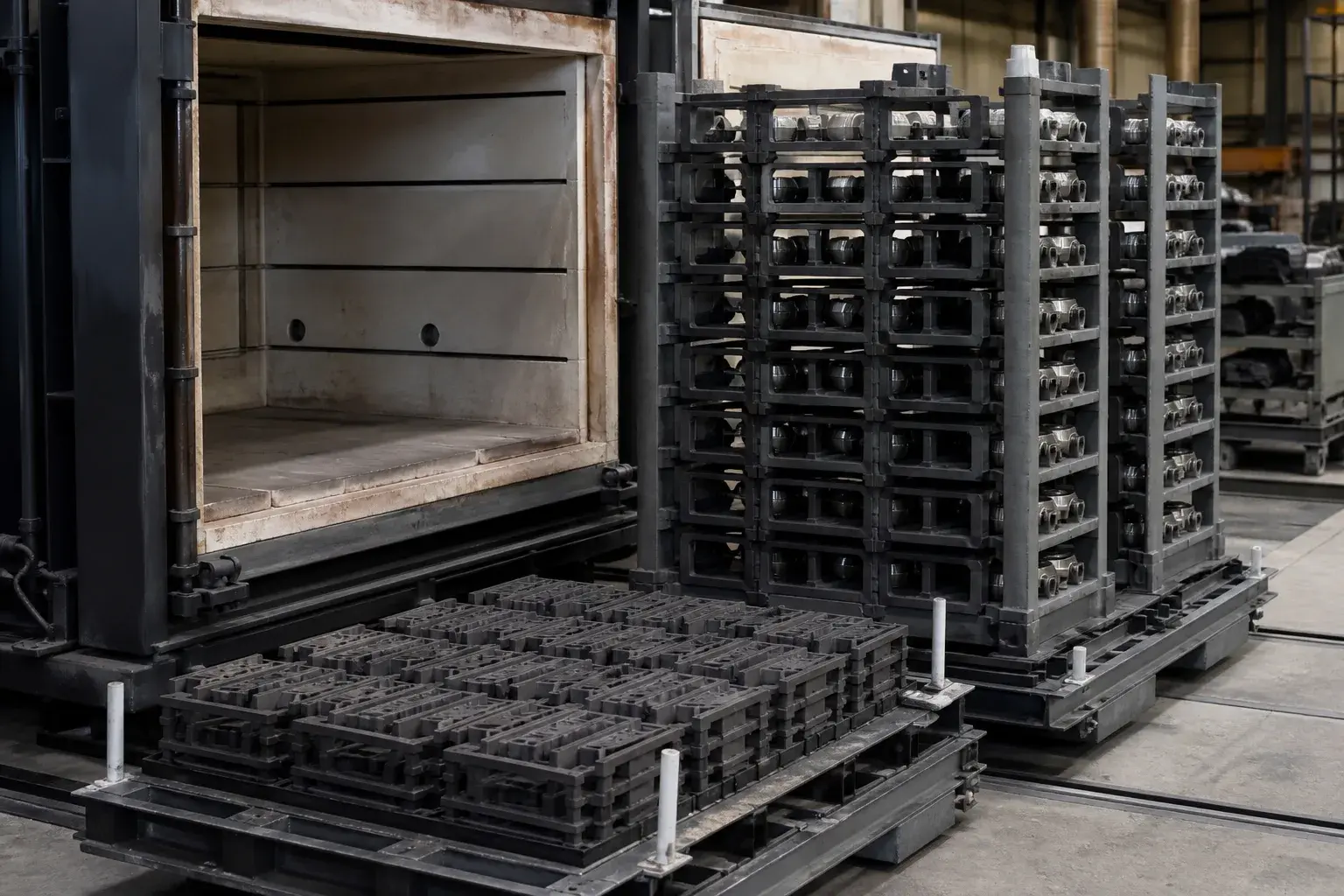
Heat-treatment fixtures
Thermal process tooling
Also known as: Graphite heat-treatment tooling · Graphite furnace fixtures · Graphite trays and bases · Tooling for hardening and annealing
Graphite tooling and supports for hardening, annealing, tempering and brazing.
[ Technical summary ]
Graphite heat-treatment tooling covers the parts that accompany the load through the cycle: bases, trays, positioning fixtures, and separators. Their job is to hold the workpiece in the right position while it heats and cools, without distorting or marking it. Graphite achieves this through dimensional stability at temperature and relatively low thermal mass, which lets the tooling follow the cycle instead of lagging behind it.
The place may be a heat-treatment line or plant (including vacuum or controlled atmosphere). The application is the graphite tooling: supports, bases, trays and fixtures that hold or position the load during the cycle.
Good tooling keeps parts stable, transfers heat predictably and avoids contamination. Design should consider thermal cycling, load weight and atmosphere.
ESGRAF machines custom fixtures from isostatic, extruded or molded graphite according to the part geometry. Provide cycle temperatures, atmosphere, load and a drawing for quotation.
[ Problem it solves ]
Hold the workpiece through the thermal cycle without the tooling itself distorting, slowing the heat-up, or leaving marks — avoiding distortion and rejects in the treatment.
Operating conditions
- Hardening
- Annealing
- Tempering
- Brazing
- Load support in the furnace
When it is suitable
- Metal fixtures bow or are consumed by the cycles
- The part must hold a precise position through the cycle
- The thermal mass travelling with the load must be reduced
- The process runs in vacuum or controlled atmosphere
When it may not be suitable
- The process runs in air at high temperature without a protective atmosphere
- The part tolerates no carbon pickup from contact
- The tooling takes knocks or rough handling on every load
Process challenges
- Fixture deformation
- Uneven heat transfer
- Part contamination
Advantages
- Dimensional stability at temperature
- Relatively low thermal mass
- Custom design by part geometry
Limitations
- Oxidation in air at high temperature without protection
- Design must account for shrinkage and cycles
- Part contact may require a low-contamination grade
[ Critical selection variables ]
These variables define the grade and the geometry. Actual values are confirmed against the grade datasheet.
- Operating temperatureDecisive
- Atmosphere (air, inert, vacuum)Decisive
- Geometry and tolerancesDecisive
- Load and its distributionDecisive
- Thermal and duty cyclingRelevant
- Heating and cooling rateRelevant
- Direct contact with the partRelevant
[ Required material properties ]
Properties that guide selection. Numerical values come from each grade's datasheet.
Critical properties
- Thermal shock resistance
- Purity
- Dimensional stability
- Thermal stability
Secondary properties
- Flexural strength
- Thermal expansion
- Machinability
[ Related ]
[ Frequently asked questions ]
View all FAQsTechnical content reviewed by ESGRAF — Last reviewed: September 8, 2026
[ Quote ]
Need the right specification—not just material?
Tell us your application. Engineering response in under 24 hours.