
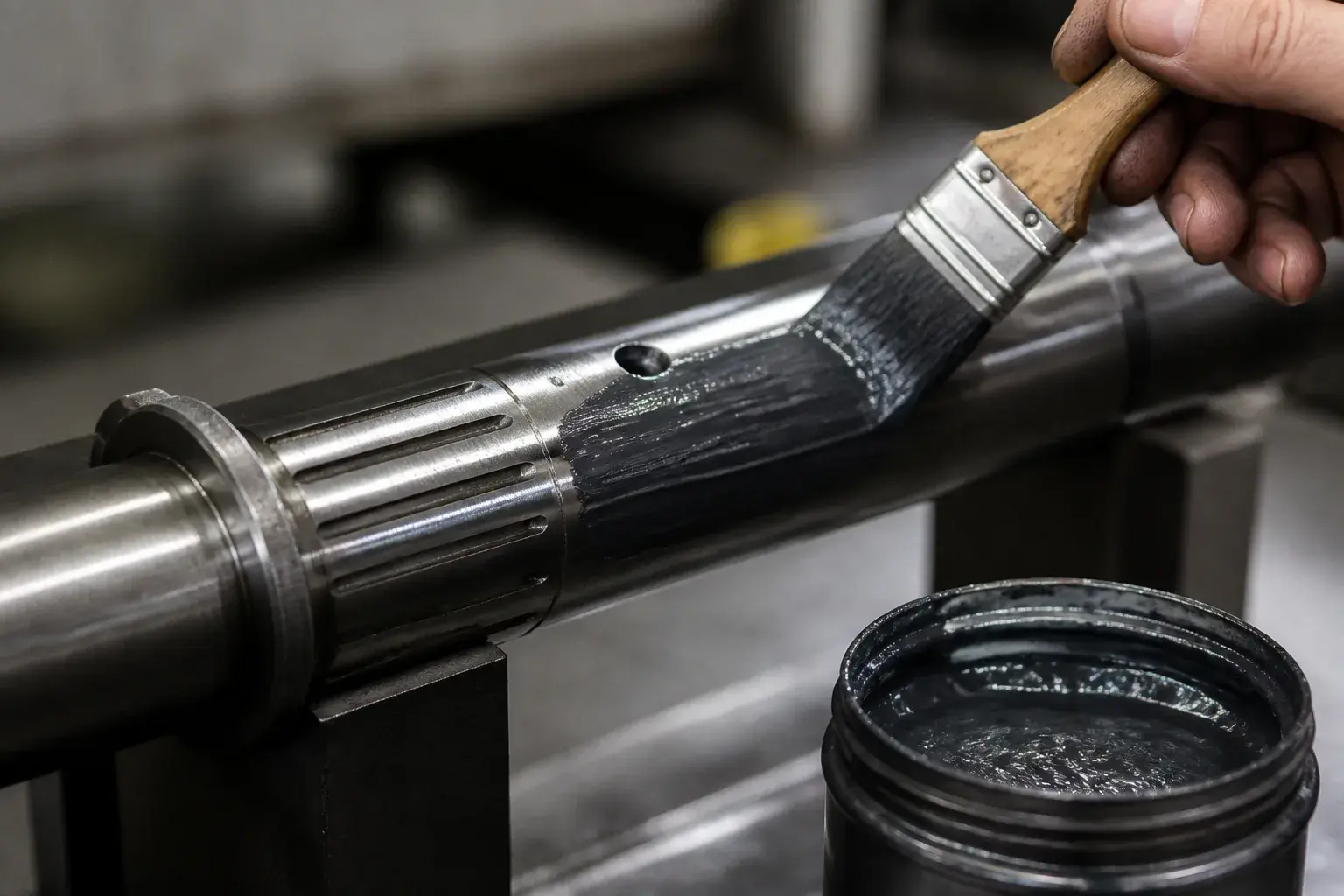
Lubricating paints
Dry-film lubricating coating
Also known as: Graphite lubricating paints · Dry film lubricant coatings · Graphite lubricating varnish · Solid lubricant applied as paint
[ Technical summary ]
A lubricating paint carries graphite dispersed in a binder that, on curing, fixes the particles to the surface. The result is an adhered, durable film rather than a loose deposit: applied once, it lubricates for an extended period without replenishment. It is the answer for friction points where relubrication is difficult or where grease would attract dust, and it is applied by brush, spray, or dip according to the part.
[ Problem it solves ]
Leave permanent lubrication at a friction point that cannot easily be revisited, with a film that adheres to the surface rather than rubbing away in service.
Operating conditions
- Application by brush, spray, or immersion
- Film curing
- Dry lubrication
When it is suitable
- The friction point is hard to reach for relubrication
- Grease would attract dust or dirt in that environment
- Lubrication that lasts without periodic maintenance is required
- The part can be prepared and cured before entering service
When it may not be suitable
- The surface cannot be cleaned or prepared before application
- The point requires continuous lubrication to flush contaminants
- The product cannot be validated in the plant before adopting it in production
Process challenges
- Friction in dry contact
- Need for an adherent film
- Temperature or aggressive environment
Advantages
- Adherent film
- Residual lubrication
- Multiple presentations
Limitations
- Not a hydrodynamic oil lubricant
- May stain light-colored surfaces
- Performance depends on surface preparation and reapplication
[ Critical selection variables ]
These variables define the grade and the geometry. Actual values are confirmed against the grade datasheet.
- Substrate or surface to be treatedDecisive
- Application methodDecisive
- Film thicknessDecisive
- Operating temperatureRelevant
- Load and its distributionRelevant
- Sliding speedRelevant
- Carrier or formulation baseRelevant
[ Required material properties ]
Properties that guide selection. Numerical values come from each grade's datasheet.
Critical properties
- Lubricating film formation
- Friction coefficient
- Thermal stability
- Particle size distribution
Secondary properties
- Self-lubrication
- Wear resistance
- Dispersibility
[ Related ]
Materials
Products
[ Frequently asked questions ]
View all FAQsTechnical content reviewed by ESGRAF — Last reviewed: September 8, 2026
[ Quote ]
Need the right specification—not just material?
Tell us your application. Engineering response in under 24 hours.