
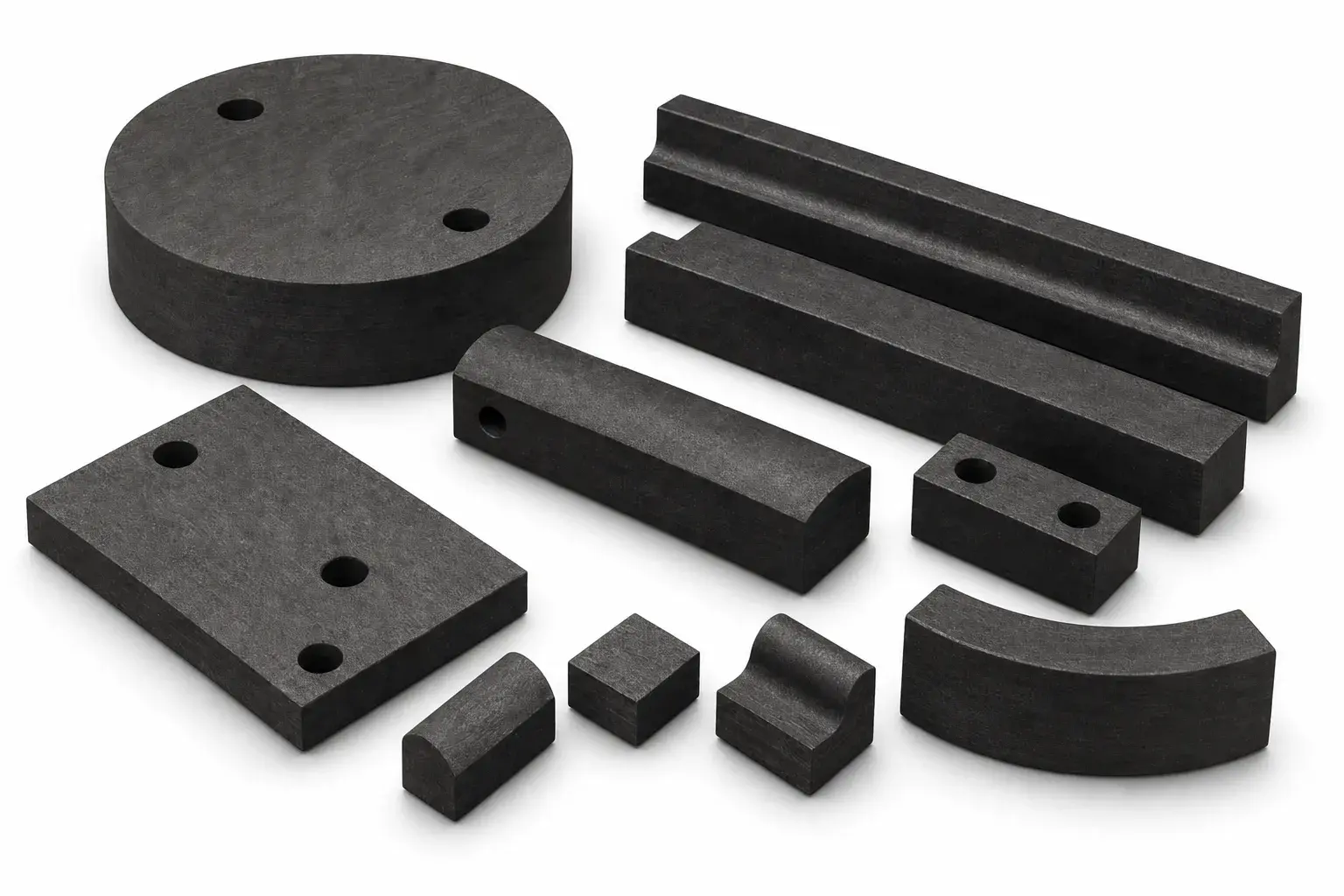
Machine wear components
Replaceable wear part
Also known as: Graphite wear parts · Carbon-graphite antifriction inserts · Graphite guides · Graphite wear shoes
[ Technical summary ]
Graphite wear components are the sacrificial parts that absorb friction in a mechanism: plates, guides, inserts, and pads. They go where metal-to-metal contact produces wear, galling, or downtime from missing lubrication, and where adding grease is not viable because of temperature or process cleanliness. They are machined to size for each mechanism.
[ Problem it solves ]
Concentrate the wear of a mechanism in a replaceable, self-lubricating part, instead of letting structural components absorb it or depending on lubrication that is hard to maintain.
Processes
- Dry friction
- Guiding and sliding
Operating conditions
- High temperature
When it is suitable
- Metal-to-metal contact produces galling or accelerated wear
- Grease lubrication cannot be maintained or contaminates
- The mechanism works at elevated temperature
- It is preferable to concentrate wear in a spare part
When it may not be suitable
- There are impact or repeated shock loads
- The part belongs to the load-bearing structure of the mechanism
- The contact continuously carries abrasives
- There is severe oxidation in air at high temperature without protection or impregnation
Process challenges
- Metal-to-metal wear
- Stoppages from insufficient lubrication
- Grease contamination
Advantages
- Self-lubrication
- Low adhesion
- Custom machining
Limitations
- Oxidation in air at high temperature without protection
- Lower mechanical strength than structural metals
- Requires grade selection by load and environment
[ Critical selection variables ]
These variables define the grade and the geometry. Actual values are confirmed against the grade datasheet.
- Load and its distributionDecisive
- Sliding speedDecisive
- Operating temperatureDecisive
- Counterface material and finishDecisive
- Geometry and tolerancesRelevant
- Presence of abrasives or solidsRelevant
- Atmosphere (air, inert, vacuum)Relevant
[ Required material properties ]
Properties that guide selection. Numerical values come from each grade's datasheet.
Critical properties
- Friction coefficient
- Wear resistance
- Compressive strength
- Thermal stability
Secondary properties
- Flexural strength
- Self-lubrication
- Machinability
- Dimensional stability
[ Related ]
[ Frequently asked questions ]
View all FAQsTechnical content reviewed by ESGRAF — Last reviewed: September 8, 2026
[ Quote ]
Need the right specification—not just material?
Tell us your application. Engineering response in under 24 hours.