
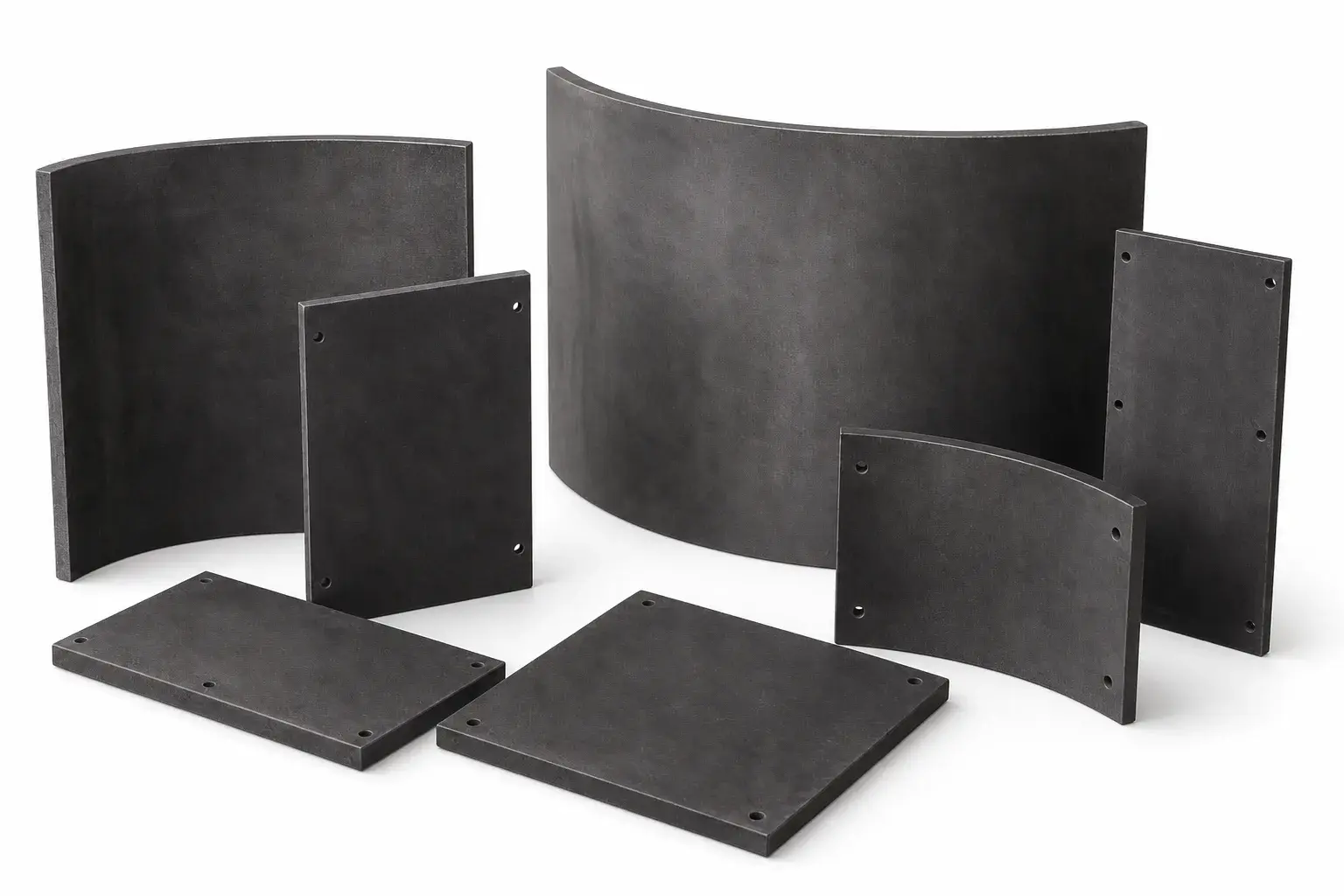
Furnace thermal shields
Thermal radiation control element
Also known as: Graphite thermal screens · Furnace heat shields · Radiation baffles · Graphite baffles
Graphite/felt thermal screens and shields to protect the load and improve thermal uniformity.
[ Technical summary ]
At high temperature, heat transfer inside the chamber is dominated by radiation, and an interposed screen changes that path. Graphite or felt shields, screens, and baffles are placed between the heating elements and the load, or facing cold zones, to prevent local overheating and improve uniformity. Being machined or cut to size, their shape is matched to the heat distribution sought in each furnace.
Thermal shields and screens direct or block radiation inside the furnace. They are made from machined graphite or felt (soft/rigid) depending on temperature, vacuum, and stiffness needs.
[ Problem it solves ]
Redirect or block thermal radiation inside the chamber to correct hot spots on the load and losses toward zones where the heat is not useful.
Operating conditions
- Radiative thermal shielding
- Vacuum and heat-treatment furnaces
- Protection of cold or load zones
- Thermal uniformity improvement
When it is suitable
- The load shows local overheating facing the elements
- There are radiation losses toward doors, feedthroughs, or cold zones
- Uniformity must improve without redesigning the hot zone
- The furnace works in vacuum or inert atmosphere
When it may not be suitable
- The process runs in air at high temperature without a protective atmosphere
- The screen would obstruct gas flow or access to the load
- The thermal problem comes from furnace control rather than radiation
Process challenges
- Local overheating of the load
- Radiation losses toward walls
- Contamination or uneven shadowing
Advantages
- Radiative heat-flow control
- Geometries machinable in graphite or cut from felt
- Compatible with vacuum and inert atmospheres
Limitations
- Design depends on chamber thermal optics
- Oxidation in air at high temperature
- Must be coordinated with heating elements and insulation
[ Critical selection variables ]
These variables define the grade and the geometry. Actual values are confirmed against the grade datasheet.
- Thermal radiation pathDecisive
- Operating temperatureDecisive
- Geometry and tolerancesDecisive
- Atmosphere (air, inert, vacuum)Relevant
- Gas flow and compositionRelevant
- Fastening system and jointsRelevant
- Thermal and duty cyclingRelevant
[ Required material properties ]
Properties that guide selection. Numerical values come from each grade's datasheet.
Critical properties
- Thermal conductivity
- Thermal shock resistance
- Purity
- Thermal stability
Secondary properties
- Dimensional stability
- Machinability
[ Related ]
Related applications
Related processes and equipment
[ Frequently asked questions ]
View all FAQsTechnical content reviewed by ESGRAF — Last reviewed: September 8, 2026
[ Quote ]
Need the right specification—not just material?
Tell us your application. Engineering response in under 24 hours.