
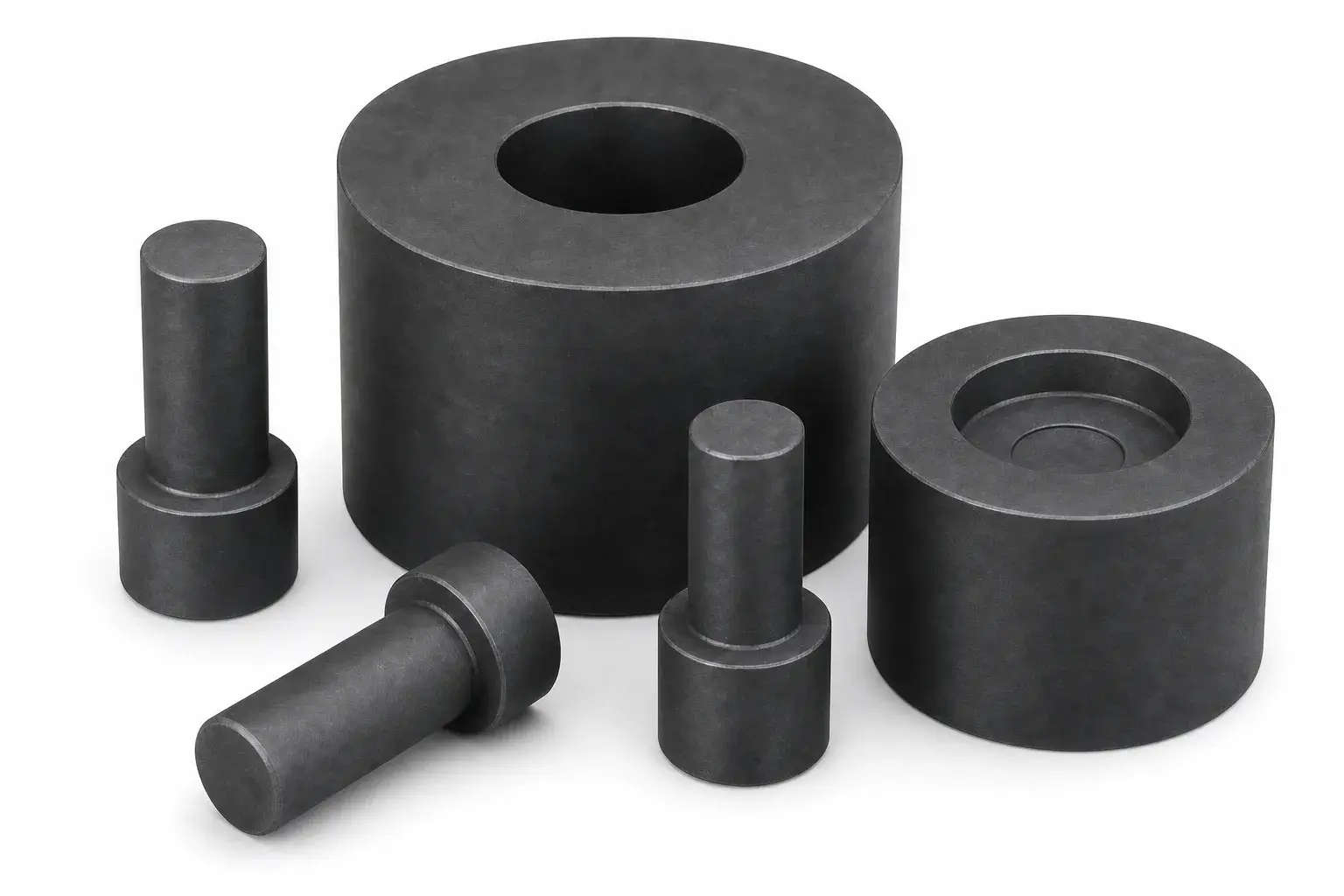
Hot-pressing dies
Hot-pressing tooling
Also known as: Graphite hot-pressing dies · Hot-press moulds · Graphite punches · Tooling for SPS and densification
[ Technical summary ]
In hot pressing, the graphite die and punches apply pressure to the material while it densifies at temperature. The tooling takes sustained compression while hot and, in equipment heated by Joule effect, also carries current into the load. Graphite combines compressive strength at temperature, thermal and electrical conductivity, and machinability, which allows die and punch sets to be made to each geometry.
Graphite dies, punches and tools for hot pressing. The process runs in a press/furnace; the documented application is the graphite tooling.
Ceramic tool inserts, armor plates, and sputtering targets are all classic "punch and die" hot pressing applications. The die must hold geometry under temperature and pressure, stay compatible with the atmosphere, and limit reaction with the workpiece.
Grade selection
Selection is made on properties and heating mode.
- Large cross-section — a grade with relatively high electrical resistivity helps the die and punches reach temperature sooner.
- High strength — when pressure and geometry demand higher density and mechanical strength.
- Spark plasma sintering (SPS) — the die is part of the electrical circuit; grade resistivity is a selection criterion.
- Resistance heating — die components that carry the current are chosen for high electrical resistivity.
Provide die drawing, temperature, pressure, atmosphere and workpiece material so ESGRAF can recommend a grade and quote machined tooling.
[ Problem it solves ]
Transmit pressure and heat into the material during densification without the tooling distorting or bonding to the part, in a temperature range where tool steels no longer retain strength.
Processes
- Hot pressing
- Densification at temperature
Operating conditions
- Vacuum or controlled atmosphere
When it is suitable
- The material densifies under simultaneous pressure and temperature
- The cycle runs in vacuum or inert atmosphere
- The tooling must carry current or heat into the load
- The die-and-punch geometry is specific to the part
When it may not be suitable
- The process runs in air at high temperature without a protective atmosphere
- The working pressure exceeds the grade capability in compression at temperature
- The part tolerates no carbon pickup from contact
Process challenges
- Tool deformation
- Reactivity with the workpiece
- Die service life
Advantages
- High-temperature resistance
- Machining of complex geometries
- Good thermal conductivity
Limitations
- Oxidation in air above roughly 400–500 °C
- Chemical compatibility with specific atmospheres
- Design must account for shrinkage and service life
[ Critical selection variables ]
These variables define the grade and the geometry. Actual values are confirmed against the grade datasheet.
- Pressing pressureDecisive
- Operating temperatureDecisive
- Geometry and tolerancesDecisive
- Atmosphere (air, inert, vacuum)Relevant
- Reactivity with the part or loadRelevant
- Electrical power and connectionRelevant
- Thermal and duty cyclingRelevant
- Clearance and type of fitRelevant
[ Required material properties ]
Properties that guide selection. Numerical values come from each grade's datasheet.
Critical properties
- Thermal conductivity
- Compressive strength
- Flexural strength
- Bulk density
Secondary properties
- Grain size
- Electrical resistivity
- Dimensional stability
- Machinability
[ Related ]
[ Frequently asked questions ]
View all FAQsTechnical content reviewed by ESGRAF — Last reviewed: September 9, 2026
[ Quote ]
Need the right specification—not just material?
Tell us your application. Engineering response in under 24 hours.