
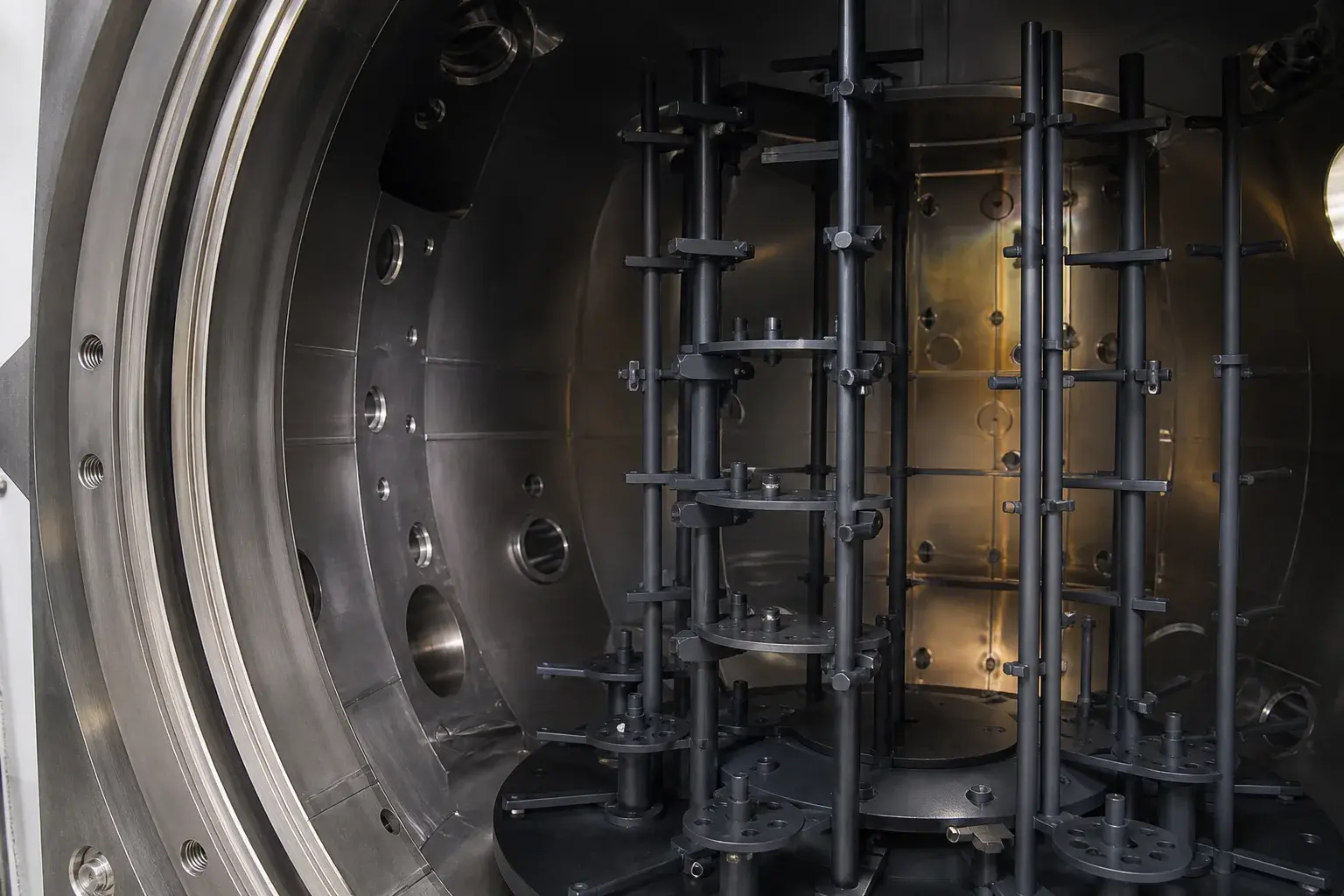
PVD release coatings
Vacuum-process release coating
Also known as: Anti-stick paint for PVD · Graphite coating for vacuum fixtures · Shield protection in PVD chambers · Release agent for vacuum coating
[ Technical summary ]
In PVD processes the deposited material does not distinguish between the part and the fixtures, shields, and chamber walls, where it builds up layer on layer until it flakes into particles that contaminate the process. An anti-stick graphite coating on those surfaces allows the accumulated deposit to be removed without abrasive cleaning, shortening chamber maintenance time and extending fixture life.
[ Problem it solves ]
Allow deposit built up on fixtures and shields to be removed without abrasive cleaning, avoiding the particle flaking that contaminates the chamber.
Operating conditions
- PVD
- Vacuum coatings
- Protection of supports and fixtures
When it is suitable
- Deposit builds up on fixtures, shields, and jigs
- Fixture cleaning consumes chamber time
- Particle flaking affects coating quality
- Surfaces can be coated between campaigns
When it may not be suitable
- The process does not tolerate carbon inside the chamber
- The surface to protect is the coated part itself
- The product cannot be validated in the plant before adopting it in production
Process challenges
- Deposit adhesion
- Difficult cleaning of supports
- Chamber contamination
Advantages
- Anti-stick
- Vacuum stability depending on product
- Easy reapplication
Limitations
- Not a hydrodynamic oil lubricant
- May stain light-colored surfaces
- Performance depends on surface preparation and reapplication
[ Critical selection variables ]
These variables define the grade and the geometry. Actual values are confirmed against the grade datasheet.
- Vacuum levelDecisive
- Operating temperatureDecisive
- Required purity and allowable contaminationDecisive
- Application methodRelevant
- Substrate or surface to be treatedRelevant
- Reapplication frequencyRelevant
[ Required material properties ]
Properties that guide selection. Numerical values come from each grade's datasheet.
Critical properties
- Lubricating film formation
- Thermal stability
- Particle size distribution
- Purity
Secondary properties
- Chemical resistance
- Dispersibility
[ Related ]
Related applications
Related processes and equipment
[ Frequently asked questions ]
View all FAQsTechnical content reviewed by ESGRAF — Last reviewed: September 8, 2026
[ Quote ]
Need the right specification—not just material?
Tell us your application. Engineering response in under 24 hours.