
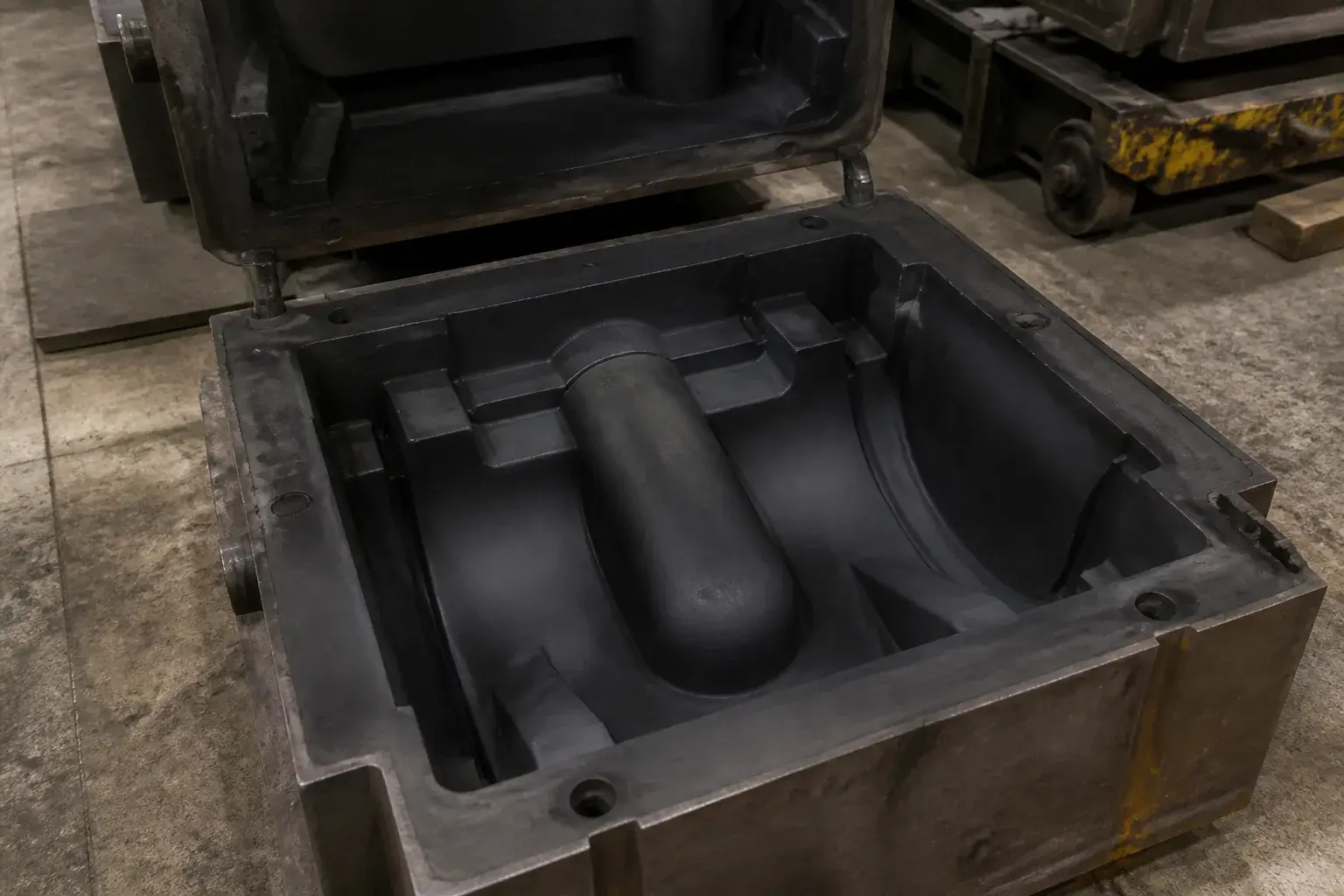
Metal mold release
Mould release coating
Also known as: Graphite release agent for metal moulds · Foundry mould coating · Non-stick coating for chill moulds · Graphite mould dressing
[ Technical summary ]
A metal mould in contact with molten metal tends to make the part stick and to degrade the mould surface cast after cast. A graphite coating interposes a layer the metal does not wet, so the part releases cleanly, and it also acts as a thermal barrier moderating cooling rate at the interface. It is applied by brush, spray, or dip on the preheated mould and renewed according to the cycle.
[ Problem it solves ]
Keep metal from sticking to the metal mould and protect its surface, while also controlling the cooling rate at the contact face.
Operating conditions
- Mold release
- Casting
- Hot forming
When it is suitable
- The part sticks to the mould and demoulding damages it
- The mould surface degrades with casting
- Cooling at the contact face needs moderating
- The coating can be renewed within the production cycle
When it may not be suitable
- The casting tolerates no carbon trace on its surface
- The mould cannot be preheated before applying the coating
- The product cannot be validated in the plant before adopting it in production
Process challenges
- Sticking to the mold
- Surface defects
- Short release-agent life
Advantages
- Better release
- Dry film
- Applicable by paint or aerosol
Limitations
- Not a hydrodynamic oil lubricant
- May stain light-colored surfaces
- Performance depends on surface preparation and reapplication
[ Critical selection variables ]
These variables define the grade and the geometry. Actual values are confirmed against the grade datasheet.
- Molten metal or alloy in contactDecisive
- Operating temperatureDecisive
- Application methodDecisive
- Film thicknessDecisive
- Reapplication frequencyRelevant
- Carrier or formulation baseRelevant
- Heat-extraction rateRelevant
[ Required material properties ]
Properties that guide selection. Numerical values come from each grade's datasheet.
Critical properties
- Lubricating film formation
- Thermal stability
- Particle size distribution
- Non-wetting by molten metal
Secondary properties
- Thermal conductivity
- Dispersibility
[ Related ]
Materials
Related applications
Related processes and equipment
[ Frequently asked questions ]
View all FAQsTechnical content reviewed by ESGRAF — Last reviewed: September 8, 2026
[ Quote ]
Need the right specification—not just material?
Tell us your application. Engineering response in under 24 hours.