
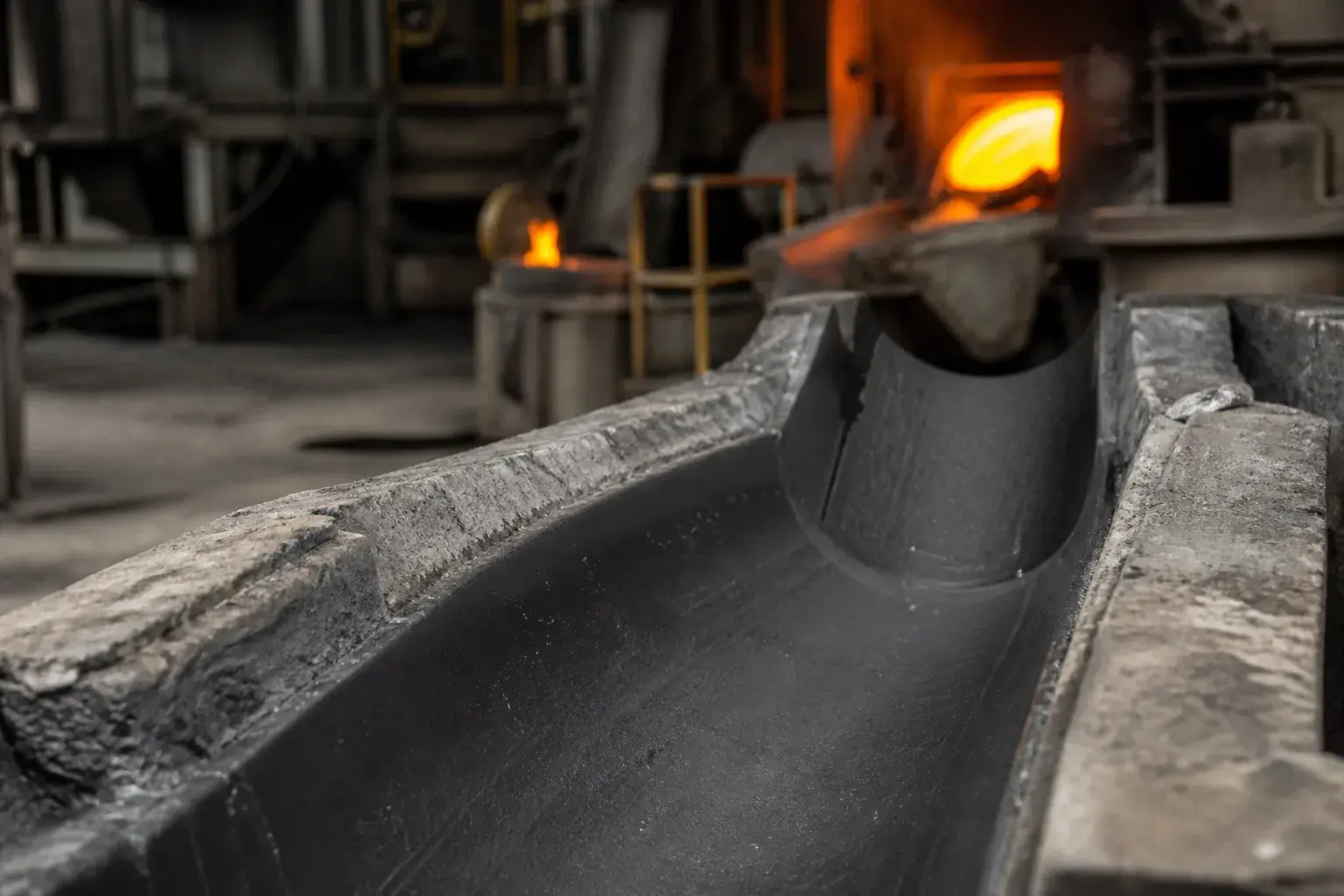
Foundry refractory channel lining
Launder coating
Also known as: Graphite coating for launders · Casting channel coating · Non-stick launder protection · Coating for molten metal channels
[ Technical summary ]
Launders carrying molten metal accumulate deposits that narrow the section and force cleaning that erodes the refractory. Applying a graphite coating to the channel surface reduces that adhesion: the metal does not wet the film, flow is maintained, and deposits come away easily. It is the specific case of refractory coating applied to launders, where preserving the flow section is what matters.
[ Problem it solves ]
Preserve the flow section of the channel by preventing metal from adhering and forming deposits that force cleaning stoppages and erode the refractory.
Processes
- Casting and channeling
- Trough coating
Operating conditions
- High temperature
When it is suitable
- The channel accumulates metal and loses flow section
- Cleaning stoppages affect line availability
- Mechanical cleaning erodes the channel surface
- The channel can be coated before the campaign starts
When it may not be suitable
- Section loss comes from flow erosion rather than adhesion
- The channel cannot be fully dried before receiving metal
- The product cannot be validated in the plant before adopting it in production
Process challenges
- Metal sticking
- Trough erosion
- Stoppages for cleaning
Advantages
- Better release
- Dry film
- Surface protection
Limitations
- Not a hydrodynamic oil lubricant
- May stain light-colored surfaces
- Performance depends on surface preparation and reapplication
[ Critical selection variables ]
These variables define the grade and the geometry. Actual values are confirmed against the grade datasheet.
- Molten metal or alloy in contactDecisive
- Operating temperatureDecisive
- Flow rate and flow regimeDecisive
- Application methodRelevant
- Substrate or surface to be treatedRelevant
- Reapplication frequencyRelevant
[ Required material properties ]
Properties that guide selection. Numerical values come from each grade's datasheet.
Critical properties
- Lubricating film formation
- Thermal stability
- Particle size distribution
- Non-wetting by molten metal
Secondary properties
- Chemical resistance
- Dispersibility
[ Related ]
[ Frequently asked questions ]
View all FAQsTechnical content reviewed by ESGRAF — Last reviewed: September 8, 2026
[ Quote ]
Need the right specification—not just material?
Tell us your application. Engineering response in under 24 hours.