
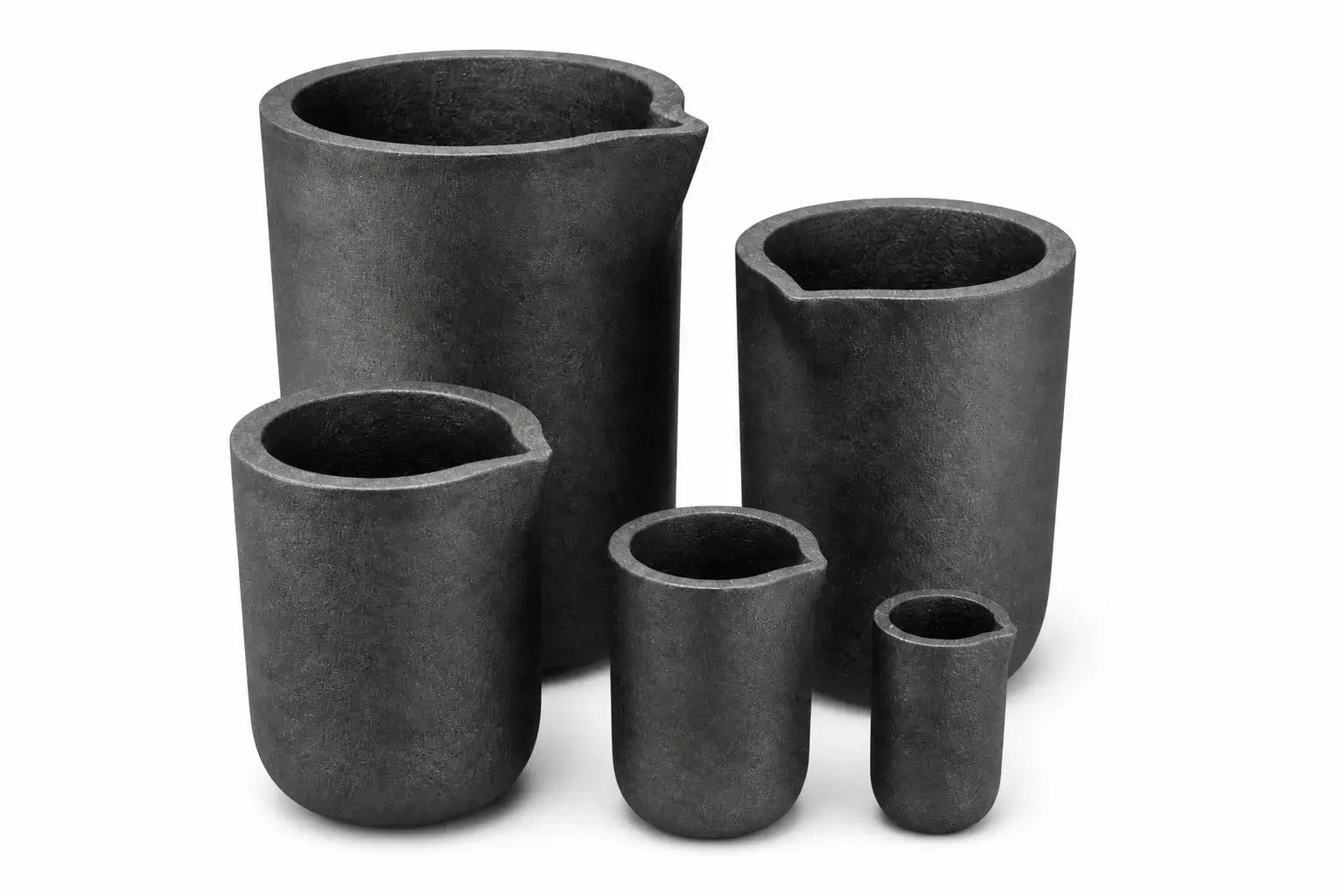
Foundry crucibles
Melting and holding vessel
Also known as: Graphite crucibles · Carbon-graphite crucibles · Metal melting crucibles · Graphite laboratory crucibles
[ Technical summary ]
A graphite crucible holds the metal while it melts and stays liquid. It works under two simultaneous demands: withstanding the thermal shock of a cold charge against a hot crucible, and not reacting with the bath. Graphite answers both because it conducts heat quickly — reducing the gradient that cracks the material — and is not wetted by most non-ferrous metals. It is used in melting aluminium, copper, their alloys, and precious metals.
Graphite crucibles for containing and melting metals in foundry and laboratory use.
Grade selection depends on the metal or alloy, operating temperature, atmosphere and how aggressively the crucible is cycled. The wrong grade shortens life through thermal shock, erosion or contamination risk.
ESGRAF supplies commercial shapes when stocked and custom crucibles machined from drawing. Share metal, temperature, geometry and quantity for a technical recommendation.
[ Problem it solves ]
Contain molten metal without the vessel cracking when charged cold or giving up elements to the bath, in a service where the crucible heats and cools on every melting cycle.
Operating conditions
- Melting
- Holding liquid metal
- Pouring
When it is suitable
- Non-ferrous or precious metals are being melted
- The charge is introduced cold and causes thermal shock
- The bath must stay free of oxides from the vessel
- A crucible geometry other than the standard sizes is needed
When it may not be suitable
- The contacting metal readily dissolves carbon and the alloy cannot tolerate it
- The part sits in air at high temperature between casts without protection
- The crucible takes blows from the charge or from the tapping tool
Process challenges
- Thermal shock
- Erosion
- Metal contamination
- Short life of unsuitable crucibles
Advantages
- Excellent thermal shock resistance
- High thermal conductivity
- Stock and custom options
Limitations
- Wear from erosion and thermal shock
- Possible metal contamination if the grade is unsuitable
- Service life depends on cycles and metal flow
[ Critical selection variables ]
These variables define the grade and the geometry. Actual values are confirmed against the grade datasheet.
- Molten metal or alloy in contactDecisive
- Operating temperatureDecisive
- Thermal shock severityDecisive
- Geometry and tolerancesDecisive
- Required purity and allowable contaminationRelevant
- Thermal and duty cyclingRelevant
- Bath or flux chemistryRelevant
[ Required material properties ]
Properties that guide selection. Numerical values come from each grade's datasheet.
Critical properties
- Thermal shock resistance
- Non-wetting by molten metal
- Thermal conductivity
- Chemical resistance
Secondary properties
- Bulk density
- Ash content
- Machinability
[ Related ]
[ Frequently asked questions ]
View all FAQsTechnical content reviewed by ESGRAF — Last reviewed: September 8, 2026
[ Quote ]
Need the right specification—not just material?
Tell us your application. Engineering response in under 24 hours.