
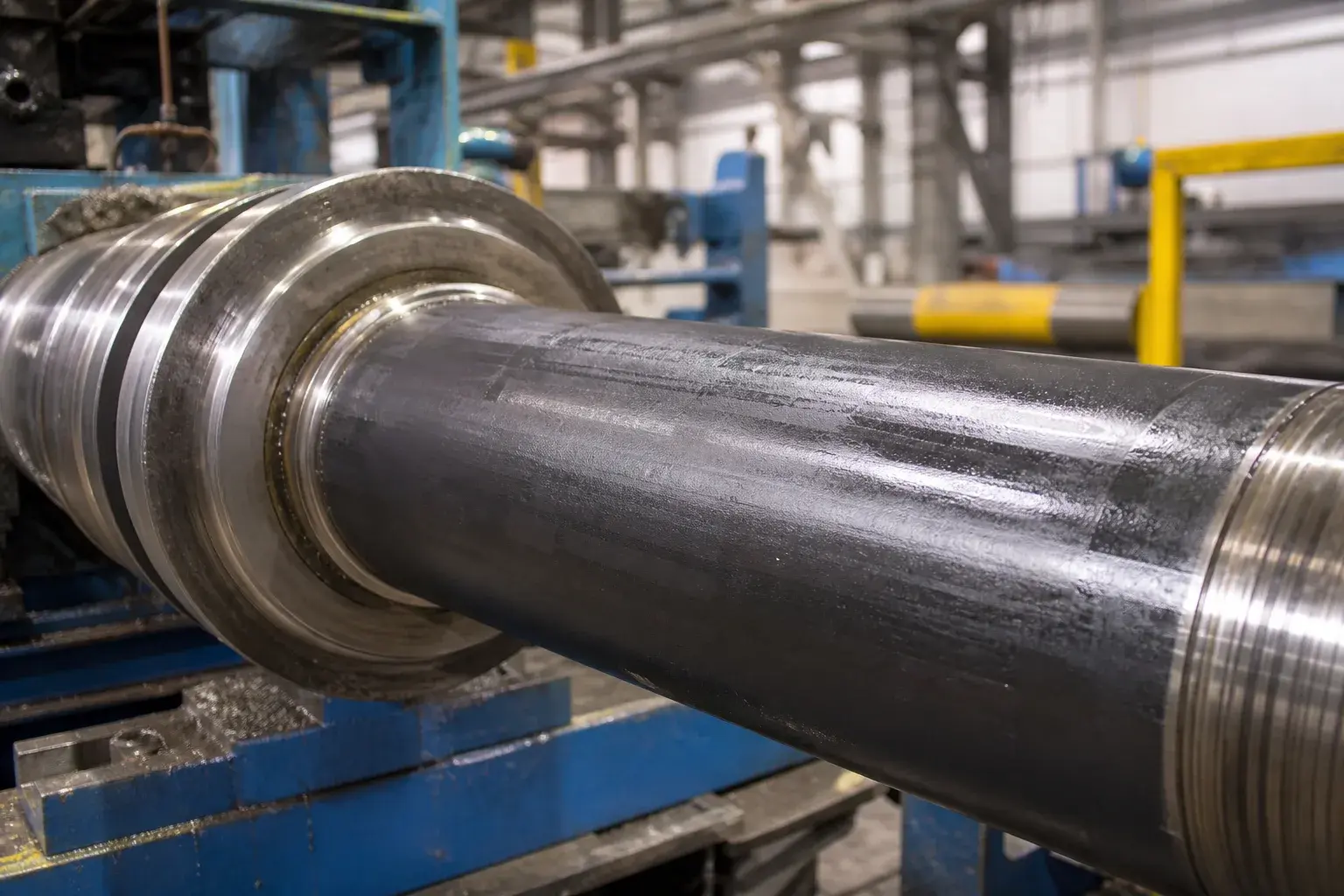
Extrusion piston lubrication
Press piston lubricant
Also known as: Graphite lubricant for extrusion rams · Press stem lubrication · Anti-seize for hot pistons · Graphite for extrusion presses
[ Technical summary ]
The ram of an extrusion press works inside the hot container, under high axial load and with tight clearance against the wall. There, conventional grease degrades quickly and the risk becomes seizing, which stops the press. A dry graphite film stays between ram and wall at that temperature, reduces advance friction, and prevents the direct metal-to-metal contact that causes seizing.
[ Problem it solves ]
Prevent the ram seizing against the hot container, in a contact where grease degrades and the available clearance does not allow product build-up.
Processes
- Press extrusion
- Piston lubrication
Operating conditions
- High temperature and pressure
When it is suitable
- The ram shows scoring or a tendency to seize
- Conventional grease degrades at container temperature
- Press stoppages from seizing are a recurring problem
- A lubrication that leaves no deposit in the container is required
When it may not be suitable
- Seizing comes from misalignment or out-of-tolerance clearance
- Product build-up in the container would affect the billet
- The product cannot be validated in the plant before adopting it in production
Process challenges
- Piston seizing
- Load-induced wear
- Grease failure at temperature
Advantages
- Resistant dry film
- Thermal stability
- Reduces scoring/seizing
Limitations
- Not a hydrodynamic oil lubricant
- May stain light-colored surfaces
- Performance depends on surface preparation and reapplication
[ Critical selection variables ]
These variables define the grade and the geometry. Actual values are confirmed against the grade datasheet.
- Operating temperatureDecisive
- Load and its distributionDecisive
- Clearance and type of fitDecisive
- Application methodRelevant
- Dosage and application frequencyRelevant
- Alignment and mounting stiffnessRelevant
[ Required material properties ]
Properties that guide selection. Numerical values come from each grade's datasheet.
Critical properties
- Lubricating film formation
- Friction coefficient
- Thermal stability
- Particle size distribution
Secondary properties
- Self-lubrication
- Wear resistance
[ Related ]
[ Frequently asked questions ]
View all FAQsTechnical content reviewed by ESGRAF — Last reviewed: September 8, 2026
[ Quote ]
Need the right specification—not just material?
Tell us your application. Engineering response in under 24 hours.