
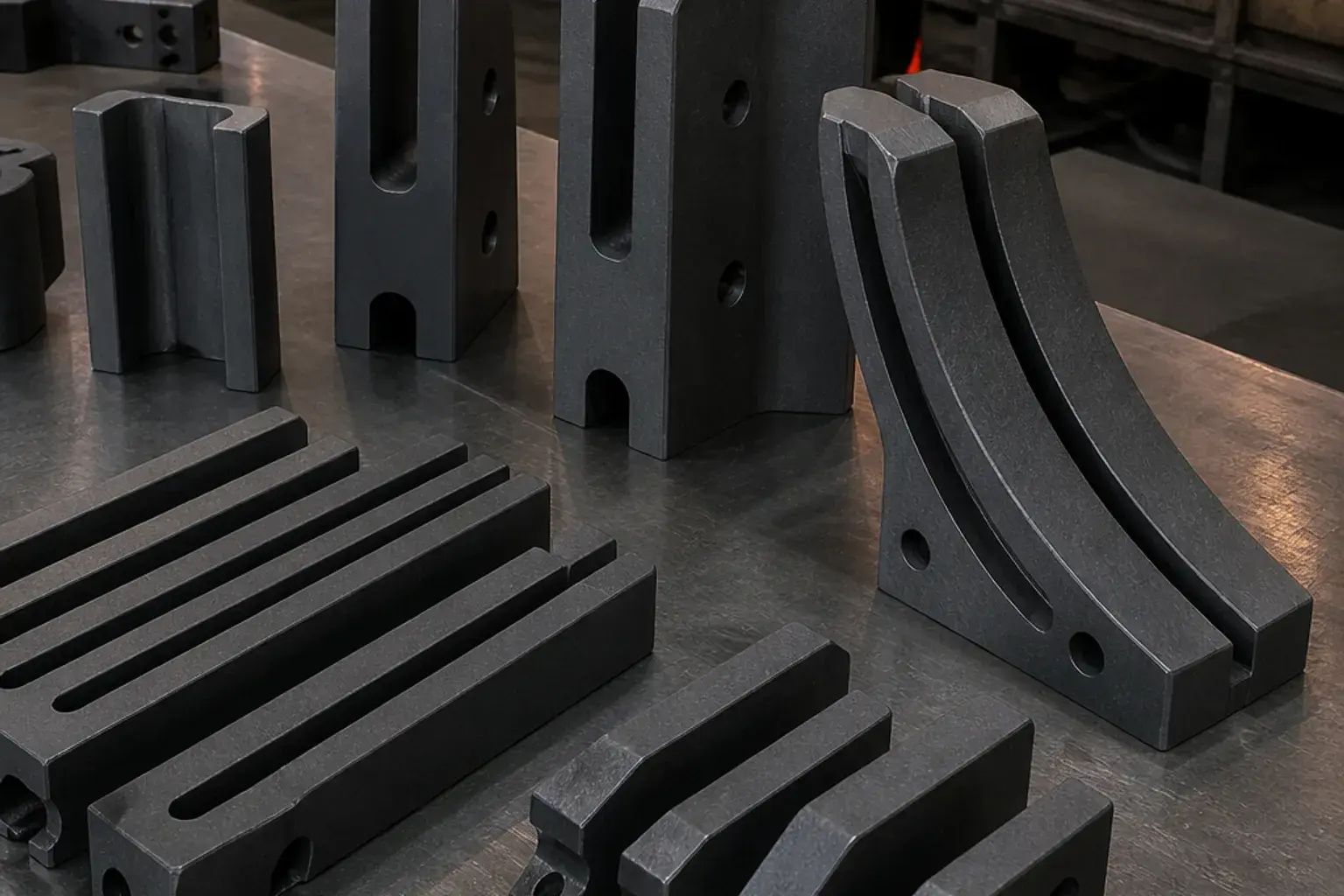
Hot-glass guides
Hot-end transfer element
Also known as: Graphite gob guides · Carbon dead plates · Graphite sweep-outs and deflectors · Conveyor guides for hot glass
Guides, sweep-out and transfer mechanisms for hot glass.
[ Technical summary ]
In the hot end of a container line, the gob and the freshly formed ware pass over guides, deflectors, dead plates, and transfer mechanisms. Each contact happens at high cadence on glass that is still soft, so the surface must slide without marking or sticking. Carbon and carbon-graphite provide self-lubrication at that contact and draw less heat at a point than a metal guide, which reduces transfer marks.
At the glass-container hot end, carbon/graphite parts contact the gob and hot ware without oil lubrication. They reduce thermal stress, marking and wear-related stops.
ESGRAF supplies blanks and machined parts for guides, deflectors, sweep-out and transfer mechanisms. Share part type, machine and cycle for a quote.
[ Problem it solves ]
Transfer ware and gobs at production cadence without leaving contact marks or causing stoppages from sticking on guides and plates.
Operating conditions
- Container forming
- Hot end
- Gob transfer
When it is suitable
- Glass is transferred while still soft between stations
- Metal guides leave marks or cause rejects
- Machine cadence requires sliding without a lubricant
- Parts must match the machine geometry
When it may not be suitable
- The part is left in hot air during stoppages, with no protection
- The zone accumulates broken glass that acts as an abrasive on the guide
- The part takes direct impact from falling ware
Process challenges
- Glass marking
- Abrasive wear
- Thermal shock
Advantages
- Self-lubrication
- Lower contact conductivity
- Less contamination
Limitations
- Service life depends on cycle
- Requires machine geometry
- Grade selection by zone
[ Critical selection variables ]
These variables define the grade and the geometry. Actual values are confirmed against the grade datasheet.
- Operating temperatureDecisive
- Machine cycle rateDecisive
- Geometry and tolerancesDecisive
- Surface finish required on the partRelevant
- Presence of abrasives or solidsRelevant
- Heat-extraction rateRelevant
- Alignment and mounting stiffnessRelevant
[ Required material properties ]
Properties that guide selection. Numerical values come from each grade's datasheet.
Critical properties
- Thermal shock resistance
- Thermal conductivity
- Wear resistance
- Friction coefficient
Secondary properties
- Self-lubrication
- Non-wetting by molten metal
- Machinability
[ Related ]
Products
Industries
Related applications
[ Frequently asked questions ]
View all FAQsTechnical content reviewed by ESGRAF — Last reviewed: September 8, 2026
[ Quote ]
Need the right specification—not just material?
Tell us your application. Engineering response in under 24 hours.