
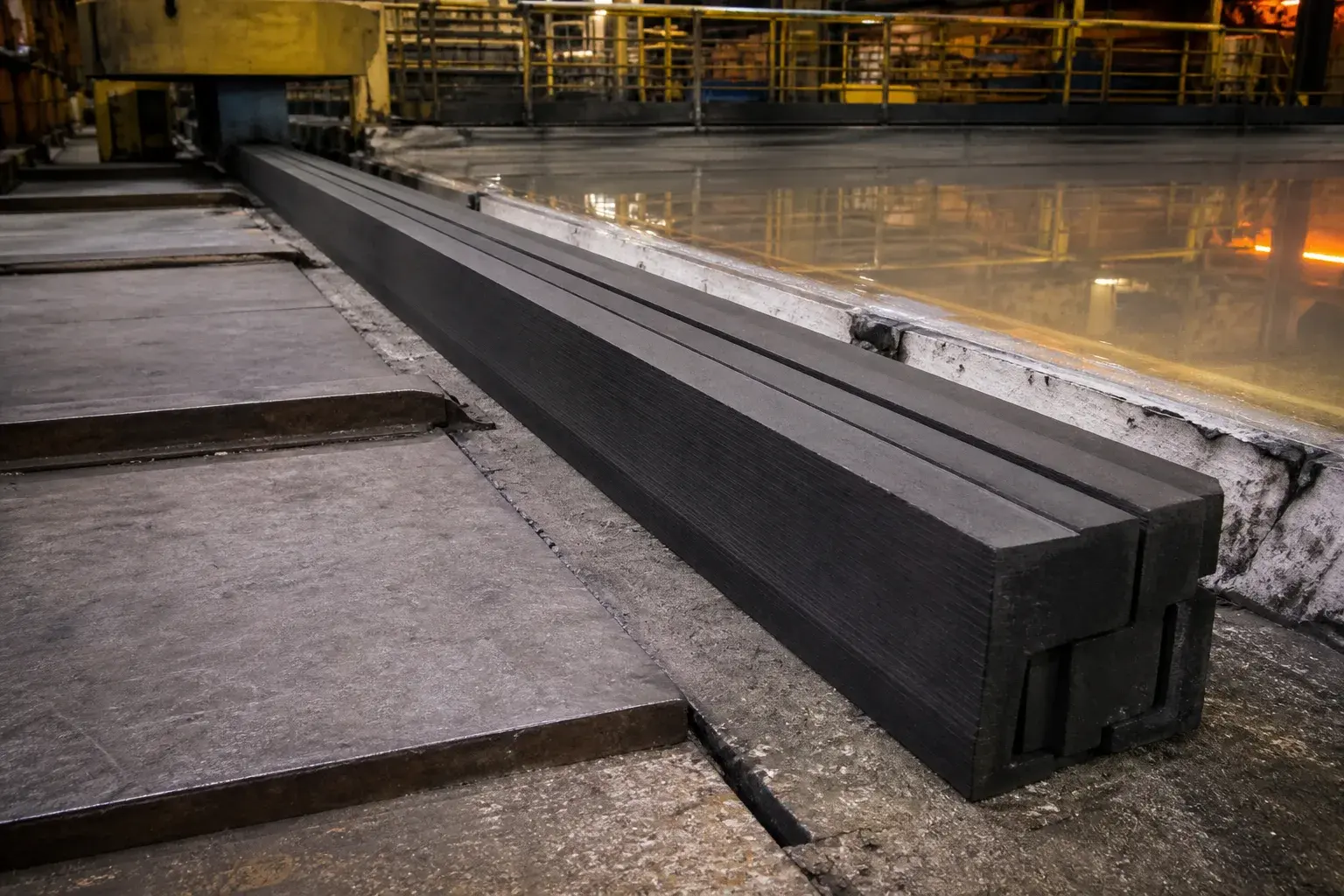
Float-glass fenders
Float line contact element
Also known as: Graphite fenders for float glass · Graphite barriers for the tin bath · Float line stops and guides · Graphite restrictors
[ Technical summary ]
On the float line, the glass ribbon advances over the tin bath and its width is controlled by barriers and fenders that touch its edge. The part works in continuous contact with hot glass and in the reducing atmosphere of the bath, so it must not stick, not mark the edge, and not contaminate the tin. Graphite meets all three conditions and is machined to the geometries each line imposes.
[ Problem it solves ]
Contain and guide the edge of the glass ribbon in the tin bath without sticking or marking, with a material stable in the reducing atmosphere of the bath.
Operating conditions
- High temperature
- Contact with molten metal or glass
When it is suitable
- The glass ribbon is contained or guided by side contact
- The part works inside the tin bath atmosphere
- The glass edge cannot take marks or sticking
- The geometry corresponds to a specific line
When it may not be suitable
- The part is left in hot air during stoppages, with no protection
- The part takes impact during installation or line adjustment
- The grade cannot be verified for purity and the bath is sensitive
Process challenges
- Adhesion / sticking
- Thermal shock
- Surface wear
Advantages
- Low adhesion
- Thermal stability
- Custom machining
Limitations
- Wear from erosion and thermal shock
- Possible metal contamination if the grade is unsuitable
- Service life depends on cycles and metal flow
[ Critical selection variables ]
These variables define the grade and the geometry. Actual values are confirmed against the grade datasheet.
- Operating temperatureDecisive
- Atmosphere (air, inert, vacuum)Decisive
- Geometry and tolerancesDecisive
- Required purity and allowable contaminationDecisive
- Glass compositionRelevant
- Surface finish required on the partRelevant
- Thermal and duty cyclingRelevant
[ Required material properties ]
Properties that guide selection. Numerical values come from each grade's datasheet.
Critical properties
- Dimensional stability
- Wear resistance
- Non-wetting by molten metal
- Purity
Secondary properties
- Thermal stability
- Ash content
- Machinability
[ Related ]
Industries
Related applications
[ Frequently asked questions ]
View all FAQsTechnical content reviewed by ESGRAF — Last reviewed: September 8, 2026
[ Quote ]
Need the right specification—not just material?
Tell us your application. Engineering response in under 24 hours.