
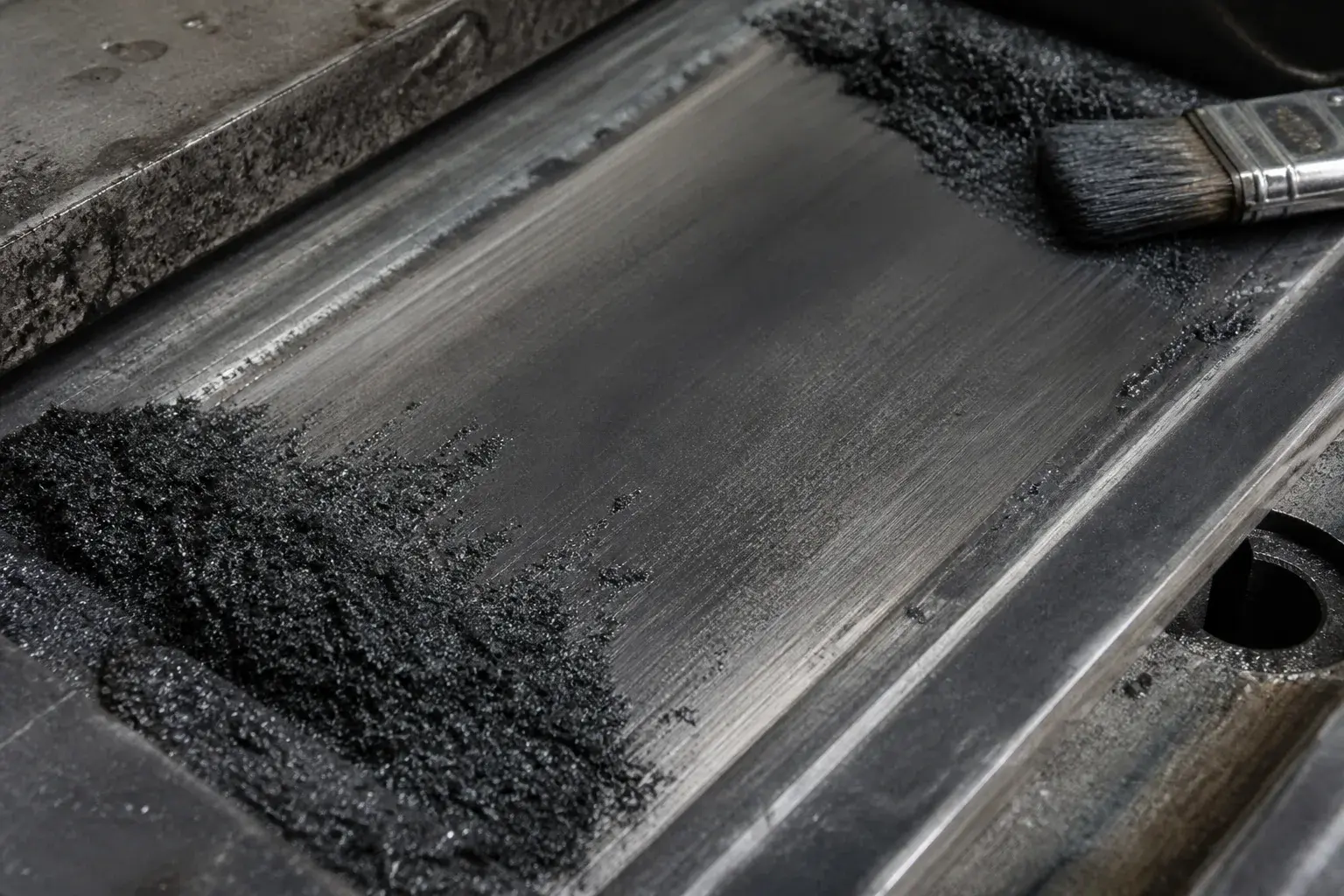
Dry lubrication
Solid lubrication principle
Also known as: Dry graphite lubrication · Graphite solid lubricant · Oil-free lubrication · Dry lubricating film
[ Technical summary ]
Graphite lubricates through its layered structure: sheets of carbon atoms slide over one another under low shear, so the film reduces friction without needing a fluid. That is the fundamental difference from oils and greases, which depend on maintaining a liquid film and fail when temperature, vacuum, or process cleanliness rule it out. This page gathers the principle; each specific application has its own format and method.
[ Problem it solves ]
Lubricate where a liquid film cannot be sustained — because of temperature, vacuum, or cleanliness requirements — without giving up friction reduction between contacting surfaces.
Processes
- Dry lubrication
Operating conditions
- High temperature
- Clean or contaminant-sensitive environments
When it is suitable
- Temperature degrades conventional oils and greases
- The process cannot tolerate contamination by a liquid lubricant
- The point works in vacuum or controlled atmosphere
- A dusty environment turns grease into an abrasive
When it may not be suitable
- The contact needs the lubricant to carry away heat or particles
- The part tolerates no black residue and there will be no later cleaning stage
- The point accepts liquid lubrication and that is more economical
Process challenges
- Liquid lubricant failure
- Seizing / scoring
- Oil contamination
Advantages
- Works without a liquid film
- Thermal stability
- Multiple presentations (powder, aerosol, or paint)
Limitations
- Not a hydrodynamic oil lubricant
- May stain light-colored surfaces
- Performance depends on surface preparation and reapplication
[ Critical selection variables ]
These variables define the grade and the geometry. Actual values are confirmed against the grade datasheet.
- Operating temperatureDecisive
- Load and its distributionDecisive
- Atmosphere (air, inert, vacuum)Relevant
- Sliding speedRelevant
- Application methodRelevant
- Humidity and ambient conditionsRelevant
- Substrate or surface to be treatedRelevant
[ Required material properties ]
Properties that guide selection. Numerical values come from each grade's datasheet.
Critical properties
- Lubricating film formation
- Friction coefficient
- Thermal stability
- Particle size distribution
Secondary properties
- Self-lubrication
- Wear resistance
[ Related ]
Materials
Related applications
[ Frequently asked questions ]
View all FAQsTechnical content reviewed by ESGRAF — Last reviewed: September 8, 2026
[ Quote ]
Need the right specification—not just material?
Tell us your application. Engineering response in under 24 hours.