
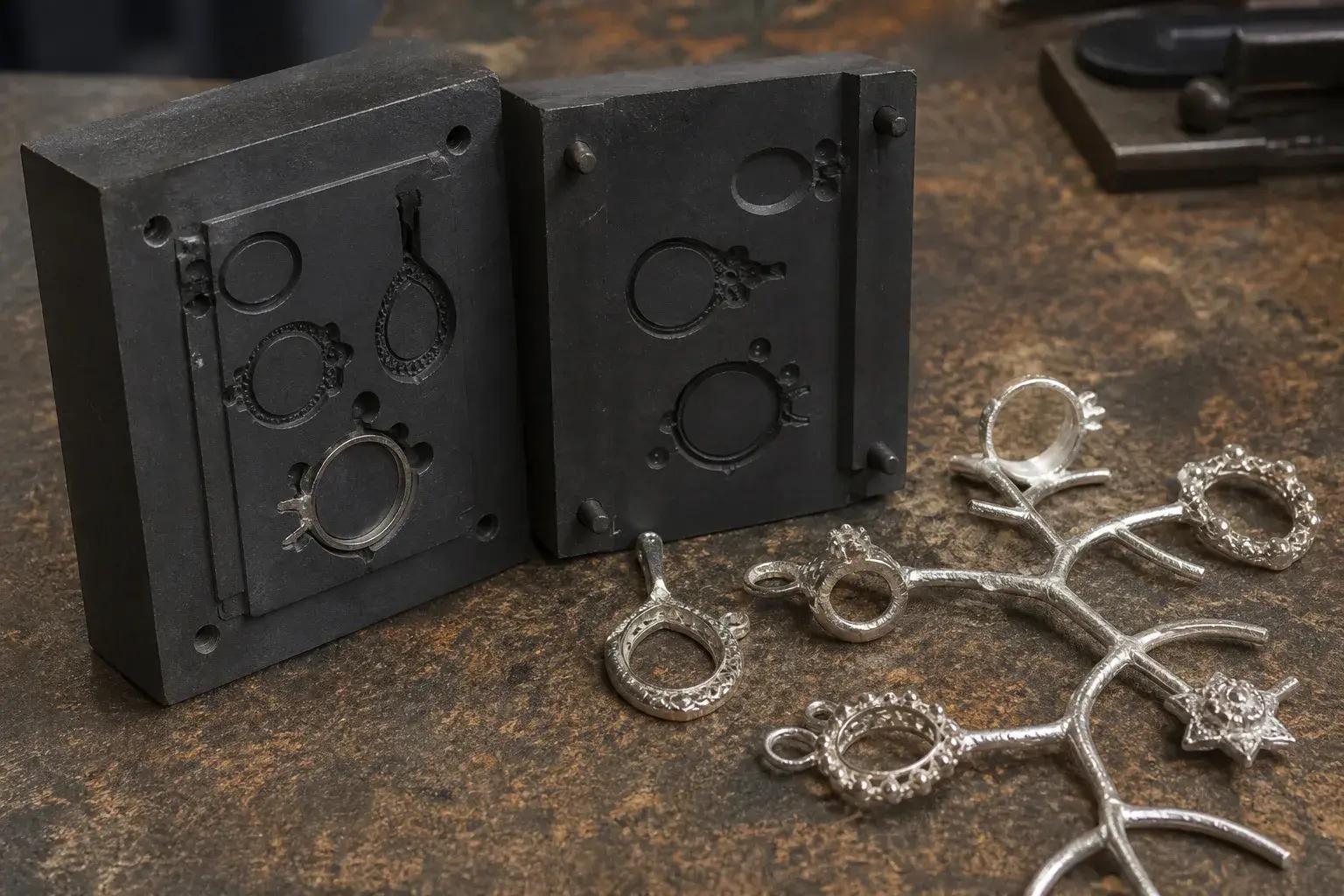
Jewelry casting molds
Precious metal casting mould
Also known as: Graphite jewellery moulds · Graphite bar moulds · Ingot moulds for gold and silver · Moulds for precious metal casting
[ Technical summary ]
In jewellery and precious metals, the graphite mould receives small quantities of metal that must release cleanly with minimal loss. The surface is not wetted by gold, silver, or their alloys, so metal is not left clinging in the cavity. Together with the ease of machining bar moulds, rods, and small shapes, that makes graphite the usual workshop material for both ingots and rolling preforms.
[ Problem it solves ]
Cast and release small quantities of precious metal without losses from cavity sticking, and with a clean surface that avoids later dressing.
Operating conditions
- High temperature
- Contact with molten metal or glass
When it is suitable
- Gold, silver, or other precious alloys are cast
- Metal loss from sticking must be minimized
- The workshop needs custom bar moulds or formats
- A clean surface ready for rolling or drawing is sought
When it may not be suitable
- The part sits in air at high temperature between casts without protection
- The cavity is cleaned with hard tools that scratch the surface
- The mould is quenched with water right after casting
Process challenges
- Adhesion / sticking
- Thermal shock
- Surface wear
Advantages
- Low adhesion
- Thermal stability
- Custom machining
Limitations
- Wear from erosion and thermal shock
- Possible metal contamination if the grade is unsuitable
- Service life depends on cycles and metal flow
[ Critical selection variables ]
These variables define the grade and the geometry. Actual values are confirmed against the grade datasheet.
- Molten metal or alloy in contactDecisive
- Geometry and tolerancesDecisive
- Surface finish required on the partDecisive
- Operating temperatureRelevant
- Thermal shock severityRelevant
- Thermal and duty cyclingRelevant
[ Required material properties ]
Properties that guide selection. Numerical values come from each grade's datasheet.
Critical properties
- Thermal shock resistance
- Non-wetting by molten metal
- Purity
- Grain size
Secondary properties
- Dimensional stability
- Machinability
- Bulk density
[ Related ]
[ Frequently asked questions ]
View all FAQsTechnical content reviewed by ESGRAF — Last reviewed: September 8, 2026
[ Quote ]
Need the right specification—not just material?
Tell us your application. Engineering response in under 24 hours.