
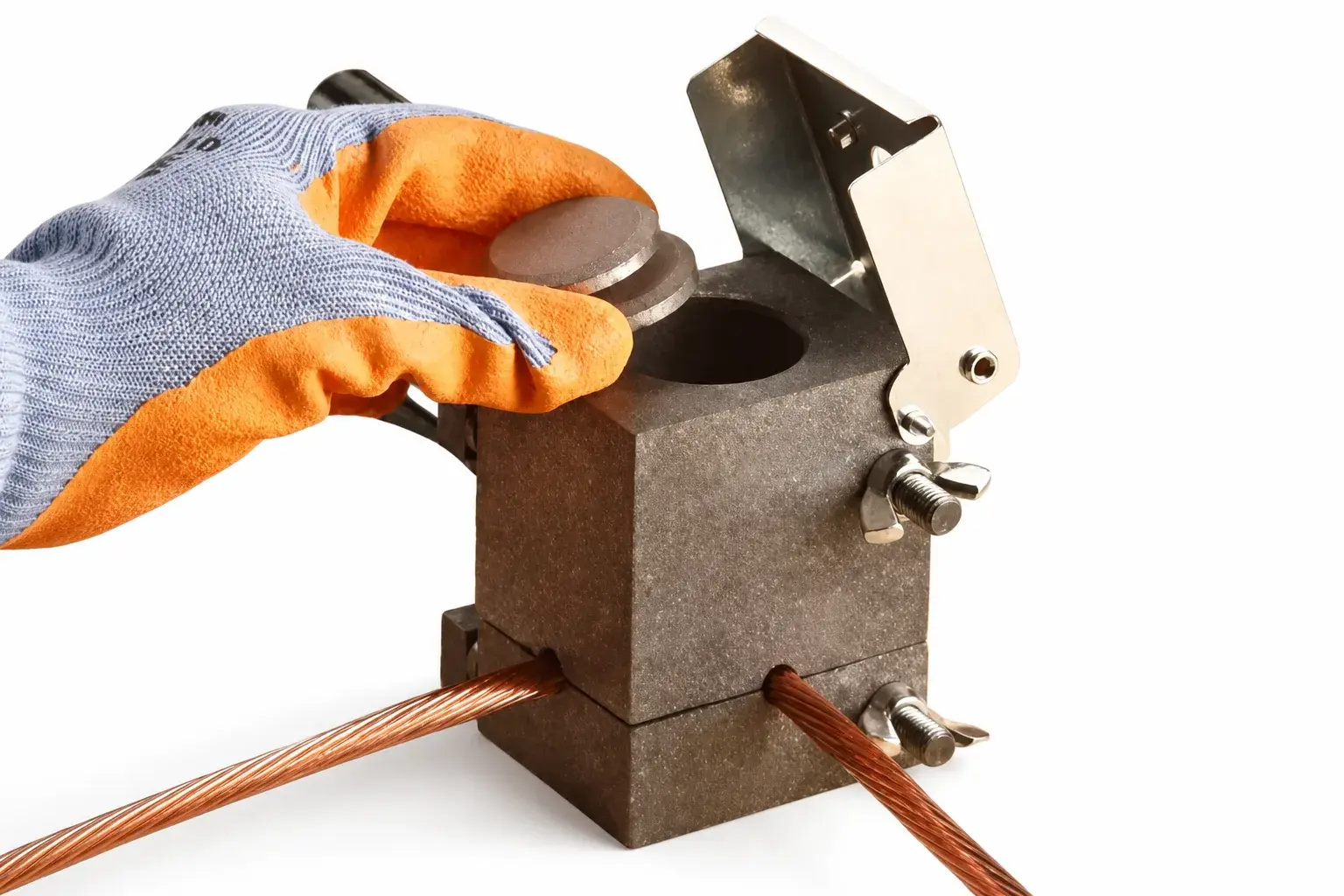
Exothermic welding molds
Reaction welding mould
Also known as: Graphite moulds for exothermic welding · Cadweld-type welding moulds · Copper thermite welding moulds · Moulds for grounding connections
[ Technical summary ]
Exothermic welding joins copper conductors through a reaction that produces molten metal inside the mould. The mould receives that pour at very high temperature for a few seconds, cools, and is used again. Graphite is the usual material because it tolerates that repeated thermal cycle, is not wetted by copper — so the connection releases cleanly — and allows the cavity, crucible, tap hole, and exact seating for each conductor configuration to be machined.
[ Problem it solves ]
Contain and shape the reaction pour over the conductor joint, withstanding severe repeated thermal shock and releasing the connection without sticking.
Operating conditions
- Exothermic welding
- Copper connections
When it is suitable
- Permanent copper connections are made by exothermic reaction
- The conductor configuration is not available as a standard mould
- The mould must be reused in the field a number of times
- The connection must come out clean and free of adhering flash
When it may not be suitable
- The mould is used damp or without preheating after cleaning
- The cavity is cleaned with hard tools that wear it away
- The configuration requires a mould that cannot be aligned with the conductors
Process challenges
- Cavity wear
- Limited reuse
- Joint quality
Advantages
- High thermal resistance
- Precise cavities
- Machined replacement
Limitations
- Wear from arcing or electrical erosion
- Conductivity and density must be calibrated to the process
- Some grades are not suitable for high purity
[ Critical selection variables ]
These variables define the grade and the geometry. Actual values are confirmed against the grade datasheet.
- Thermal shock severityDecisive
- Geometry and tolerancesDecisive
- Conductor size and typeDecisive
- Thermal and duty cyclingDecisive
- Operating temperatureRelevant
- Surface finish required on the partRelevant
[ Required material properties ]
Properties that guide selection. Numerical values come from each grade's datasheet.
Critical properties
- Machinability
- Thermal shock resistance
- Non-wetting by molten metal
- Grain size
Secondary properties
- Bulk density
- Dimensional stability
- Thermal conductivity
[ Related ]
[ Frequently asked questions ]
View all FAQsTechnical content reviewed by ESGRAF — Last reviewed: September 8, 2026
[ Quote ]
Need the right specification—not just material?
Tell us your application. Engineering response in under 24 hours.