
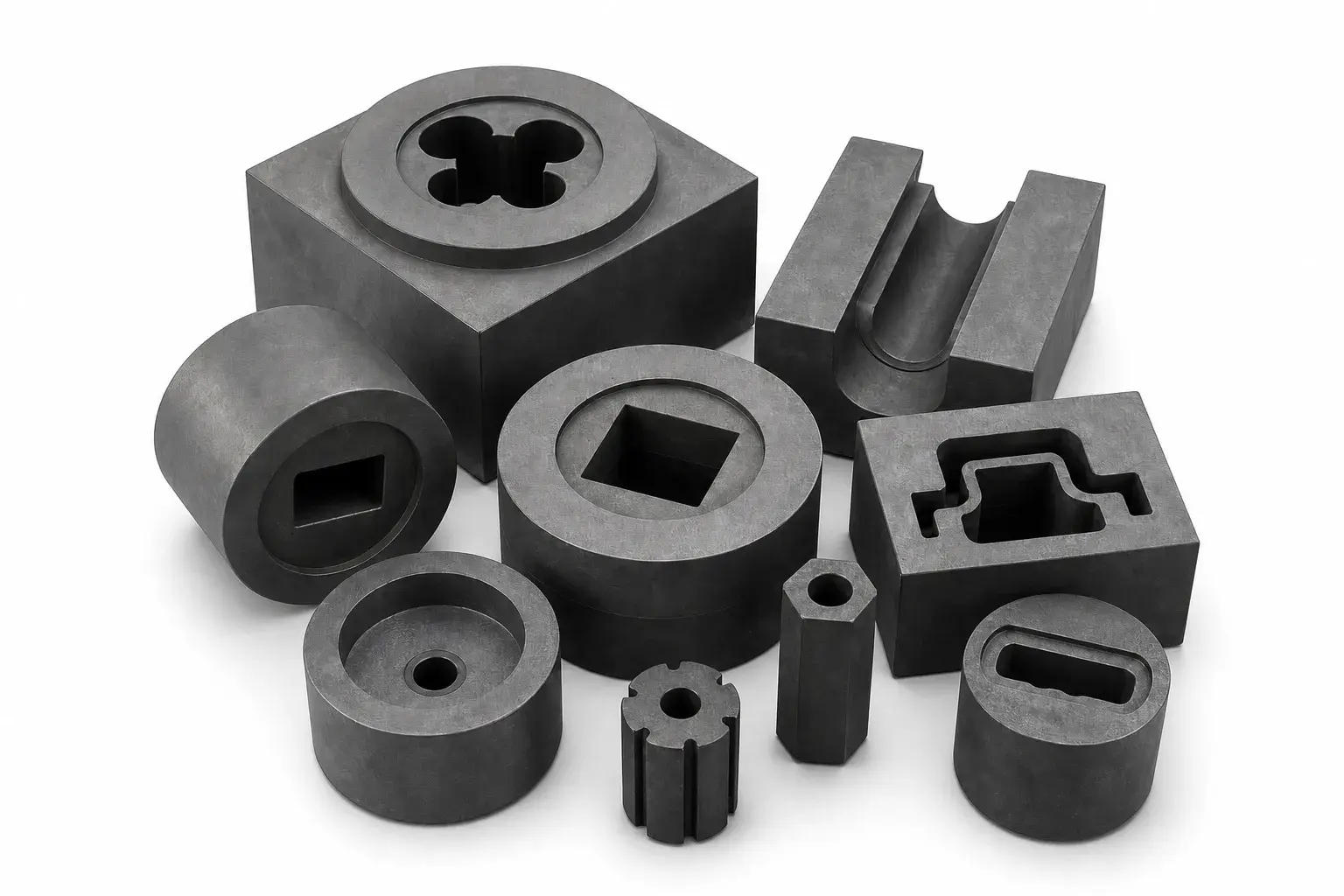
Extrusion dies
Through-feed forming tool
Also known as: Graphite dies · Graphite forming dies · Graphite drawing dies · Extrusion and casting dies
[ Technical summary ]
A graphite die gives section to material passing through it: metal in hot extrusion, product in continuous casting, or a part in forming. Unlike a mould, the material is moving against the die wall, so the inherent lubricity of graphite reduces through-feed friction and sticking. Combined with stability at temperature and easy machining or repair, it keeps the exit section constant across production.
Graphite dies are used in extrusion, forming, and continuous casting. For casting dies, selection depends on metal and format: fine-grain isostatic grades cover grey and ductile iron, brasses, bronzes, Cu-Zn-Ni, Cu-Ni, copper, aluminium, and precious metals; confirm the exact grade with temperature, speed, and geometry.
For hot extrusion and forming, prioritize lubricity, dimensional stability, and machinability of replacements. Share metal, temperature, pressure, and drawing.
[ Problem it solves ]
Hold the section and finish of the product passing through the tool, reducing friction and sticking without lubricants that would contaminate the formed material.
Operating conditions
- Hot extrusion
- Forming
- Pressing
- Continuous-casting dies (wire, billet, strip, tube)
When it is suitable
- The material is hot-formed as it passes through the tool
- Sticking to the die marks the product or stops the line
- Temperature exceeds the useful range of tool steels
- The die must be replaced often and at controlled cost
When it may not be suitable
- The part sits in air at high temperature between casts without protection
- The contacting metal readily dissolves carbon and the alloy cannot tolerate it
- The process subjects the die to impact or tensile loading
Process challenges
- Die wear
- Metal sticking
- Uneven heating
- Matching grade to alloy and format
Advantages
- Inherent lubricity
- Thermal stability
- Machinable repair or replacement
Limitations
- Service life depends on metal and cycle
- Oxidation in air at high temperature
- Die design must be validated
[ Critical selection variables ]
These variables define the grade and the geometry. Actual values are confirmed against the grade datasheet.
- Geometry and tolerancesDecisive
- Operating temperatureDecisive
- Molten metal or alloy in contactDecisive
- Casting speedRelevant
- Surface finish required on the partRelevant
- Heat-extraction rateRelevant
- Thermal and duty cyclingRelevant
[ Required material properties ]
Properties that guide selection. Numerical values come from each grade's datasheet.
Critical properties
- Non-wetting by molten metal
- Compressive strength
- Wear resistance
- Friction coefficient
Secondary properties
- Dimensional stability
- Grain size
- Thermal conductivity
- Machinability
[ Related ]
[ Frequently asked questions ]
View all FAQsTechnical content reviewed by ESGRAF — Last reviewed: September 9, 2026
[ Quote ]
Need the right specification—not just material?
Tell us your application. Engineering response in under 24 hours.