
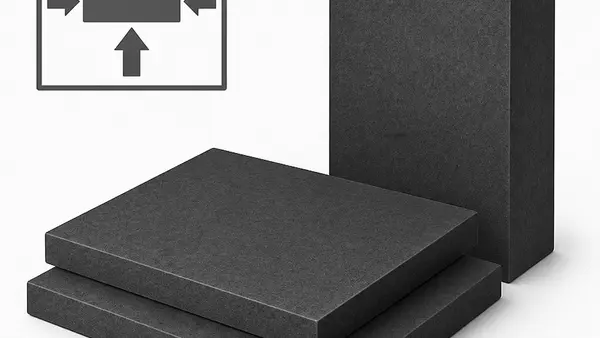
Non-graphitized carbon
Structural thermal barrier — low conductivity
Structural thermal barrier
Carbon material with a less crystalline structure than graphitized technical graphite. Lower thermal conductivity makes it an efficient solution for structural thermal separation: it maintains dimensional stability, good mechanical strength and excellent machinability, with a favorable cost profile compared to highly conductive graphites when heat dissipation is not desired.
| Property | Typical range |
|---|---|
| Bulk density | 1.60 g/cm³ |
| Max. grain size | 0.8 mm |
| Flexural strength | 22 MPa |
| Compressive strength | 64 MPa |
| Open porosity | 18 % |
| Ash content | 0.2 % |
Also available as denser, harder carbons (~1.62 g/cm³, ~10 W/m·K) for electrolysis anodes when low thermal conductivity is required.
Typical applications
- Separators and structural plates in furnaces
- Thermal barriers between process zones
- Supports in the glass industry and metallurgical processes
- Electrolysis anodes and extruded-carbon duties
- Cost-effective alternative when high conductivity is not required
Available in standard plates and blocks or machined parts to drawing. Inventory and machining in García, N.L.
See also carbon-graphite mechanical and extruded graphite.
[ Where it is used ]
Typical applications for this family.
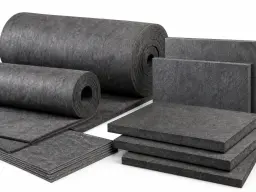 Furnace thermal insulationProvides protection against high temperatures in industrial applications with graphite and carbon felts.
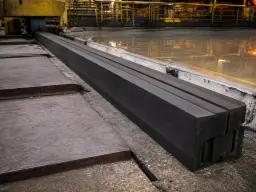 Float-glass fendersThey protect float glass during manufacturing, preventing damage from contact with other surfaces.
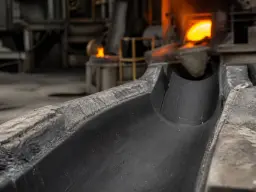 Foundry refractory channel liningProtects gutters subjected to high temperatures in casting processes.
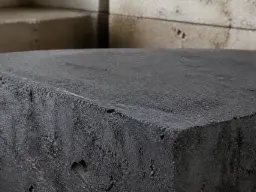 Refractory surface lubricationProtection of blocks, molds and surfaces subjected to high temperatures with a release and non-stick effect.
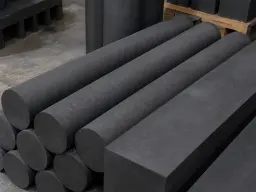 Electrolysis anodesCarbon anodes for electrolytic processes.
[ Advantages ]
- Lower thermal conductivity than graphite
- Good dimensional stability at elevated temperature
- Excellent machinability
- Cost-effective alternative when heat dissipation is not required
[ Build to print ]
Any grade in this family can also be delivered as a finished part: we machine to your drawing, sample or 3D model. Tolerances, impregnation and finish are confirmed in technical review.
[ FAQ ]
View all FAQs[ Quote ]
Need the right specification—not just material?
Tell us your application. Engineering response in under 24 hours.