
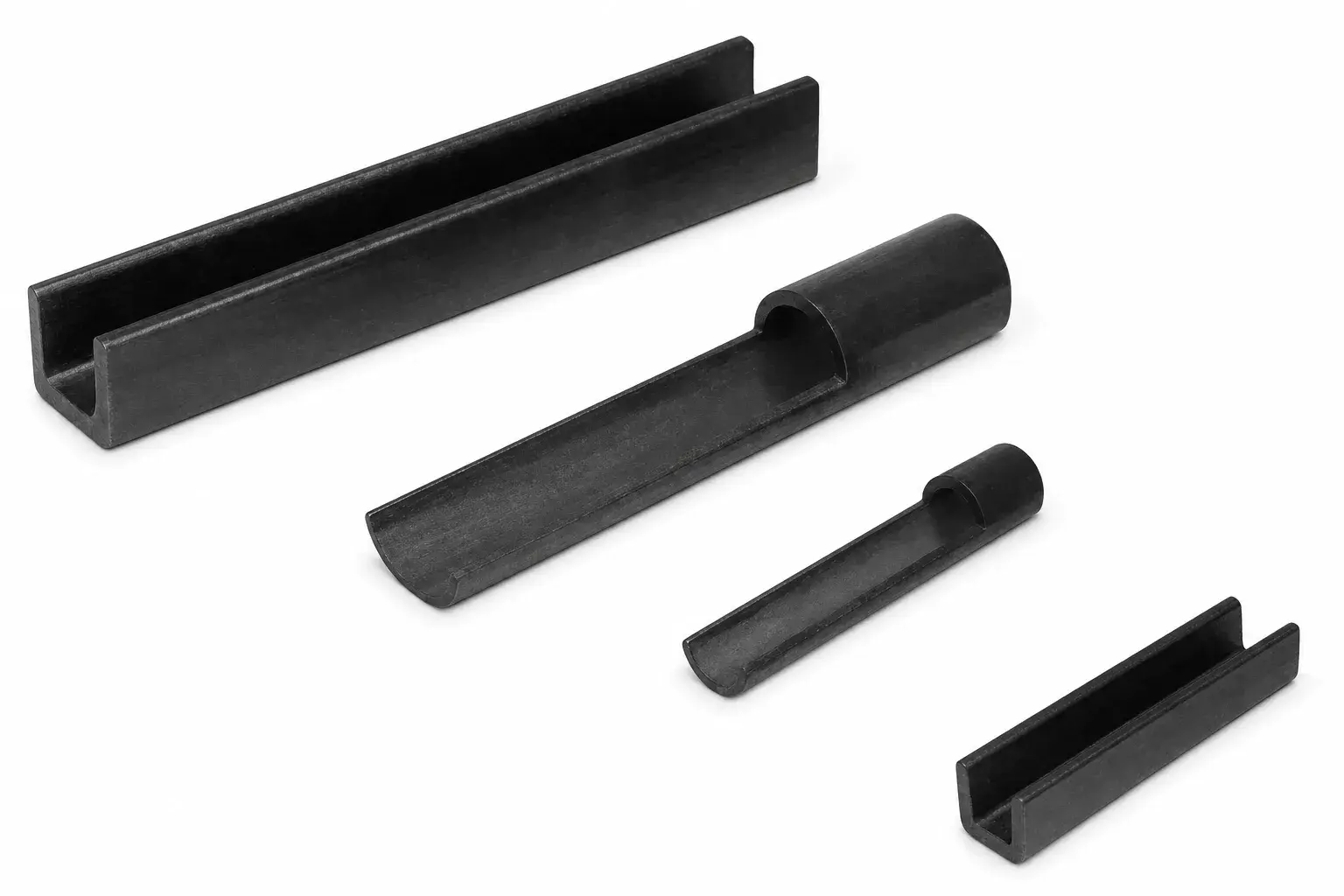
Foundry pouring spouts
Molten metal conveyance element
Also known as: Graphite launders for molten metal · Graphite pouring spouts · Casting troughs · Graphite pouring lips
[ Technical summary ]
Launders, spouts, and troughs carry molten metal from the furnace to the mould or machine. The part is in permanent contact with moving metal, so its wear responds to flow erosion rather than to static temperature. Graphite withstands the thermal shock of the first stream against a cold channel, is not wetted by non-ferrous metals — which avoids build-up and carry-over — and machines to the section and slope each installation requires.
[ Problem it solves ]
Convey molten metal without it sticking to the wall or picking up oxides from the channel itself, and without the first stream against the cold channel cracking it.
Processes
- Liquid-metal conduction
- Casting distribution
Operating conditions
- High temperature
When it is suitable
- Metal is transferred in an open channel between furnace and mould
- Conventional refractories build up metal or shed particles
- The channel cools between casts and suffers thermal shock
- The channel section or slope is specific to the installation
When it may not be suitable
- The contacting metal readily dissolves carbon and the alloy cannot tolerate it
- The part sits in air at high temperature between casts without protection
- The channel must take mechanical impact or cleaning with hard tools
Process challenges
- Flow erosion
- Thermal leaks
- Metal contamination
Advantages
- Thermal shock resistance
- Machined geometries
- Lower sticking than many refractories
Limitations
- Erosion wear
- Grade selection by metal
- Service life depends on cycles
[ Critical selection variables ]
These variables define the grade and the geometry. Actual values are confirmed against the grade datasheet.
- Molten metal or alloy in contactDecisive
- Flow rate and flow regimeDecisive
- Operating temperatureDecisive
- Thermal shock severityDecisive
- Geometry and tolerancesRelevant
- Thermal and duty cyclingRelevant
- Bath or flux chemistryRelevant
[ Required material properties ]
Properties that guide selection. Numerical values come from each grade's datasheet.
Critical properties
- Thermal shock resistance
- Non-wetting by molten metal
- Wear resistance
- Thermal conductivity
Secondary properties
- Chemical resistance
- Machinability
- Bulk density
[ Related ]
[ Frequently asked questions ]
View all FAQsTechnical content reviewed by ESGRAF — Last reviewed: September 8, 2026
[ Quote ]
Need the right specification—not just material?
Tell us your application. Engineering response in under 24 hours.