
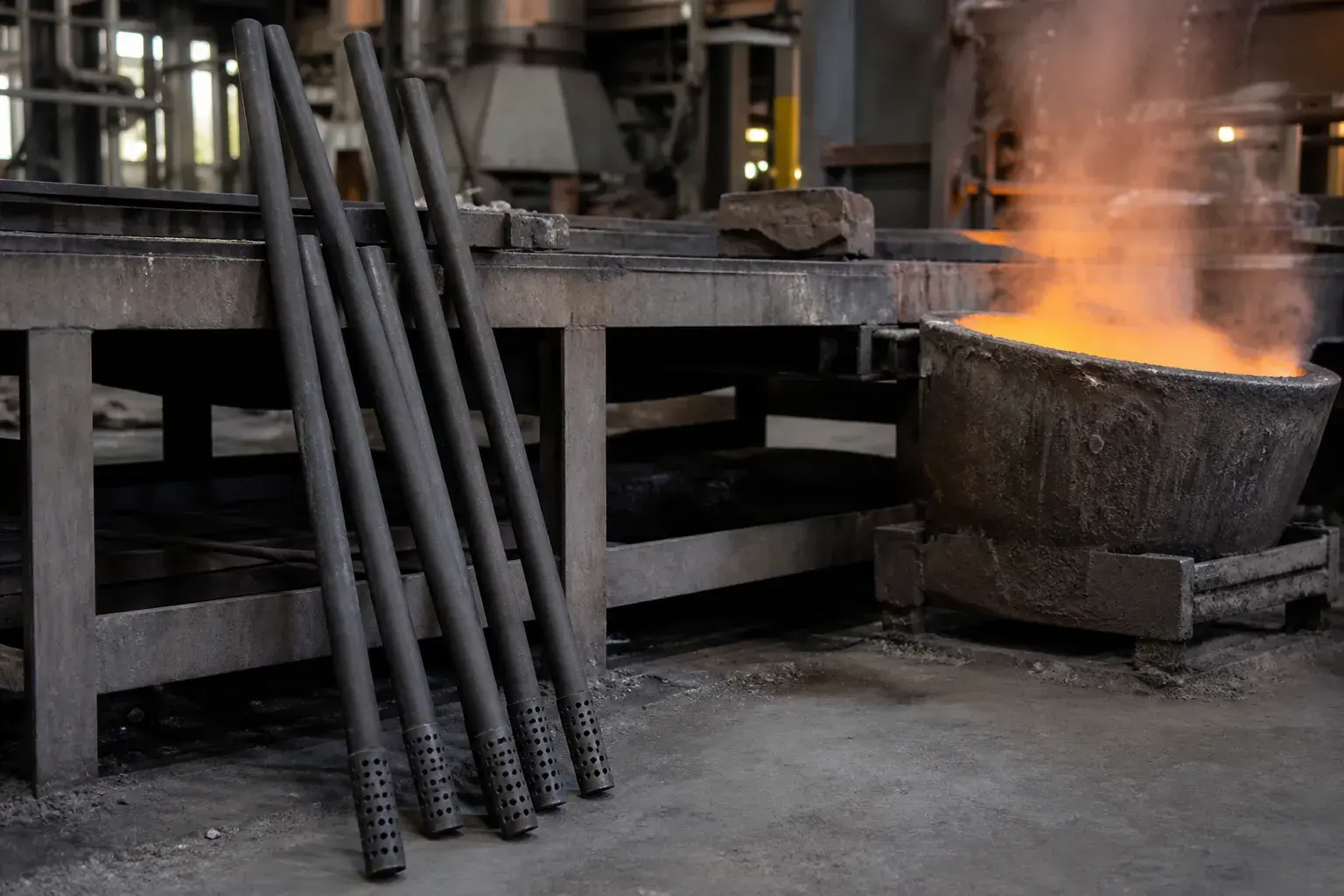
Foundry degassing lances
Molten bath injection element
Also known as: Graphite degassing lances · Graphite fluxing tubes · Degassing rotors · Gas injection lances
[ Technical summary ]
Lances and fluxing tubes introduce gas — or gas with flux — into the molten bath to carry hydrogen and inclusions to the surface. The part sits submerged in molten metal with gas flowing inside it, so it needs stability at temperature, chemical resistance to the bath, and an internal channel that does not clog. Graphite meets those conditions and allows the bore, the diffuser tip, and the equipment connection to be machined.
[ Problem it solves ]
Carry gas to the bottom of the bath and disperse it finely without the lance being rapidly consumed or adding contamination to the treated metal.
Operating conditions
- Degassing
- Gas injection
- Bath treatment
When it is suitable
- The bath requires degassing or inert-gas treatment
- The lance stays submerged through the treatment
- The equipment requires a tip or rotor of defined geometry
- Lances must be replaced without depending on the equipment maker
When it may not be suitable
- The contacting metal readily dissolves carbon and the alloy cannot tolerate it
- The flux used chemically attacks carbon under those conditions
- The lance takes bending loads or knocks during immersion
Process challenges
- Lance erosion
- Blockage
- Contamination
Advantages
- Thermal stability
- Machining of internal channels
- Quick replacement
Limitations
- Wear from erosion and thermal shock
- Possible metal contamination if the grade is unsuitable
- Service life depends on cycles and metal flow
[ Critical selection variables ]
These variables define the grade and the geometry. Actual values are confirmed against the grade datasheet.
- Molten metal or alloy in contactDecisive
- Bath or flux chemistryDecisive
- Gas flow and compositionDecisive
- Operating temperatureDecisive
- Geometry and tolerancesRelevant
- Rotational speedRelevant
- Required purity and allowable contaminationRelevant
[ Required material properties ]
Properties that guide selection. Numerical values come from each grade's datasheet.
Critical properties
- Thermal shock resistance
- Non-wetting by molten metal
- Chemical resistance
- Flexural strength
Secondary properties
- Thermal stability
- Machinability
- Ash content
[ Related ]
Related applications
[ Frequently asked questions ]
View all FAQsTechnical content reviewed by ESGRAF — Last reviewed: September 8, 2026
[ Quote ]
Need the right specification—not just material?
Tell us your application. Engineering response in under 24 hours.