
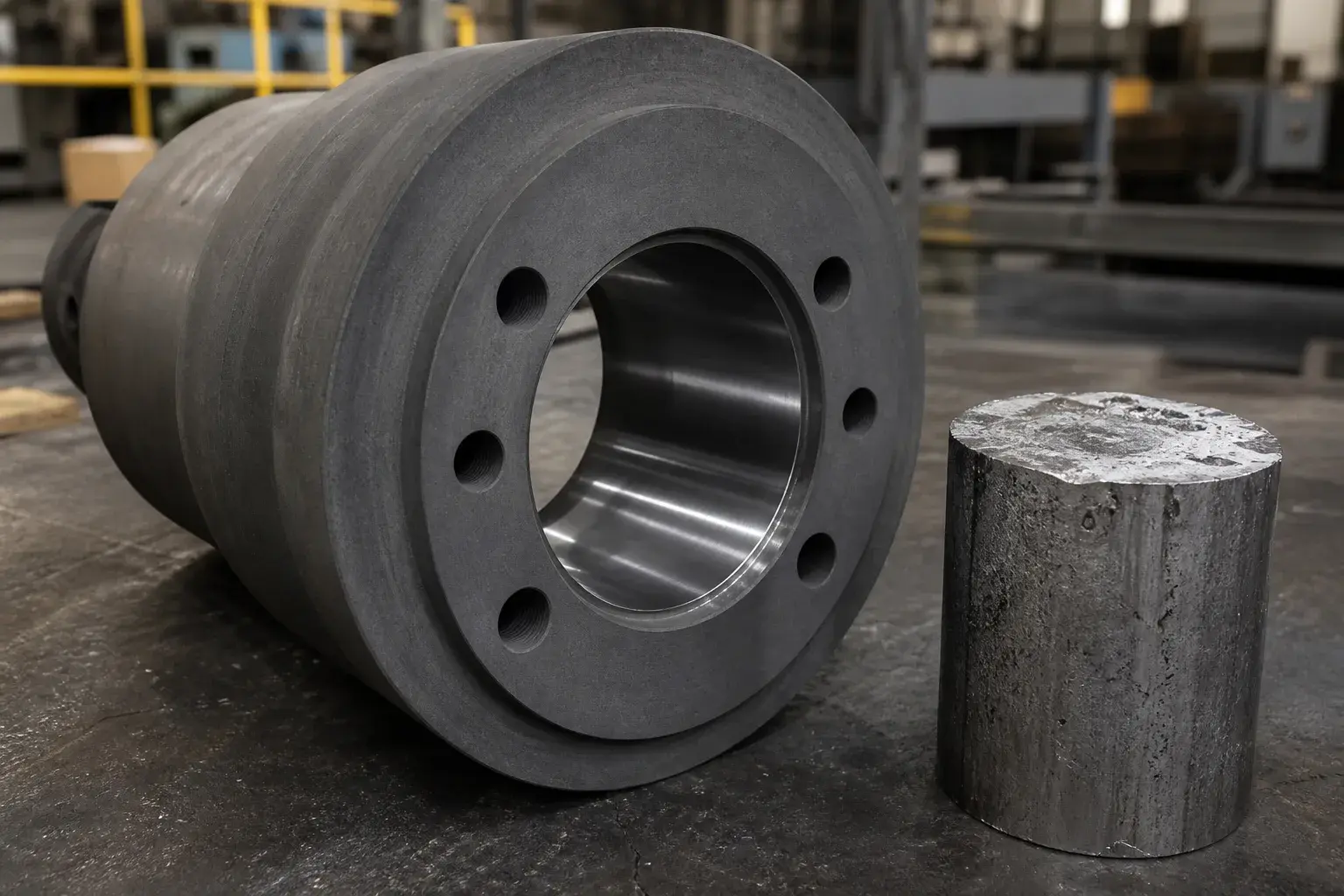
Continuous-casting components
Continuous casting forming component
Also known as: Graphite continuous casting dies · Continuous casting moulds · Graphite casting nozzles · Graphite dies for wire rod and billet
[ Technical summary ]
In continuous casting, molten metal passes through a cooled graphite die or mould where it solidifies and takes its section: wire rod, billet, strip, or tube. The part works with metal permanently moving against its wall, combining erosion, a severe thermal gradient, and the need for non-stick behaviour. Graphite conducts heat toward the cooling, is not wetted by non-ferrous metals, and machines to the precision the exit section demands.
Continuous casting gives continuous control over the transformation of liquid metal into a solid state, producing semi-finished products directly: wires, rods, tubes, strips, and custom sections. The graphite die does two jobs at once: it shapes the metal and extracts the heat needed to solidify it. Confirm metal, temperature, and geometry with applications engineering.
[ Problem it solves ]
Solidify moving metal to a constant section, extracting heat in a controlled way and without the product sticking to the wall, which is what causes tearing and line stoppages.
Operating conditions
- Non-ferrous continuous casting (wire, billet, strip, tube)
- Solidification dies and molds
- Liquid-metal channeling
- Controlled cooling
When it is suitable
- Wire rod, billet, strip, or tube is cast continuously
- The product must leave with constant section and finish
- Heat extraction must be even along the die
- Dies must be replaced with the exact line geometry
When it may not be suitable
- The contacting metal readily dissolves carbon and the alloy cannot tolerate it
- Die cooling is uncontrolled or uneven
- The part sits in air at high temperature between casts without protection
Process challenges
- Metal-flow erosion
- Thermal shock
- Metal contamination
- Wrong grade for alloy or cast format
Advantages
- Thermal shock resistance
- Machining of precise channels and cavities
- Good service life with the right grade for the metal
Limitations
- Wear from erosion and cycling
- Wrong grade can contaminate the metal
- Service life depends on flow and temperature
[ Critical selection variables ]
These variables define the grade and the geometry. Actual values are confirmed against the grade datasheet.
- Molten metal or alloy in contactDecisive
- Casting speedDecisive
- Heat-extraction rateDecisive
- Geometry and tolerancesDecisive
- Operating temperatureDecisive
- Surface finish required on the partRelevant
- Required purity and allowable contaminationRelevant
[ Required material properties ]
Properties that guide selection. Numerical values come from each grade's datasheet.
Critical properties
- Thermal shock resistance
- Non-wetting by molten metal
- Thermal conductivity
- Grain size
Secondary properties
- Bulk density
- Wear resistance
- Dimensional stability
- Machinability
[ Related ]
Related applications
[ Frequently asked questions ]
View all FAQsTechnical content reviewed by ESGRAF — Last reviewed: September 8, 2026
[ Quote ]
Need the right specification—not just material?
Tell us your application. Engineering response in under 24 hours.