
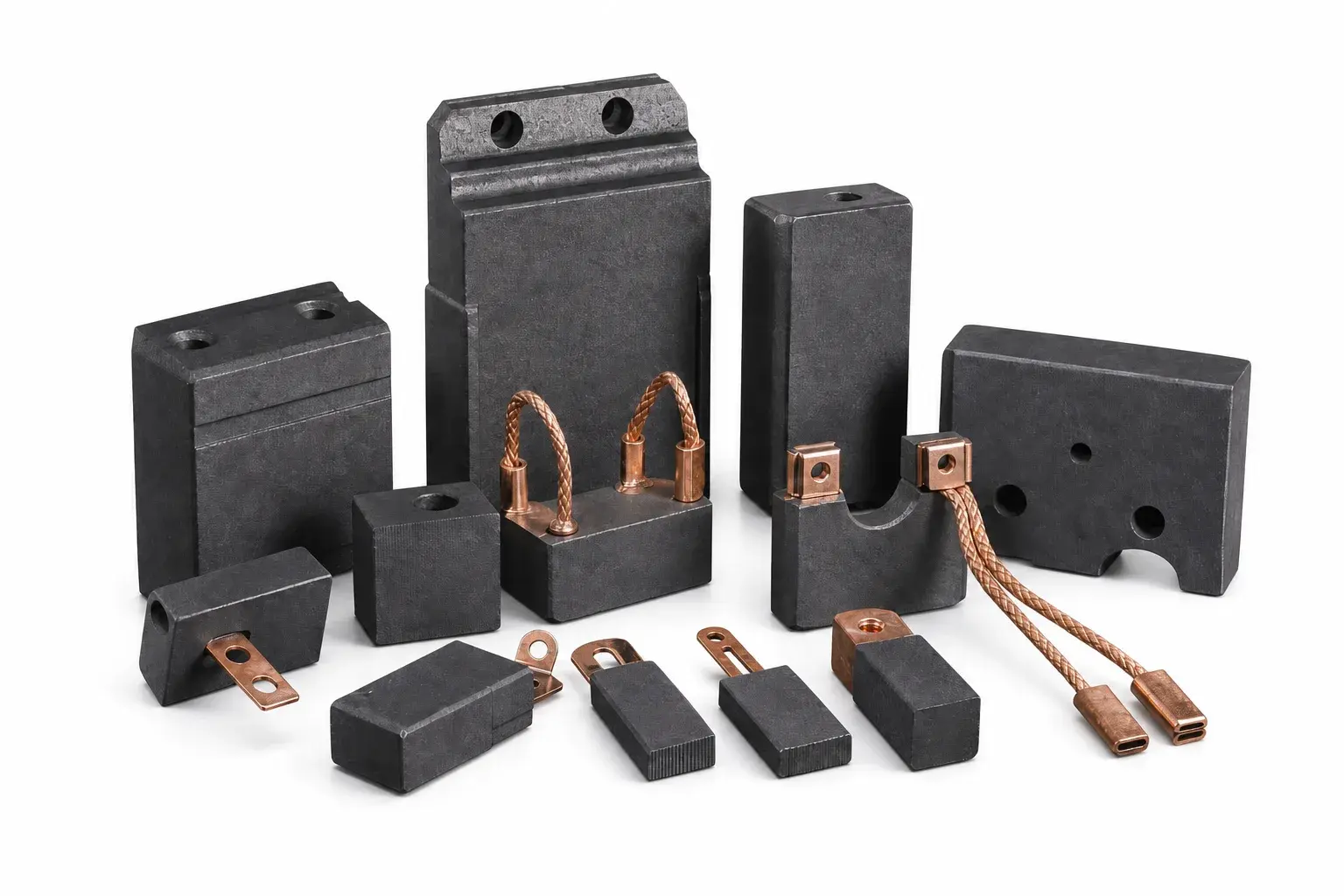
Electrical contacts
Sliding electrical contact
Also known as: Carbon brushes · Carbon-graphite contacts · Pantograph contact strips · Graphite sliding contacts
[ Technical summary ]
A sliding electrical contact must carry current while rubbing against a moving part — commutator, slip ring, or contact wire — without wearing the counterface. Carbon and carbon-graphite meet that dual demand because they conduct reasonably and self-lubricate, forming a film that stabilizes the contact. The cheaper element of the pair is sacrificed in a controlled way, protecting the commutator or wire, which is the costly part of the system.
[ Problem it solves ]
Transfer current between a fixed and a moving part without wearing the metal counterface or relying on a lubricant, which in an electrical contact would act as an insulator.
Operating conditions
- Electrical sliding contact
- Current conduction
- Dynamic contact
When it is suitable
- Current is transferred between parts in relative motion
- The metal counterface must be protected from wear
- A lubricant cannot be used because it is insulating
- The contact is to be replaced as a planned wear part
When it may not be suitable
- Sustained arcing occurs because the contact is undersized
- Contact pressure is outside the brush-holder design range
- The environment carries abrasives or vapours that prevent film formation
Process challenges
- Contact wear
- Electric arc
- Overheating
Advantages
- Good conductivity
- Contact self-lubrication
- Grades by current and speed
Limitations
- Wear from arcing or electrical erosion
- Conductivity and density must be calibrated to the process
- Some grades are not suitable for high purity
[ Critical selection variables ]
These variables define the grade and the geometry. Actual values are confirmed against the grade datasheet.
- Current densityDecisive
- Sliding speedDecisive
- Contact forceDecisive
- Counterface material and finishDecisive
- Humidity and ambient conditionsRelevant
- Operating temperatureRelevant
- Geometry and tolerancesRelevant
[ Required material properties ]
Properties that guide selection. Numerical values come from each grade's datasheet.
Critical properties
- Electrical resistivity
- Friction coefficient
- Self-lubrication
- Wear resistance
Secondary properties
- Lubricating film formation
- Hardness
- Compressive strength
[ Related ]
[ Frequently asked questions ]
View all FAQsTechnical content reviewed by ESGRAF — Last reviewed: September 8, 2026
[ Quote ]
Need the right specification—not just material?
Tell us your application. Engineering response in under 24 hours.