
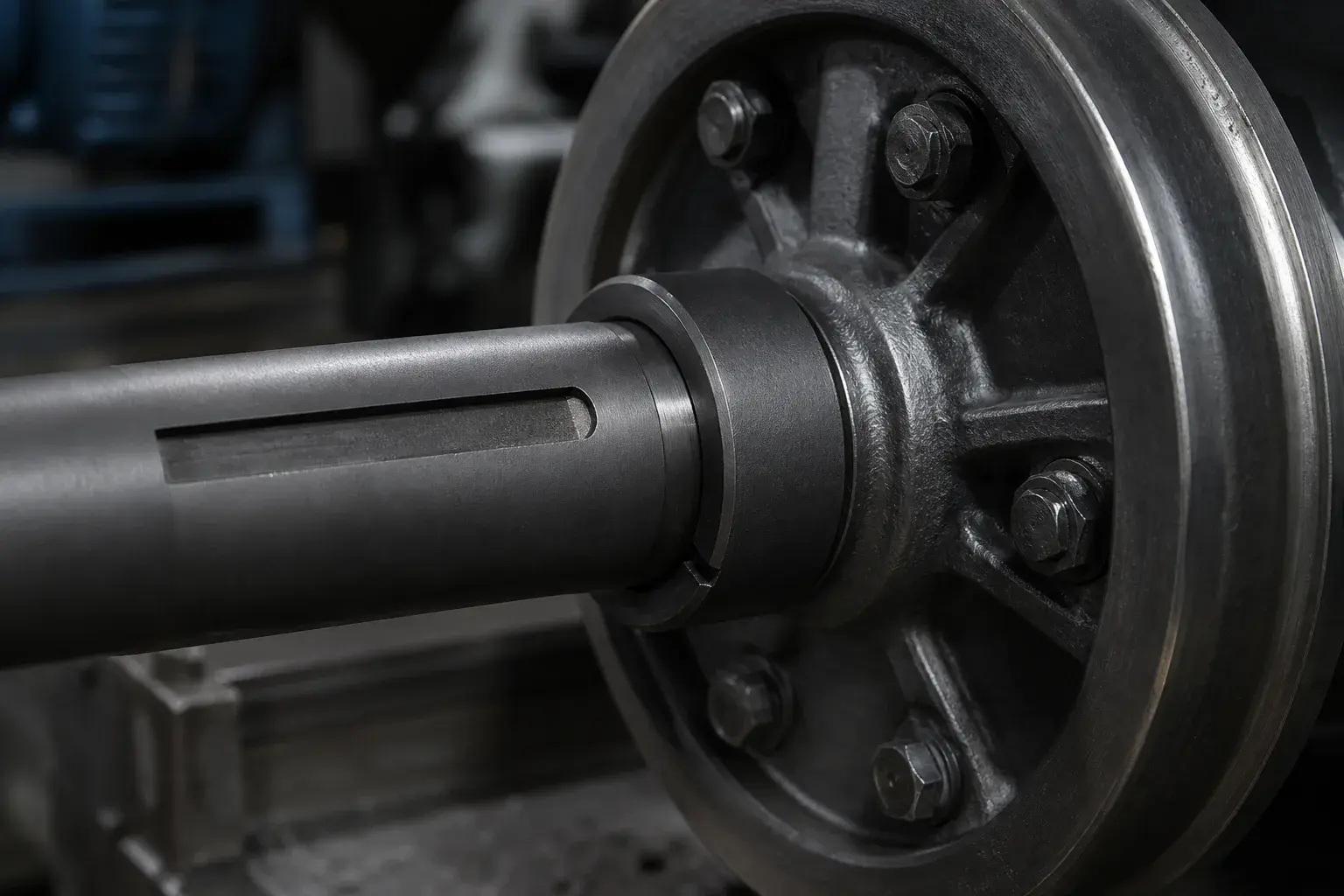
Shaft and axle lubrication
Rotating friction point lubrication
Also known as: Graphite lubricant for shafts · Dry lubrication for axles and bushings · Anti-friction for metal wheels · Solid lubricant for drives
Dry-film graphite lubricant for shafts, axles, and metal wheels under load.
[ Technical summary ]
Shafts, axles, bushings, and metal wheels concentrate load on a small contact area, and there conventional grease is displaced, runs off, or traps dust until it becomes an abrasive. A graphite lubricant penetrates as a liquid, dries, and leaves a solid film that stays in the contact: it carries load without running off and does not attract particles. It is especially useful at hard-to-reach points where frequent relubrication is not practical.
Shafts, axles, and metal wheels usually run where grease is a liability: it runs off, attracts abrasive dust, degrades with temperature, and the point to lubricate is hard to reach. A graphite lubricant penetrates as a liquid, dries to a solid film, and keeps working without a greasy residue that traps contaminants.
Selection and application
Load, rotating speed, and temperature determine the product and the reapplication interval. Apply to a clean surface and let it dry before returning to service. ESGRAF supplies LUBRISHAFT for shafts, axles, and metal wheels, and GRAFICOAT where a thicker paint film is needed.
[ Problem it solves ]
Keep a loaded contact lubricated without the lubricant running off or turning into an abrasive paste when it mixes with ambient dust.
Operating conditions
- Shaft and axle lubrication
- Metal wheels and rollers
- Drivetrain maintenance
- Bushing and bearing lubrication
When it is suitable
- Grease runs off or is displaced from the contact point
- A dusty environment turns grease into an abrasive
- Access to the point makes frequent relubrication difficult
- Temperature degrades the oil before the next service
When it may not be suitable
- The bearing needs the lubricant to dissipate heat
- The equipment specifies a liquid lubricant by design
- The surface tolerates no black residue and there will be no cleaning stage
Process challenges
- Wear from metal-to-metal contact
- Greases that run off or attract dust
- Limited access for relubrication
- Temperature degrading the oil
Advantages
- Dry film with no greasy residue
- Withstands load and temperature
- Does not attract dust or abrasives
- Penetrates as a liquid, dries solid
Limitations
- Not a hydrodynamic oil lubricant
- Requires periodic reapplication
- May stain light-colored surfaces
[ Critical selection variables ]
These variables define the grade and the geometry. Actual values are confirmed against the grade datasheet.
- Load and its distributionDecisive
- Rotational speedDecisive
- Operating temperatureRelevant
- Presence of abrasives or solidsRelevant
- Application methodRelevant
- Reapplication frequencyRelevant
- Counterface material and finishRelevant
[ Required material properties ]
Properties that guide selection. Numerical values come from each grade's datasheet.
Critical properties
- Lubricating film formation
- Friction coefficient
- Thermal stability
- Particle size distribution
Secondary properties
- Self-lubrication
- Wear resistance
[ Related ]
[ Frequently asked questions ]
View all FAQsTechnical content reviewed by ESGRAF — Last reviewed: September 8, 2026
[ Quote ]
Need the right specification—not just material?
Tell us your application. Engineering response in under 24 hours.