
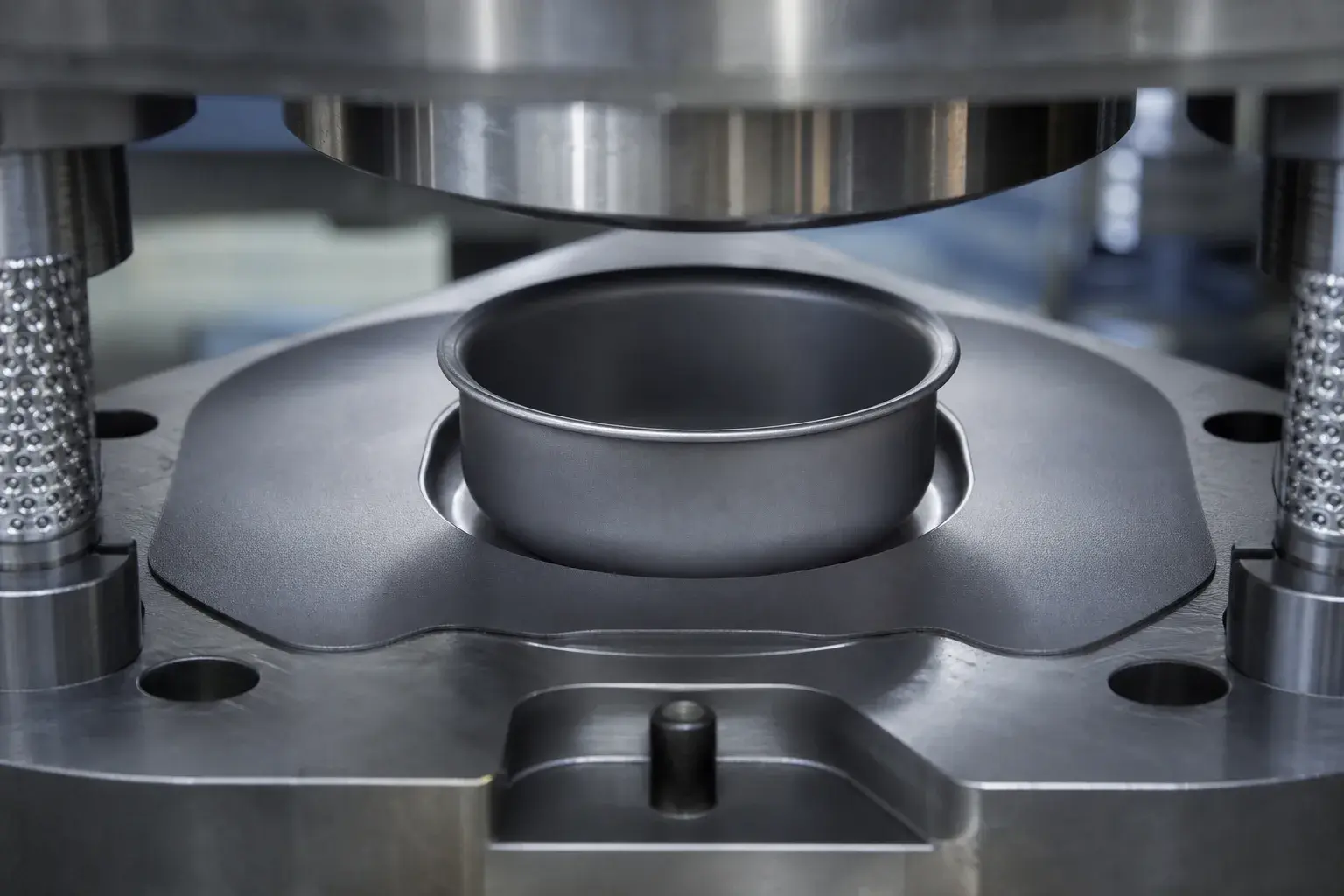
Cold-forming lubrication
Cold forming lubricant
Also known as: Graphite stamping lubricant · Deep drawing lubricant · Dry film for cold forming · Sheet metal forming lubricant
Graphite coating for cold stamping, deep drawing, and bending with an even lubricating film.
[ Technical summary ]
In stamping, drawing, and bending, the sheet slides against the die under high pressure. If the lubricant film breaks down, metal sticks locally to the tooling and scoring, marking, and in severe cases part tearing appear. A graphite lubricant leaves a dry, continuous film that carries that contact pressure without running off, which is particularly useful in deep draws and in zones where oil is squeezed away.
Cold drawing and bending fail because of friction: the sheet scores, marks, or tears when it does not slide evenly against the die. A dry graphite film spreads the sliding across the whole contact area and leaves the part clean, without the oily residue that later has to be degreased.
Selection and application
Sheet thickness and forming severity set the dilution and whether to coat the die, the blank, or both. Apply by brush, roller, or spray onto a clean surface. ESGRAF supplies GRAFOPLATE for cold stamping, drawing, and bending of metals.
[ Problem it solves ]
Sustain the lubricant film between sheet and die under high pressure, avoiding the scoring and sticking that cause rejects and tooling wear.
Operating conditions
- Stamping
- Deep drawing
- Bending
- Cold forming
When it is suitable
- The sheet is scored or marked during forming
- The draw is deep and oil is squeezed out of the contact
- A lubricant that does not run or drip on the press is required
- The process needs a non-flammable alternative to the current lubricant
When it may not be suitable
- The part tolerates no black residue and there will be no later cleaning stage
- The part goes straight to painting with no degreasing stage
- The product cannot be validated in the plant before adopting it in production
Process challenges
- Sheet scoring and marking
- Sticking to the die
- Tearing from excess friction
- Residue that forces degreasing
Advantages
- Dry drip-free film
- Reduces friction and marking
- Non-flammable water-based version
- Eases part release
Limitations
- Does not replace stamping oils in severe operations
- Requires a clean surface
- May stain light-colored surfaces
[ Critical selection variables ]
These variables define the grade and the geometry. Actual values are confirmed against the grade datasheet.
- Material of the workpieceDecisive
- Application methodDecisive
- Film thicknessDecisive
- Carrier or formulation baseRelevant
- Geometry and tolerancesRelevant
- Dosage and application frequencyRelevant
- Surface finish required on the partRelevant
[ Required material properties ]
Properties that guide selection. Numerical values come from each grade's datasheet.
Critical properties
- Lubricating film formation
- Friction coefficient
- Particle size distribution
- Self-lubrication
Secondary properties
- Dispersibility
- Wear resistance
[ Related ]
[ Frequently asked questions ]
View all FAQsTechnical content reviewed by ESGRAF — Last reviewed: September 8, 2026
[ Quote ]
Need the right specification—not just material?
Tell us your application. Engineering response in under 24 hours.