
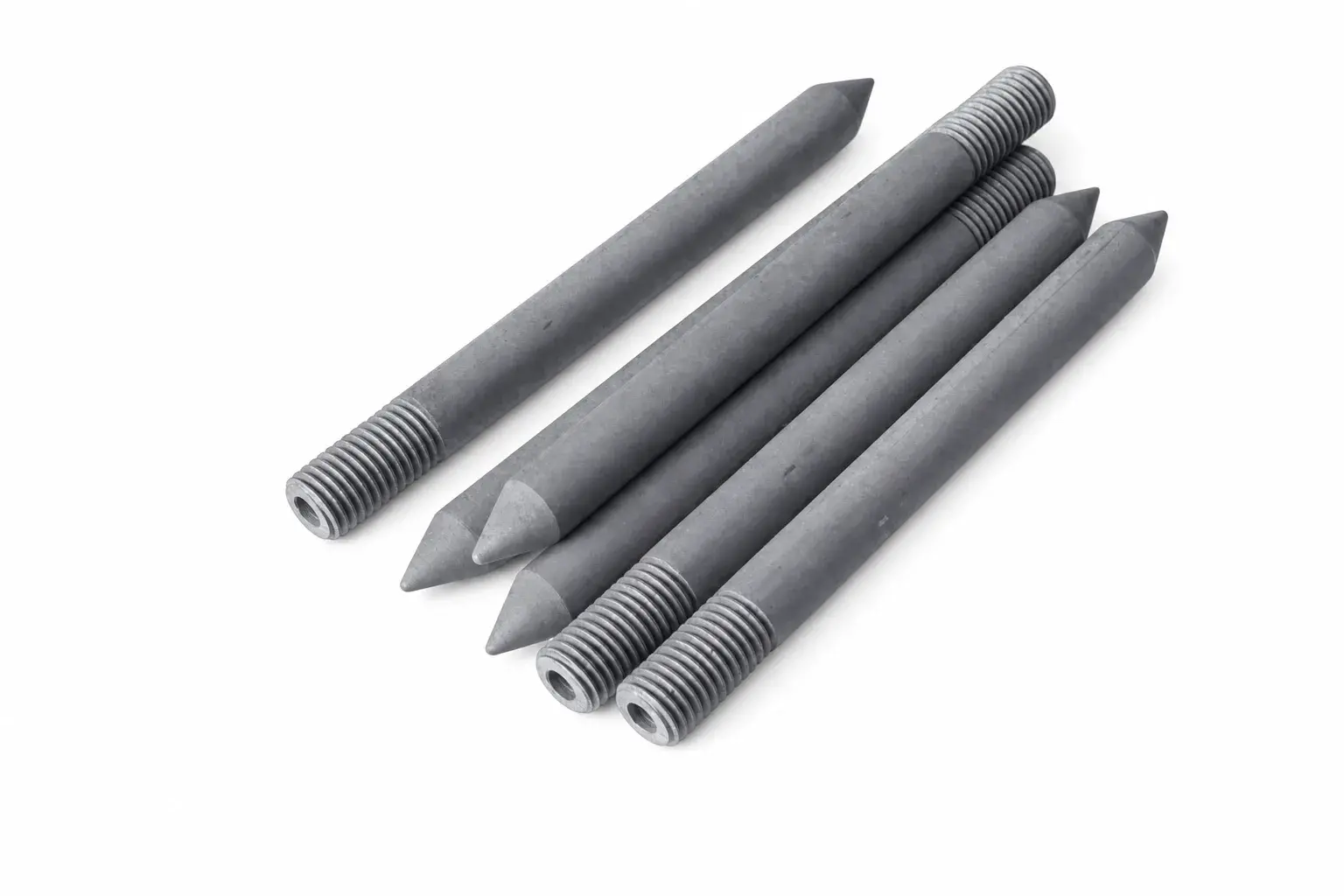
Foundry stirring bars
Bath stirring element
Also known as: Graphite stirring bars · Graphite rotors for molten metal · Graphite stirring paddles · Molten bath stirrers
[ Technical summary ]
Stirring bars, paddles, and rotors homogenize the metal bath in temperature and composition, and help incorporate alloying additions or distribute treatment gas. The part rotates or moves within molten metal, adding flow erosion to the thermal and chemical demand. Graphite is used because it is not wetted by non-ferrous metals, withstands the thermal shock of immersion, and machines into paddle or rotor geometries matched to the furnace.
[ Problem it solves ]
Homogenize the bath without introducing an element that dissolves, is wetted, or adds inclusions — and that also tolerates repeated immersion in molten metal.
Operating conditions
- Bath agitation
- Degassing
- Homogenization
When it is suitable
- The bath shows thermal or compositional stratification
- Alloying or refining additions must be distributed
- The stirrer is immersed and withdrawn on each treatment
- Aluminium, copper, or other non-ferrous metals are treated
When it may not be suitable
- The contacting metal readily dissolves carbon and the alloy cannot tolerate it
- Stirring imposes high bending loads on the shaft
- The bath flux attacks carbon under those conditions
Process challenges
- Agitator erosion
- Metal contamination
- Fracture from thermal shock
Advantages
- Chemical resistance to many non-ferrous metals
- Thermal stability
- Custom design
Limitations
- Wear from erosion and thermal shock
- Possible metal contamination if the grade is unsuitable
- Service life depends on cycles and metal flow
[ Critical selection variables ]
These variables define the grade and the geometry. Actual values are confirmed against the grade datasheet.
- Molten metal or alloy in contactDecisive
- Rotational speedDecisive
- Operating temperatureDecisive
- Bath or flux chemistryDecisive
- Geometry and tolerancesRelevant
- Thermal shock severityRelevant
- Thermal and duty cyclingRelevant
[ Required material properties ]
Properties that guide selection. Numerical values come from each grade's datasheet.
Critical properties
- Thermal shock resistance
- Non-wetting by molten metal
- Chemical resistance
- Flexural strength
Secondary properties
- Wear resistance
- Thermal stability
- Machinability
[ Related ]
[ Frequently asked questions ]
View all FAQsTechnical content reviewed by ESGRAF — Last reviewed: September 8, 2026
[ Quote ]
Need the right specification—not just material?
Tell us your application. Engineering response in under 24 hours.