
Forge lubrication
Hot die release agent
Also known as: Graphite forging release agent · Forging die lubricant · Graphite for hot forging · Release agent for forging dies
Graphite release coating for hot forging that protects the die and eases part release.
[ Technical summary ]
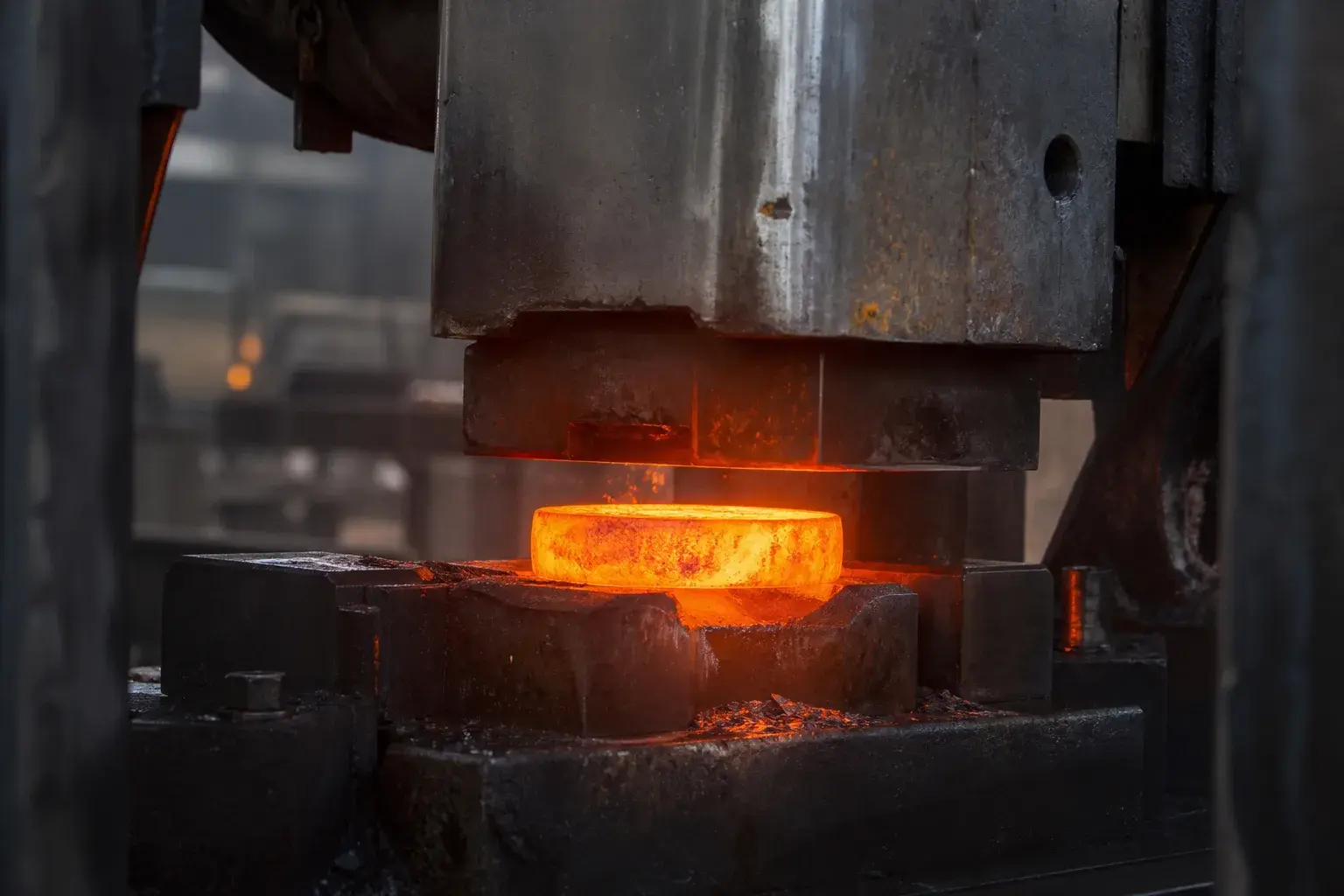
In hot forging, the die receives the red-hot workpiece blow after blow. The lubricant is applied between blows and must do two things at once: form a film that keeps the part from sticking in the impression, and act as a thermal barrier that reduces heat transferred into the die. Graphite keeps its lubricating ability at working temperature, where an organic lubricant simply burns off, which is why it remains the usual base of these products.
In hot forging the die takes a glowing billet blow after blow. Without a stable lubricating film the material sticks to the impression, parts come out with defects, and the die wears through abrasion and thermal fatigue. Graphite keeps lubricating at temperatures where oils have already burned off.
Selection and application
Process temperature, impression depth, and application method set the dilution and film thickness. It is sprayed between strokes onto a clean die. ESGRAF supplies GRAFOTERM for mid-to-high temperature forming and forging, and GRAFOLAGE for molds and dies in contact with hot metal.
[ Problem it solves ]
Keep the part from sticking in the impression and limit the heat the die takes on each blow — the two main causes of tooling wear and thermal fatigue.
Operating conditions
- Hot forging
- Closed-die forging
- Upsetting
- Die lubrication
When it is suitable
- The part sticks in the impression and is hard to extract
- The die shows premature thermal fatigue
- The current lubricant burns off and stops protecting between blows
- Application is by automated spray between cycles
When it may not be suitable
- The part tolerates no black residue and there will be no later cleaning stage
- Build-up in the impression cannot be removed between cycles
- The product cannot be validated in the plant before adopting it in production
Process challenges
- Part sticking to the die
- Impression wear and thermal fatigue
- Surface defects on the part
- Lubricant burning off with heat
Advantages
- Lubricating film that is stable at high temperature
- Eases part release
- Extends die life
- Sprayed between strokes
Limitations
- Does not replace die cooling
- Requires reapplication between strokes
- May stain light-colored surfaces
[ Critical selection variables ]
These variables define the grade and the geometry. Actual values are confirmed against the grade datasheet.
- Operating temperatureDecisive
- Application methodDecisive
- Dosage and application frequencyDecisive
- Material of the workpieceDecisive
- Geometry and tolerancesRelevant
- Carrier or formulation baseRelevant
- Machine cycle rateRelevant
[ Required material properties ]
Properties that guide selection. Numerical values come from each grade's datasheet.
Critical properties
- Lubricating film formation
- Friction coefficient
- Thermal stability
- Particle size distribution
Secondary properties
- Self-lubrication
- Dispersibility
- Non-wetting by molten metal
[ Related ]
[ Frequently asked questions ]
View all FAQsTechnical content reviewed by ESGRAF — Last reviewed: September 8, 2026
[ Quote ]
Need the right specification—not just material?
Tell us your application. Engineering response in under 24 hours.