
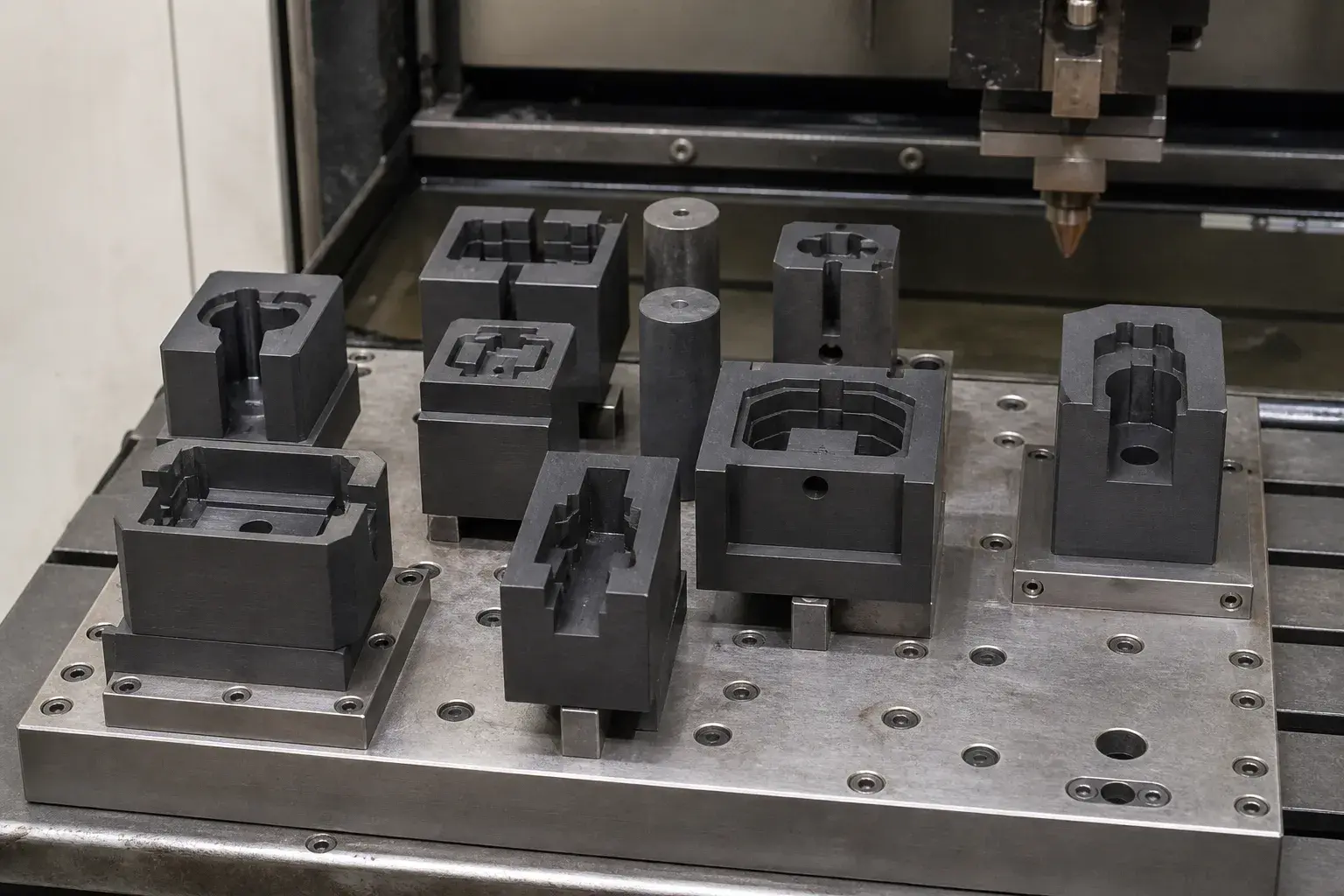
EDM electrodes
Electrical discharge machining electrode
Also known as: Graphite EDM electrodes · Electrical discharge machining electrodes · Graphite for sinker EDM · Graphite electrodes for mould making
[ Technical summary ]
In sinker EDM, the electrode reproduces the target shape in negative and is partly consumed during the process. Graphite dominates this application because it machines fast and in fine detail — allowing the electrode to be made in a fraction of the time copper requires — and because it withstands the discharge with comparatively low wear. The grade is chosen on grain size and density according to whether fast roughing or fine finishing is sought.
Graphite EDM electrodes need structural uniformity, machinability and dimensional stability during sinker EDM. ESGRAF recommends the material family by finish, wear rate and geometry complexity.
For grade selection and specifications, see EDM graphite. For finished electrodes to print, graphite machining. Industry context: EDM industry.
[ Problem it solves ]
Produce cavities and details that cannot be cut by conventional machining, with an electrode that is fast to make and holds its shape during erosion.
Operating conditions
- Sinker EDM
- Electrode machining
When it is suitable
- The geometry cannot be produced by conventional cutting
- The electrode must be made quickly and in fine detail
- The cavity requires sharp edges or deep walls
- Hardened steels or hard-to-machine materials are being eroded
When it may not be suitable
- The process is wire EDM rather than sinker EDM
- The shop cannot control the dust from machining the electrode
- The target finish requires a finer grade than the shop has available
Process challenges
- Uneven electrode wear
- Poor surface finish
- Incorrect grade selection
Advantages
- Excellent machinability
- Good erosion performance
- Grades for fine finish or roughing
Limitations
- Wear from arcing or electrical erosion
- Conductivity and density must be calibrated to the process
- Some grades are not suitable for high purity
[ Critical selection variables ]
These variables define the grade and the geometry. Actual values are confirmed against the grade datasheet.
- Geometry to erode and fine detailDecisive
- Roughing or finishing regimeDecisive
- Surface finish required on the partDecisive
- Current densityRelevant
- Geometry and tolerancesRelevant
- Required purity and allowable contaminationRelevant
[ Required material properties ]
Properties that guide selection. Numerical values come from each grade's datasheet.
Critical properties
- Electrical resistivity
- Machinability
- Flexural strength
- Grain size
Secondary properties
- Bulk density
- Hardness
- Dimensional stability
[ Related ]
Materials
Products
[ Frequently asked questions ]
View all FAQsTechnical content reviewed by ESGRAF — Last reviewed: September 8, 2026
[ Quote ]
Need the right specification—not just material?
Tell us your application. Engineering response in under 24 hours.