
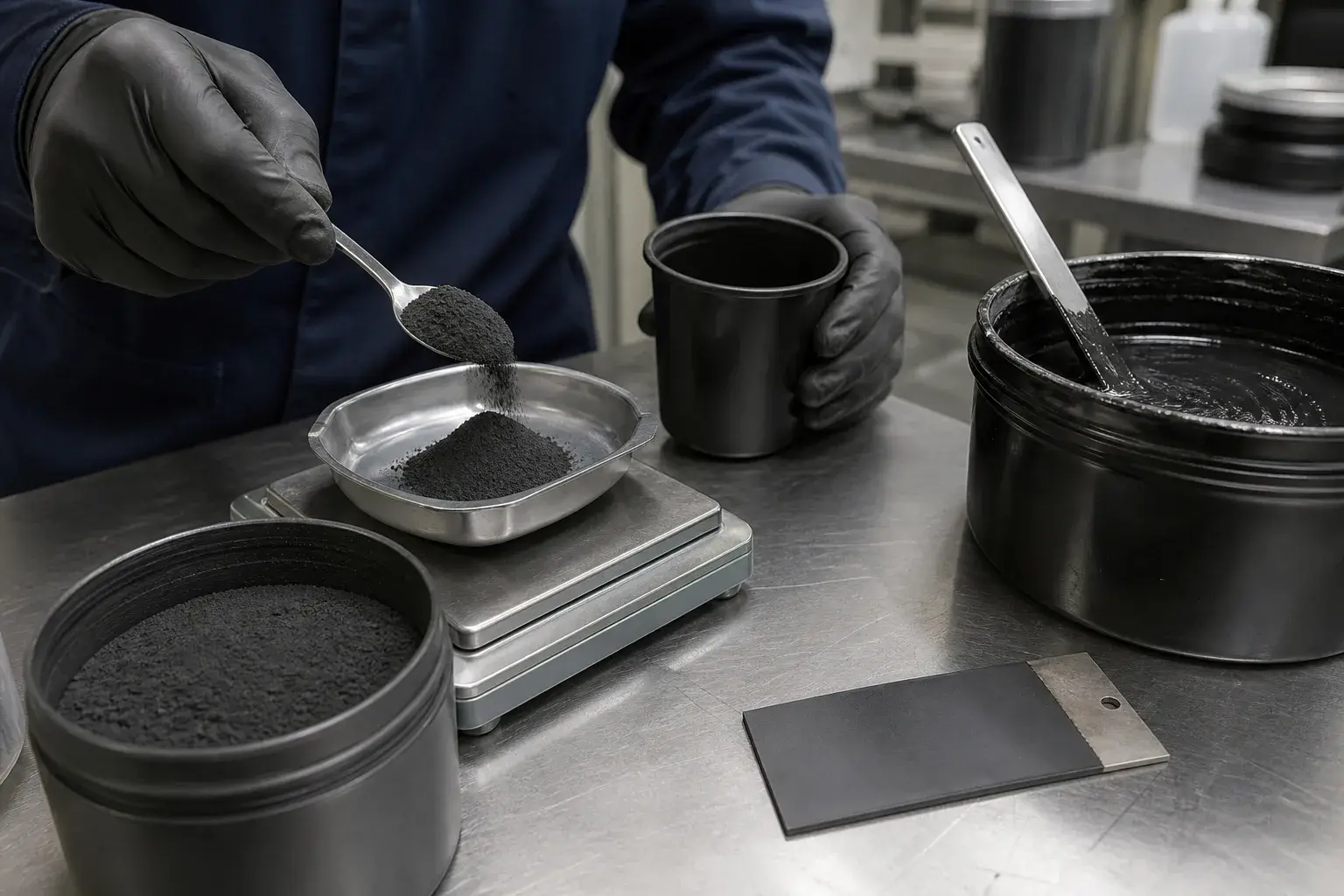
Conductive paint additive
Conductive additive for formulations
Also known as: Conductive graphite for paints · Graphite antistatic additive · Conductive filler for coatings · Graphite for dissipative coatings
[ Technical summary ]
A paint or coating conducts when its conductive filler reaches a concentration high enough to form continuous paths within the film. Graphite powder serves that role and also brings chemical and thermal stability compared with other fillers. The result depends as much on the graphite — particle size, purity, morphology — as on the formulation and applied thickness, so the conductivity level is validated on the actual film rather than predicted from the additive.
[ Problem it solves ]
Give conductivity or dissipative character to a coating with a chemically stable filler, preventing electrostatic charge build-up on the treated surface.
Operating conditions
- Paint formulation
- Dissipative coatings
When it is suitable
- The film must dissipate electrostatic charge
- The formulation accepts a solid filler at the required loading
- Chemical stability of the filler in service is required
- The additive must disperse in the carrier without excessive settling
When it may not be suitable
- The finish requires a colour or transparency incompatible with graphite
- The target conductivity requires a loading the formulation cannot tolerate
- Performance cannot be validated on the applied film
Process challenges
- High film resistivity
- Electrostatic discharge
Advantages
- Conductivity improvement
- Chemical stability
- Easy dispersion depending on particle size
Limitations
- Wear from arcing or electrical erosion
- Conductivity and density must be calibrated to the process
- Some grades are not suitable for high purity
[ Critical selection variables ]
These variables define the grade and the geometry. Actual values are confirmed against the grade datasheet.
- Particle sizeDecisive
- Dosage and application frequencyDecisive
- Carrier or formulation baseDecisive
- Film thicknessRelevant
- Required purity and allowable contaminationRelevant
- Application methodRelevant
[ Required material properties ]
Properties that guide selection. Numerical values come from each grade's datasheet.
Critical properties
- Electrical resistivity
- Purity
- Particle size distribution
- Dispersibility
Secondary properties
- Chemical resistance
- Ash content
[ Related ]
Industries
[ Frequently asked questions ]
View all FAQsTechnical content reviewed by ESGRAF — Last reviewed: September 8, 2026
[ Quote ]
Need the right specification—not just material?
Tell us your application. Engineering response in under 24 hours.