
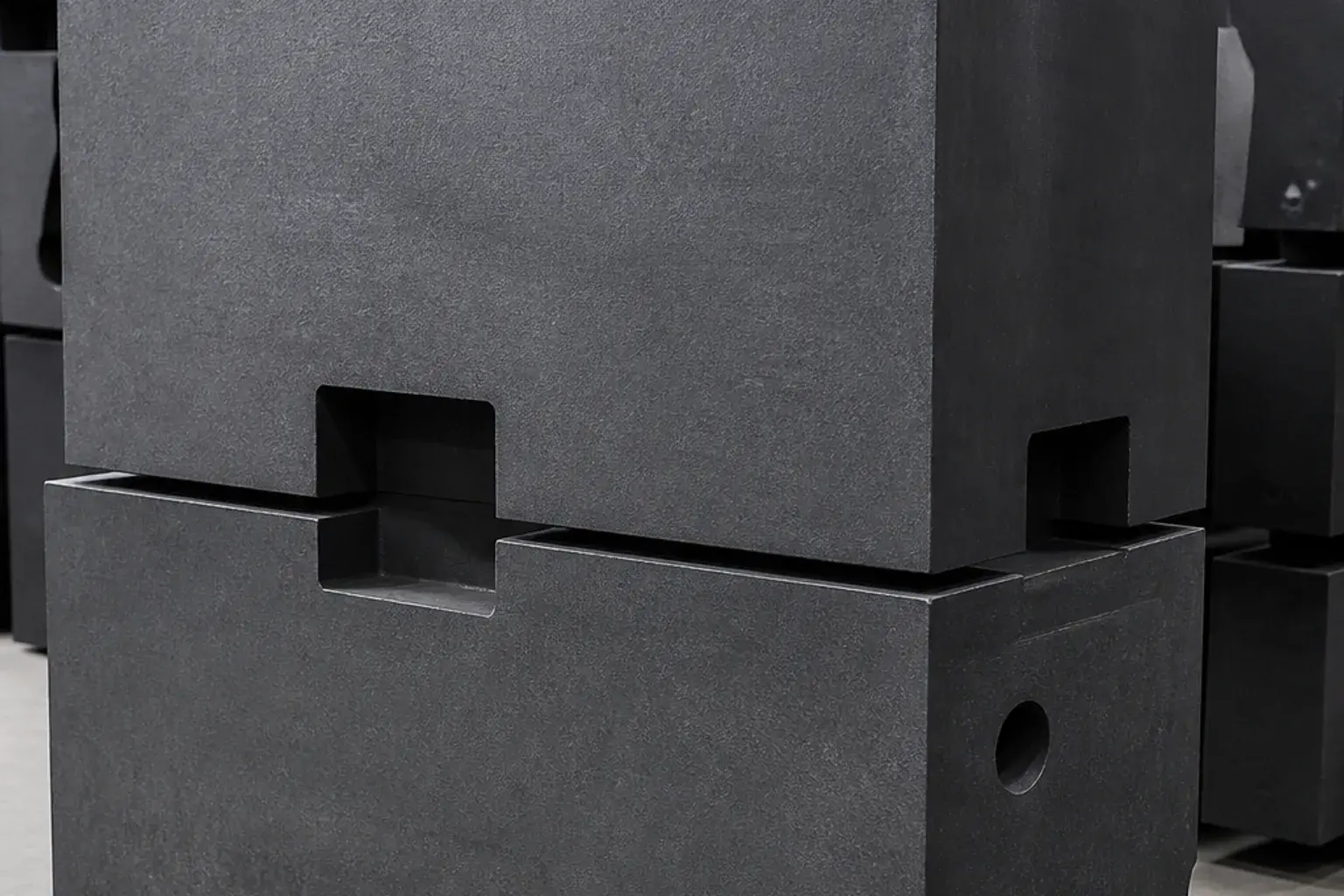
Blast furnace linings
Refractory lining block
Also known as: Graphite blocks for blast furnaces · Blast furnace carbon lining · Hearth and crucible blocks · Carbonaceous refractory
Graphite blocks for hearth, stack, bosh and blast-furnace sidewalls.
[ Technical summary ]
Carbon and graphite block linings protect the blast furnace structure in the zones contacting hot metal: hearth, crucible, bosh, and walls. Their role is not only to resist but to conduct heat toward the external cooling, so that a stable protective layer forms on the hot face. That conductivity, together with resistance to molten metal attack, is why carbonaceous blocks are used where ceramic refractories are consumed.
Blast-furnace linings need graphite with high thermal conductivity, low ash and good machinability in large formats. ESGRAF advises the grade by zone (hearth, stack, bosh, tuyeres) and thermal cycle.
Request a quote with furnace zone, dimensions or drawing and service temperature.
[ Problem it solves ]
Protect the furnace structure in hot-metal contact zones by evacuating heat toward the cooling system, rather than accumulating it in the lining until it is consumed.
Processes
- Refractory lining
- Blast furnace
Operating conditions
- Hot-metal contact
When it is suitable
- The zone contacts hot metal or slag
- The furnace has external cooling in that zone
- Ceramic refractories are consumed rapidly
- The lining is installed or repaired block by block
When it may not be suitable
- The zone is exposed to an oxidizing atmosphere with no cooling or protection
- There is no heat evacuation to sustain the protective layer
- The lining design has not been defined by the refractory engineer
Process challenges
- Thermal shock
- Oxidation
- Wear from liquid metal
Advantages
- High thermal conductivity
- Low ash in selected grades
- Machining of large blocks
Limitations
- Service life depends on atmosphere and zone
- Requires drawing or block format
- Oxidation in air at high temperature
[ Critical selection variables ]
These variables define the grade and the geometry. Actual values are confirmed against the grade datasheet.
- Operating temperatureDecisive
- Molten metal or alloy in contactDecisive
- Geometry and tolerancesDecisive
- Heat-extraction rateDecisive
- Bath or flux chemistryRelevant
- Fastening system and jointsRelevant
- Required purity and allowable contaminationRelevant
[ Required material properties ]
Properties that guide selection. Numerical values come from each grade's datasheet.
Critical properties
- Compressive strength
- Thermal conductivity
- Chemical resistance
- Bulk density
Secondary properties
- Ash content
- Thermal expansion
- Machinability
[ Related ]
Products
Industries
Related applications
[ Frequently asked questions ]
View all FAQsTechnical content reviewed by ESGRAF — Last reviewed: September 8, 2026
[ Quote ]
Need the right specification—not just material?
Tell us your application. Engineering response in under 24 hours.