
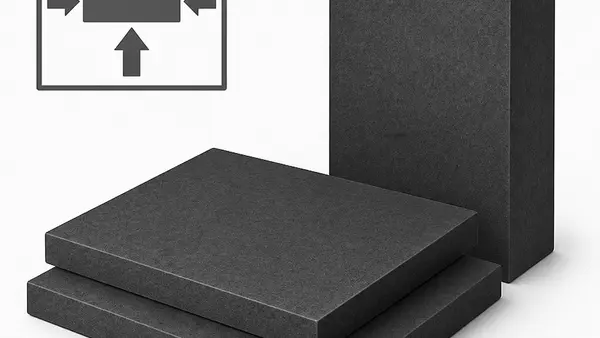
Non-graphitized carbon
[ Description ]
Structural thermal barrier — low conductivity
Structural thermal barrier
Carbon material with a less crystalline structure than graphitized technical graphite. Lower thermal conductivity makes it an efficient solution for structural thermal separation: it maintains dimensional stability, good mechanical strength and excellent machinability, with a favorable cost profile compared to highly conductive graphites when heat dissipation is not desired.
| Property | Typical range (ABR grade) |
|---|---|
| Bulk density | 1.60 g/cm³ |
| Max. grain size | 0.8 mm |
| Flexural strength | 22 MPa |
| Compressive strength | 64 MPa |
| Open porosity | 18 % |
| Ash content | 0.2 % |
Also available as denser, harder carbons (~1.62 g/cm³, ~10 W/m·K) for electrolysis anodes when low thermal conductivity is required.
Typical applications
- Separators and structural plates in furnaces
- Thermal barriers between process zones
- Supports in the glass industry and metallurgical processes
- Electrolysis anodes and extruded-carbon duties
- Cost-effective alternative when high conductivity is not required
Available in standard plates and blocks or machined parts to drawing. Inventory and CNC in García, N.L.
See also carbon-graphite mechanical and extruded graphite.
[ Build to print ]
Any grade in this family can also be delivered as a finished part: we CNC machine to your drawing, sample or 3D model. Tolerances, impregnation and finish are confirmed in technical review.
[ Applications ]
[ Advantages ]
- Lower thermal conductivity than graphite
- Good dimensional stability at elevated temperature
- Excellent machinability
- Cost-effective alternative when heat dissipation is not required
[ FAQ ]
View all FAQs[ Quote ]
Need the right specification—not just material?
Tell us your application. Engineering response in under 24 hours.