
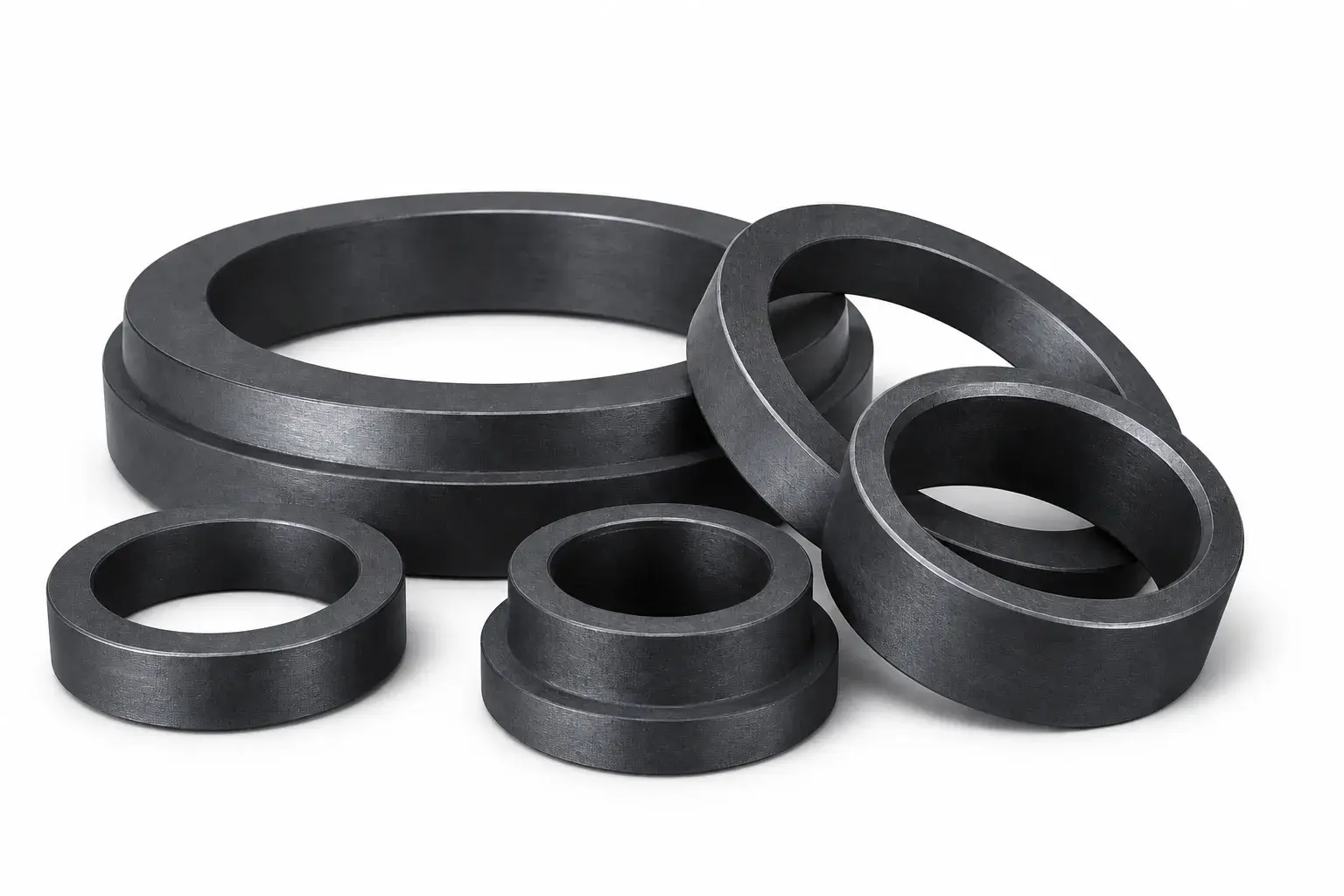
Valve seats
Seat sealing element
Also known as: Graphite valve seats · Carbon-graphite seats · Graphite valve seat rings · Carbon seat rings
[ Technical summary ]
Graphite and carbon-graphite valve seats are the surface the closure member shuts against. They are used when temperature or medium rules out a polymeric seat, and when a metal seat galls or distorts with cycling. Graphite holds dimensional stability at temperature and accepts a finish capable of sealing, with chemical resistance depending on the grade.
[ Problem it solves ]
Keep a valve shut across repeated open-and-close cycles at temperature, where a polymeric seat cannot survive and a metal seat tends to gall or lose geometry.
Processes
- Process valves
- Open/close cycles
Operating conditions
- High temperature
When it is suitable
- Service temperature exceeds the range of a polymeric seat
- The process medium attacks polymeric seats
- The metal seat galls or distorts with cycling
- Repeatable shut-off without lubricant at the seat is wanted
When it may not be suitable
- The seat must deform to seal over irregular geometry
- The flow drives abrasive particles against the seat
- There are impact or repeated shock loads
- There is severe oxidation in air at high temperature without protection or impregnation
Process challenges
- Seat leakage
- Thermal deformation
- Cycling wear
Advantages
- Thermal stability
- Good sealing with proper finish
- Chemical resistance depending on grade
Limitations
- Oxidation in air at high temperature without protection
- Lower mechanical strength than structural metals
- Requires grade selection by load and environment
[ Critical selection variables ]
These variables define the grade and the geometry. Actual values are confirmed against the grade datasheet.
- Operating temperatureDecisive
- Differential pressureDecisive
- Fluid or medium in contactDecisive
- Thermal and duty cyclingDecisive
- Flatness and surface finishDecisive
- Geometry and tolerancesRelevant
- Type of impregnationRelevant
[ Required material properties ]
Properties that guide selection. Numerical values come from each grade's datasheet.
Critical properties
- Wear resistance
- Compressive strength
- Flexural strength
- Thermal expansion
Secondary properties
- Impermeability
- Chemical resistance
- Dimensional stability
- Machinability
[ Related ]
[ Frequently asked questions ]
View all FAQsTechnical content reviewed by ESGRAF — Last reviewed: September 8, 2026
[ Quote ]
Need the right specification—not just material?
Tell us your application. Engineering response in under 24 hours.