
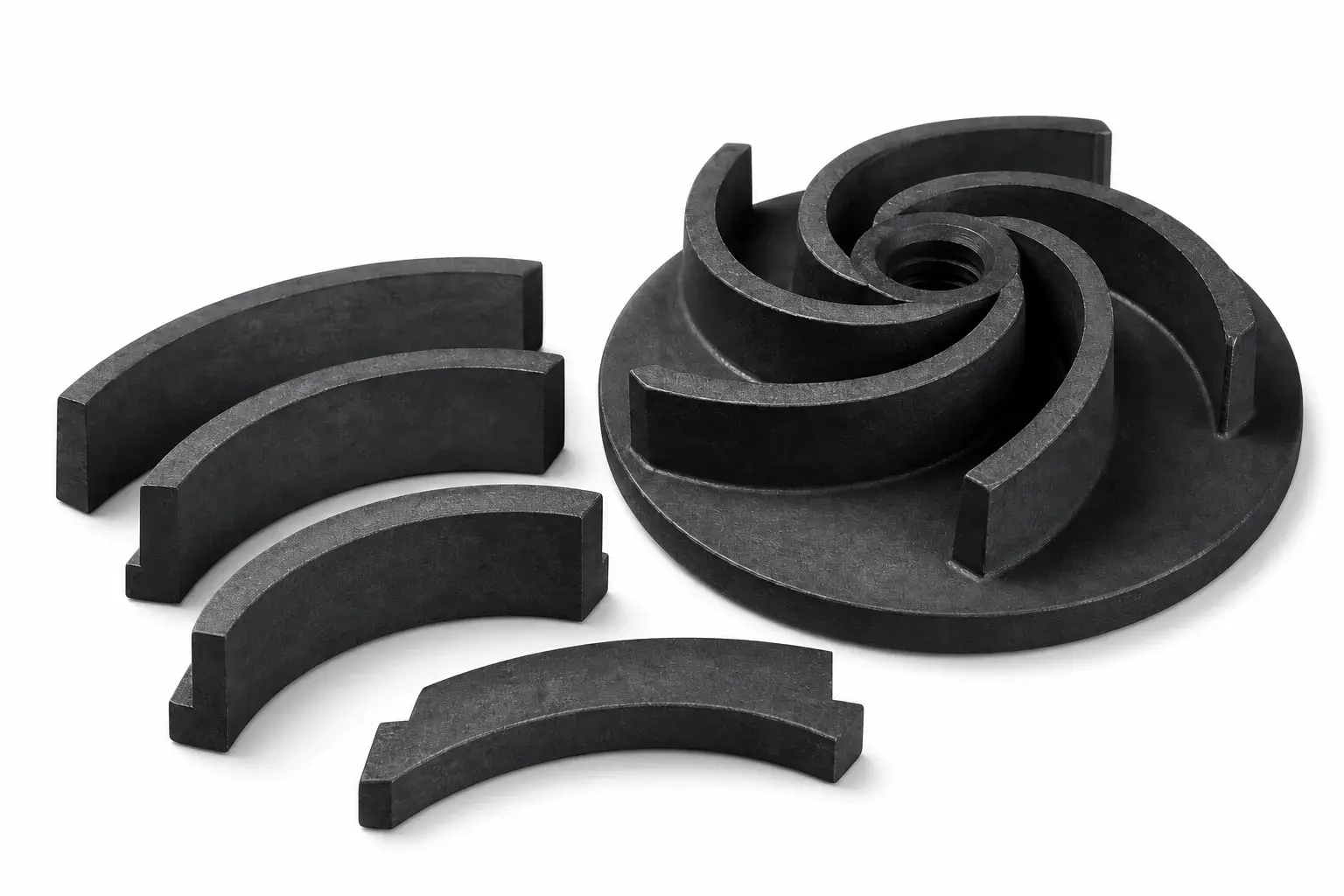
Centrifugal pump blades
Rotating pumping element
Also known as: Graphite vanes · Graphite pump blades · Carbon-graphite vanes · Graphite vacuum pump vanes · Graphite impellers
[ Technical summary ]
Graphite vanes and blades are the moving elements that displace fluid in vacuum pumps, vane pumps, and rotating equipment. Graphite and carbon-graphite are used when the vane must slide against the stator without oil, withstand corrosive media, or avoid contaminating the fluid. Some designs machine the complete impeller or rotor, although the replaceable vane remains the most common part.
Replaceable graphite/carbon-graphite vanes are the most common wear part in vacuum pumps, blowers, and rotating equipment exposed to wear or corrosion. Some designs also use a fully machined graphite impeller or rotor (less common than individual vanes; steel rotors with vane slots remain typical).
[ Problem it solves ]
Sustain the continuous sliding contact between vane and stator in pumps that run oil-free, or whose fluid tolerates neither lubricant nor metallic wear debris.
Processes
- Centrifugal pumping
- Positive displacement
Operating conditions
- Abrasive or corrosive media
When it is suitable
- The pump runs dry, without oil in the chamber
- The pumped fluid is corrosive or must stay oil-free
- Wear of metal vanes forces frequent shutdowns
- Modular replacement of the wear part is required
When it may not be suitable
- The fluid carries a significant amount of abrasive solids
- There are impact or repeated shock loads
- The design requires the ductility of a metal vane
- There is severe oxidation in air at high temperature without protection or impregnation
Process challenges
- Accelerated wear of metal vanes
- Corrosion
- Fluid contamination
Advantages
- Wear resistance
- Self-lubrication
- Dimensional stability
Limitations
- Oxidation in air at high temperature without protection
- Lower mechanical strength than structural metals
- Requires grade selection by load and environment
[ Critical selection variables ]
These variables define the grade and the geometry. Actual values are confirmed against the grade datasheet.
- Rotational speedDecisive
- Fluid or medium in contactDecisive
- Geometry and tolerancesDecisive
- Operating temperatureDecisive
- Counterface material and finishRelevant
- Presence of abrasives or solidsRelevant
- Clearance and type of fitRelevant
[ Required material properties ]
Properties that guide selection. Numerical values come from each grade's datasheet.
Critical properties
- Friction coefficient
- Wear resistance
- Compressive strength
- Flexural strength
Secondary properties
- Self-lubrication
- Chemical resistance
- Dimensional stability
- Machinability
[ Related ]
[ Frequently asked questions ]
View all FAQsTechnical content reviewed by ESGRAF — Last reviewed: September 8, 2026
[ Quote ]
Need the right specification—not just material?
Tell us your application. Engineering response in under 24 hours.