
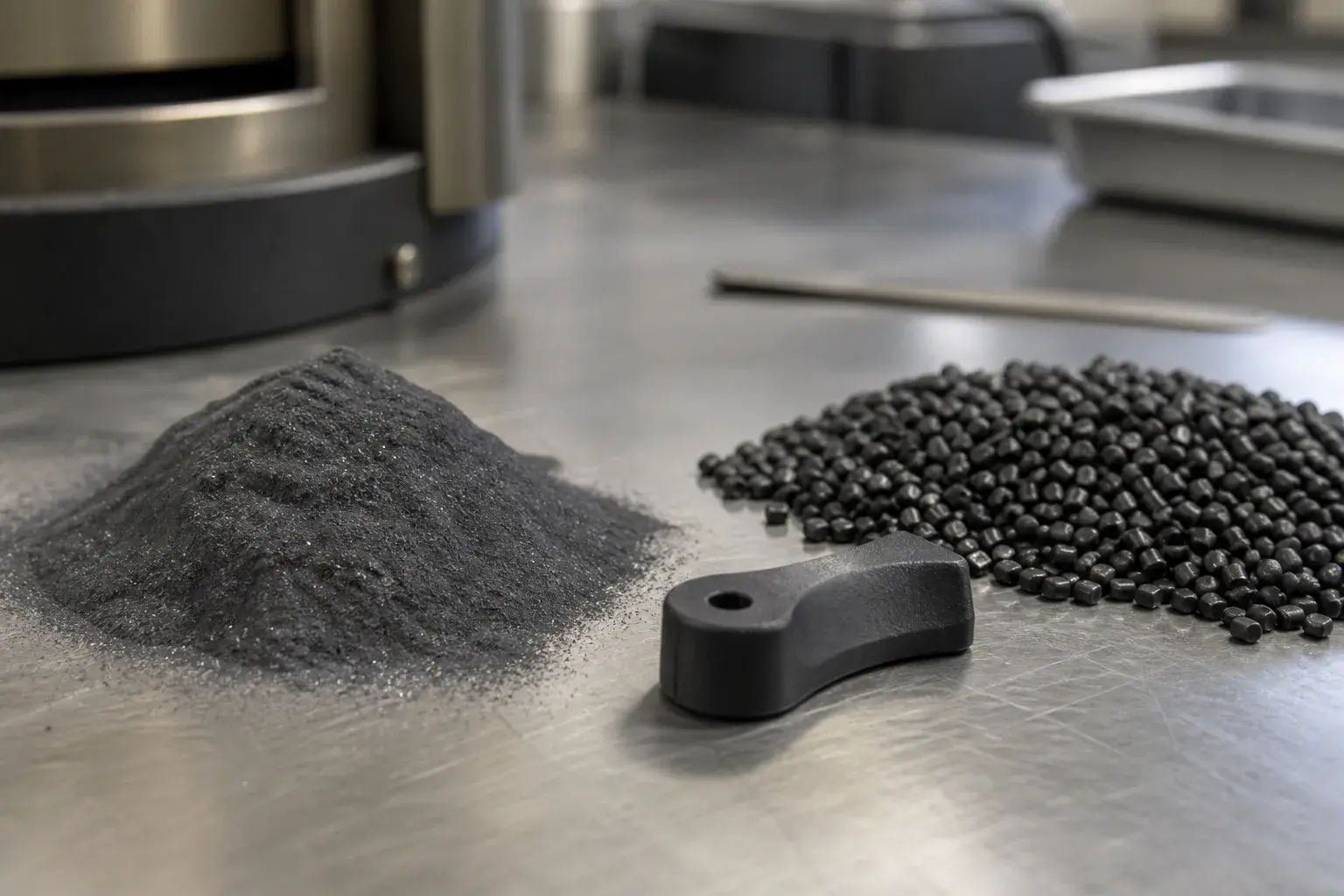
Plastics lubricant additive
Polymer compound additive
Also known as: Graphite as an additive for plastics · Lubricating filler for polymer compounds · Anti-friction additive for thermoplastics · Graphite for plastic friction parts
[ Technical summary ]
A plastic part working in dry friction depends on what happens at its own surface, because there is no external lubricant to protect it. Adding graphite to the compound distributes the solid lubricant through the whole mass, so wear keeps exposing lubricated material instead of leaving the part unprotected. It is the usual route for injection-moulded bushings, gears, and guides that must run maintenance-free.
[ Problem it solves ]
Give the plastic part its own lubrication distributed through its mass, so that wear does not leave it unprotected in a service with no external lubricant.
Operating conditions
- Plastics compounding
- Injection and extrusion
- Dry-friction parts
When it is suitable
- The part works in dry friction with no external lubricant
- Wear of the plastic part is premature
- The design requires maintenance-free operation
- The compound accepts a solid filler without losing processability
When it may not be suitable
- The formulation requires a light colour or transparency
- The effect cannot be validated with tests on the actual formulation
- The loading required would reduce mechanical strength below what is needed
Process challenges
- High friction in plastic parts
- Premature wear
- Need for external lubrication
Advantages
- Internal/external lubrication
- Wear improvement
- Thermal stability of graphite
Limitations
- Not a hydrodynamic oil lubricant
- May stain light-colored surfaces
- Performance depends on surface preparation and reapplication
[ Critical selection variables ]
These variables define the grade and the geometry. Actual values are confirmed against the grade datasheet.
- Base matrix or resinDecisive
- Dosage and application frequencyDecisive
- Particle sizeDecisive
- Operating temperatureRelevant
- Load and its distributionRelevant
- Sliding speedRelevant
[ Required material properties ]
Properties that guide selection. Numerical values come from each grade's datasheet.
Critical properties
- Friction coefficient
- Particle size distribution
- Self-lubrication
- Dispersibility
Secondary properties
- Wear resistance
- Thermal conductivity
[ Related ]
Industries
[ Frequently asked questions ]
View all FAQsTechnical content reviewed by ESGRAF — Last reviewed: September 8, 2026
[ Quote ]
Need the right specification—not just material?
Tell us your application. Engineering response in under 24 hours.