
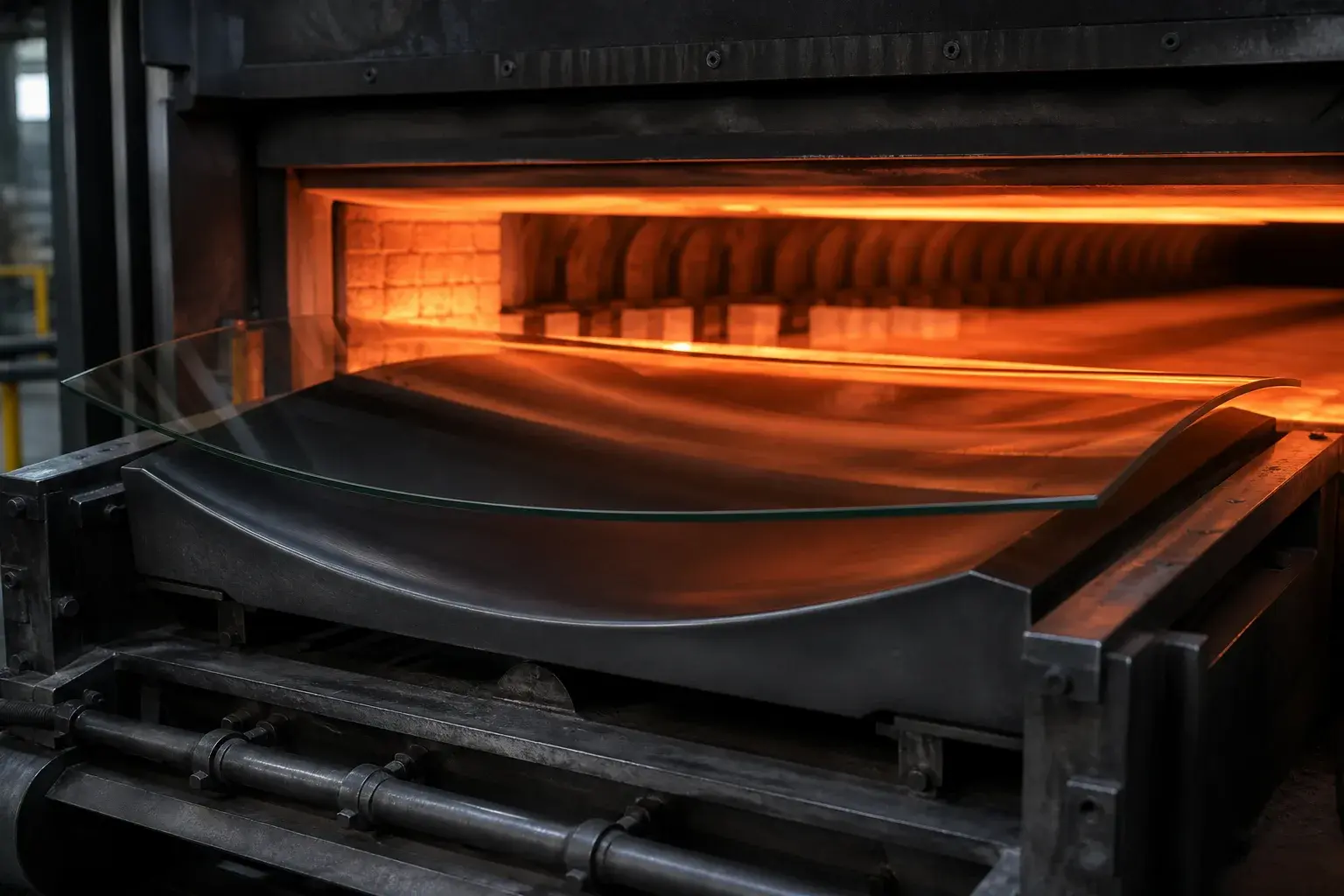
Glass mold release
Glass mould release coating
Also known as: Graphite release agent for glass · Coating for bending moulds · Non-stick paint for glass moulds · Release agent for glass tempering
Anti-stick graphite coating for glass bending and forming molds.
[ Technical summary ]
In glass bending and forming, the mould surface is reproduced on the part, so any defect in the film becomes a visible optical mark. A graphite coating leaves a uniform, non-stick layer between mould and hot glass, preventing both sticking and the imprint of mould texture. It is applied by brush or spray and must survive thermal cycles without flaking or transferring residue to the part.
Hot glass copies any defect in the mold and sticks to the metal surface unless something separates them. A graphite coating provides an even anti-stick layer that lets glass bend and release without marking the part, and it absorbs the thermal shock of each cycle without flaking off.
Selection and application
The thermal cycle, mold geometry, and required glass finish set the film thickness and reapplication interval. Apply by brush or spray onto a clean, dry mold. ESGRAF supplies HIDROCOLAGE for automotive and architectural glass bending and release, also packed as GRAFOGLAS.
[ Problem it solves ]
Keep glass from sticking to the mould and mould texture from marking the part, in a process where a surface defect is visible and cause for rejection.
Operating conditions
- Glass bending
- Forming and tempering
- Glass mold release
- Mold coating
When it is suitable
- Glass sticks to the mould during bending or forming
- Optical marks appear that trace back to mould contact
- The mould must be coated uniformly before each run
- The coating must survive several cycles without flaking
When it may not be suitable
- The part tolerates no trace that would need cleaning afterwards
- The mould cannot be prepared or preheated before application
- The product cannot be validated in the plant before adopting it in production
Process challenges
- Marks and optical defects in the glass
- Glass sticking to the mold
- Thermal shock on the mold
- Residue transferring to the part
Advantages
- Fast-drying anti-stick film
- Even surface without marking
- Withstands thermal cycling
- Applied by brush or spray
Limitations
- Requires a clean, dry mold
- Reapplication depends on production cycles
- Optical finish requires validating film thickness
[ Critical selection variables ]
These variables define the grade and the geometry. Actual values are confirmed against the grade datasheet.
- Operating temperatureDecisive
- Application methodDecisive
- Film thicknessDecisive
- Surface finish required on the partDecisive
- Glass compositionRelevant
- Reapplication frequencyRelevant
- Thermal and duty cyclingRelevant
[ Required material properties ]
Properties that guide selection. Numerical values come from each grade's datasheet.
Critical properties
- Lubricating film formation
- Thermal stability
- Particle size distribution
- Non-wetting by molten metal
Secondary properties
- Dispersibility
- Thermal shock resistance
[ Related ]
[ Frequently asked questions ]
View all FAQsTechnical content reviewed by ESGRAF — Last reviewed: September 8, 2026
[ Quote ]
Need the right specification—not just material?
Tell us your application. Engineering response in under 24 hours.