
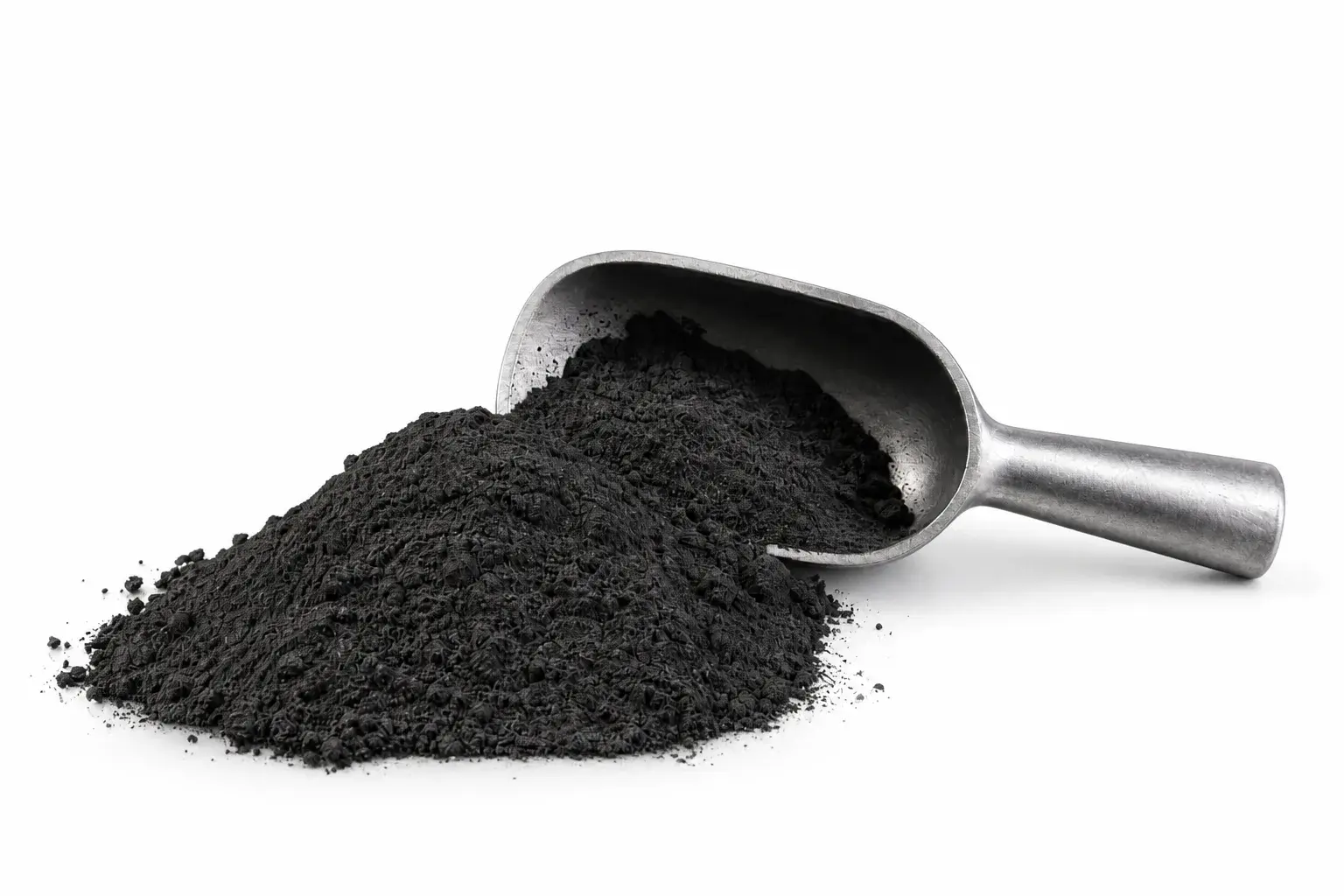
Foundry additive
Carbonaceous process additive
Also known as: Graphite recarburizer · Carbon additive for foundries · Graphite for moulding sands and coatings · Graphite powder for foundry use
[ Technical summary ]
In foundries, graphite is used as powder or granulate with two distinct roles: as a carbon source that adjusts the composition of the bath, and as a component of moulding sands, coatings, and dispersions, where its lubricity and non-wetting character improve release and part finish. Selection is by particle size, carbon and ash content, and by how it is incorporated into the process.
[ Problem it solves ]
Add carbon to the process in a controlled way — to the bath or to the mould surface — without introducing impurities that alter the composition or finish of the casting.
Operating conditions
- Foundry / casting
- Formulation
When it is suitable
- The bath composition requires a carbon adjustment
- The moulding sand or coating needs a carbonaceous component
- Release and surface finish of the casting must improve
- The process accepts powder or granulate addition
When it may not be suitable
- The alloy cannot tolerate variation in carbon content
- The process requires ash or sulphur levels below what can be verified
- Dust handling cannot be controlled at the point of application
Process challenges
- Wetting
- Casting quality
Advantages
- Carbon pickup
- Mold-release improvement depending on use
Limitations
- Wear from erosion and thermal shock
- Possible metal contamination if the grade is unsuitable
- Service life depends on cycles and metal flow
[ Critical selection variables ]
These variables define the grade and the geometry. Actual values are confirmed against the grade datasheet.
- Particle sizeDecisive
- Required purity and allowable contaminationDecisive
- Dosage and application frequencyDecisive
- Application methodDecisive
- Molten metal or alloy in contactRelevant
- Operating temperatureRelevant
[ Required material properties ]
Properties that guide selection. Numerical values come from each grade's datasheet.
Critical properties
- Non-wetting by molten metal
- Purity
- Ash content
- Particle size distribution
Secondary properties
- Dispersibility
- Thermal stability
[ Related ]
Materials
Products
[ Frequently asked questions ]
View all FAQsTechnical content reviewed by ESGRAF — Last reviewed: September 8, 2026
[ Quote ]
Need the right specification—not just material?
Tell us your application. Engineering response in under 24 hours.