How to specify a graphite block: order parameters that matter
Published on 7/3/2026· Updated on 7/3/2026
Checklist to specify a graphite block: dimensions, density, grain, porosity, strength, format, and atmosphere. Clear data so ESGRAF can quote accurately.

Ordering “a graphite block” without parameters is like ordering “a steel plate” without grade or thickness. Purchasing gets incomparable quotes; engineering gets material that will not hold tolerance or process atmosphere.
This guide focuses on how to specify a graphite block with an order-parameter checklist. It complements —does not replace— how to choose an industrial graphite grade, which organizes the decision by family and application.
The problem: specifying only by brand or size
In many plants the PO lists only a commercial code or “block 300 × 200 × 100.” Density, grain, porosity, orientation, or atmosphere are missing. The result: material that “almost fits” but fails in CNC, EDM, sealing, or temperature.
A specialist asks for the job the block must do and the numbers that define the blank, not only the catalog name.
What a “block” means in purchasing practice
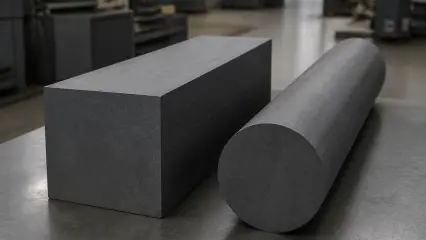
In technical graphite supply, format may be block, plate, round or rectangular bar, tube, or cut-to-size. “Block” usually means a prism for later machining —in-house or via block, bar, and plate cutting.
Before listing properties, fix:
- Format (block, plate, bar, tube)
- Dimensions L × W × T (or diameter and length) in mm (in)
- Quantity and target date
- Whether the blank is machined later or used as-is
Order parameters that matter (and why)
Blank dimensions and tolerance
They define whether the stock reaches the finished part after CNC stock removal or EDM tip wear. Include machining allowance if needed. Without supply tolerance, two “same size” quotes are not equivalent.
Apparent density
Density relates to blank solidity, machinability, and, in many grades, the porosity/strength balance. Use it as a comparison anchor between offers, not as the only criterion.
In high-density families, typical datasheet ranges may sit around 1.78–1.90 g/cm³; extruded grades often show lower typical densities (for example on the order of 1.65–1.75 g/cm³). The contractual value is the quoted grade.
Grain size
Influences machinable detail, surface finish, and EDM behavior. Fine grain favors detail; coarser grain appears in many volume formats. For electrodes, also see selecting graphite for EDM.
Open porosity
Affects hermeticity, later impregnation, fluid retention, and how the environment attacks the material at temperature. If the part seals or works with fluids, do not omit this.
Flexural strength (and compression if relevant)
Helps when there is mechanical load, cantilevers, or breakage risk in machining/service. Extruded flexural ranges on datasheets often differ from precision isostatic grades: always compare within the same forming family.
Orientation / anisotropy
In extruded graphite, properties change with grain direction. State how the part is mounted or machined relative to the extrusion axis. In isostatic / high-density stock the response is usually more uniform, but the drawing still rules.
Impregnation (yes / no and type)
If the blank must be impregnated (resin or metal) or will be impregnated later, say so on the order. It changes density, porosity, and service limits. See mechanical carbon-graphite (impregnated grades in catalog).
Service atmosphere and temperature
Air, vacuum, inert gas, or reducing atmospheres change oxidation and life. Without this, two grades that look equivalent cold can behave differently in a furnace. See graphite oxidation in uncontrolled atmospheres.
Quantity, certification, and brand equivalence
State whether you need a lot certificate, equivalence to a MERSEN, SGL, Toyo, or other grade, or performance only. Equivalence is validated by properties, not name alone.
Checklist ready to send for a quote
Copy and complete:
- Application and current issue (if failing)
- Format and dimensions (mm / in) + blank tolerance
- Target or reference apparent density
- Grain size / open porosity (if known)
- Relevant mechanical strength
- Grain orientation (if extruded)
- Impregnation: none / resin / metal
- Temperature and atmosphere
- Quantity and date
- Reference grade or brand (a datasheet photo helps)
To choose the material family before the blank, use material selection and the grade selection guide.
Limitations to consider
- Do not invent “internet numbers” if they are not on your datasheet or quote.
- Two blocks with the same size can differ in grain and porosity.
- Stock and lead time depend on format; a clear spec speeds the proposal but does not guarantee immediate inventory.
- CNC machining adds its own tolerances on top of the blank.
FAQ
Is the grade code enough?
It helps, but without dimensions, quantity, and service conditions the quote is still incomplete. A code without format does not define the blank.
What comes first: family or checklist?
If you do not know whether you need isostatic, extruded, or carbon-graphite, start with the grade guide. If you already know the family, the parameter checklist closes the PO.
Can I quote with only L × W × T?
Yes as a first contact, but expect follow-up on density, grain, and application. The fuller the checklist, the fewer loops.
Does ESGRAF cut blocks to size?
Yes. Block, bar, and plate cutting starts from a clear format and dimension spec.
Where do I see typical property ranges?
On materials product pages and in commercial advice by grade. Catalog ranges orient; the contractual value is on the quote.
Request a quote
If you need to specify a graphite block with clear parameters, request a quote or contact us with the checklist above. A specialist will help align blank, grade, and cutting or CNC when needed.