How to choose the right industrial graphite grade
Published on 8/26/2026· Updated on 8/26/2026
Practical guide to selecting an industrial graphite grade: forming process, density, grain, impregnation, application, and what ESGRAF needs to quote.

Choosing an industrial graphite grade is not about picking the “purest” block in a catalog. The right grade supports your process temperature, load, atmosphere, and tolerance without overpaying or underperforming.
This guide turns the decision into clear steps: what problem you solve, which material family fits, and what to send ESGRAF for a grounded recommendation.
The problem: specifying by brand or by habit
In many plants the grade is inherited from an old drawing, a previous supplier, or a generic table. When material fails — early wear, oxidation, EDM tip wear, thermal cracking — teams ask for “the same but better” without reviewing real conditions.
A specialist starts the other way: application → conditions → process family → grade and format.
Step 1: define the job graphite must do
Before talking codes, summarize the function in one sentence:
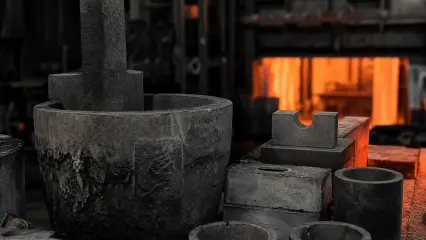
- Transfer or withstand heat (furnaces, crucibles, elements)
- Conduct current or serve as an electrode (EDM, contacts)
- Reduce friction or seal (bushings, seals, vanes)
- Act as a mold or contact surface with metal/glass
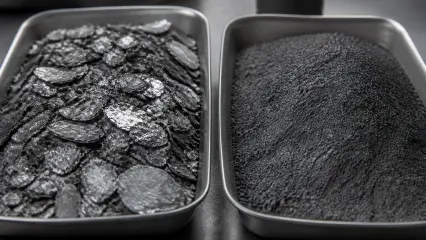
- Serve as powder or lubricant in process
That function narrows whether you look at solid technical graphite, graphite powders, lubricants, or already machined components.
Step 2: pick the process family (not only the trade name)
In solid technical graphite, the most used families are:
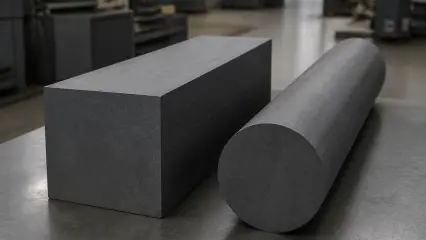
- Extruded — bars, tubes, and profiles; more directional properties. See extruded.
- Isostatic / isomolded — higher uniformity and fine grain for precision and EDM. See isostatic.
- Molded / vibro-molded — large formats or parts where volume matters.
- EDM — grades oriented to electrical discharge machining.
- Impregnated (resin or metal) — when open porosity, sealing, or extra mechanical strength matter.
- Mechanical carbon-graphite — friction pairs and seals.
If your spec only says “synthetic graphite,” you still need to decide process and grain size.
Step 3: map properties to your process
Do not memorize datasheets: link each property to a practical effect.
| Property | Practical question |
|---|---|
| Density / porosity | Do you need fewer pores or higher mechanical strength? |
| Grain size | Are you machining fine detail or large robust sections? |
| Thermal conductivity | Should heat spread — or be limited in one direction? |
| Mechanical strength | Is there thermal shock, pressure, or bending? |
| Ash / purity | Does the process contaminate easily or need a clean atmosphere? |
| Anisotropy | Is the part always oriented the same way relative to load? |
| Impregnation | Are there fluids, vacuum, or a need to seal pores? |
Atmosphere (air, vacuum, inert gas) and maximum working temperature weigh as much as nominal density.
Step 4: decide format and service
The grade travels in a concrete format:
- Blocks, plates, bars, tubes, and cut-to-size stock
- Components: bushings, electrodes, crucibles and molds, custom parts
If you machine in-house, confirm machinability and scrap. If you prefer a finished part, request graphite machining from a drawing or sample.
Step 5: when there is an international brand reference
Many specs cite an international manufacturer (MERSEN, SGL, Toyo Tanso, Nippon Graphite, Ibiden, Entegris POCO, Graftech, and others). At ESGRAF we listen to the application and propose original and/or equivalent grades with local inventory. We do not rank brands against each other or assume equivalence from a similar-sounding name alone.
More context in original and equivalent grades from international manufacturers and Graphite Mexico.
Common grade-selection mistakes
- Buying isostatic “just in case” when oriented extruded stock is enough
- Ignoring grain direction on anisotropic parts
- Asking for maximum purity without reviewing oxidizing atmosphere or impregnation
- Quoting dimensions only, without tolerance or finish
- Switching suppliers without sharing a datasheet or sample of the current material
Limitations
No guide replaces application review. The same grade can work in a furnace and fail in a mechanical seal. ESGRAF recommendations follow the data you share; incomplete conditions produce tentative options, not a locked specification.
Information needed for a quote
- Function of the part, powder, or lubricant
- Temperature, atmosphere, load, speed, chemical media
- Drawing, CAD, sample, or dimensions
- Tolerances, finish, and quantity
- Current grade or brand reference
- Observed issue (wear, tip wear, oxidation, cracking, contamination)
FAQ
What is a graphite “grade”?
It is a commercial designation tied to a manufacturing process and a property range (density, grain, porosity, and so on). It is not a generic label for “soft graphite.”
Should I start with isostatic or extruded?
It depends on anisotropy, format, and precision. If unsure, read isostatic vs extruded and send the drawing.
Is higher density always better?
No. Higher density helps many mechanical or precision parts, but process, grain, and atmosphere also govern. Sometimes an impregnated grade or carbon-graphite is a better fit.
Can I choose from a property table alone?
Tables guide; they do not replace the application. Two grades with similar density can machine or oxidize differently.
Does ESGRAF recommend a grade or only sell what I ask for?
Both paths exist. If you bring a locked grade, we quote that material or a justified alternative. If you bring the process problem, we help select.
Request a quote
Share application, dimensions, and reference grade via quote or contact. A specialist will help you choose the industrial graphite grade that fits your process — not only the catalog name.