
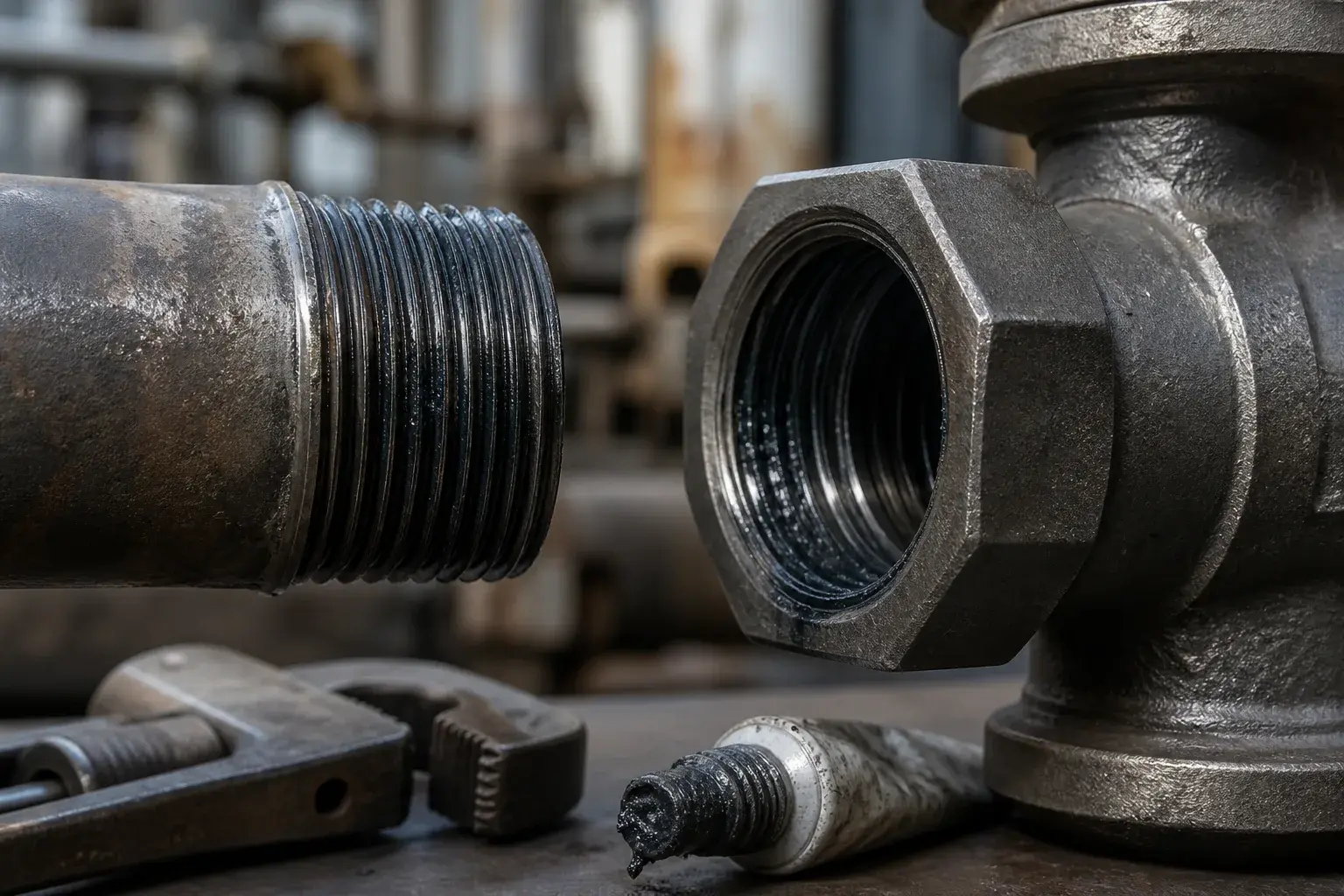
Thread sealing and lubrication
Sealing and anti-seize compound
Also known as: Graphite thread paste · Graphite anti-seize · High-temperature thread sealant · Anti-seize compound for studs
Graphite paste that seals and lubricates threaded joints exposed to high temperature and pressure.
[ Technical summary ]
A threaded joint working hot presents two problems at once: leakage along the thread and seizing between the contacting surfaces, which turns disassembly into a destructive operation. Graphite paste addresses both: it fills the thread to close the fluid path and leaves a solid film that prevents cold welding between threads. Unlike organic sealants, graphite does not degrade with heat, so the joint remains removable.
A threaded joint in hot service has to solve two problems at once: it must stay leak-tight, and it must come apart months or years later. Graphite pastes cover both, because graphite neither degrades nor hardens with heat the way organic sealants do, and it keeps the thread lubricated for disassembly.
Selection and application
Operating temperature, pressure, and process fluid determine whether a graphite paste works alone or alongside gaskets. Apply it to a clean, dry thread, covering the full flank. ESGRAF supplies graphite paste for valves, piping, and process equipment.
[ Problem it solves ]
Seal and lubricate the thread of a hot threaded joint in a single application, preventing both leakage and the seizing that makes removal impossible without damaging the thread.
Operating conditions
- Threaded joint sealing
- Valve and piping assembly
- Stud anti-seize
- Process maintenance
When it is suitable
- The threaded joint works at temperature and pressure
- Threads seize and disassembly becomes destructive
- The conventional sealant degrades with service heat
- The joint must be opened periodically for maintenance
When it may not be suitable
- Compatibility with the process fluid has not been verified
- The thread is dirty, damaged, or cannot be cleaned before application
- The joint requires a gasket or packing rather than a thread sealant
Process challenges
- Thread seizing and galling
- Joint leakage
- Destructive disassembly
- Sealant degrading with heat
Advantages
- Seals and lubricates in one application
- Stable at high temperature and pressure
- Allows later disassembly
- Compatible with steel and alloys
Limitations
- Does not replace flange gaskets or packing
- Process fluid compatibility must be validated
- Apply only to a clean thread
[ Critical selection variables ]
These variables define the grade and the geometry. Actual values are confirmed against the grade datasheet.
- Operating temperatureDecisive
- Fluid or medium in contactDecisive
- Differential pressureDecisive
- Geometry and tolerancesRelevant
- Application methodRelevant
- Substrate or surface to be treatedRelevant
[ Required material properties ]
Properties that guide selection. Numerical values come from each grade's datasheet.
Critical properties
- Thermal stability
- Chemical resistance
- Lubricating film formation
- Self-lubrication
Secondary properties
- Friction coefficient
- Particle size distribution
[ Related ]
[ Frequently asked questions ]
View all FAQsTechnical content reviewed by ESGRAF — Last reviewed: September 9, 2026
[ Quote ]
Need the right specification—not just material?
Tell us your application. Engineering response in under 24 hours.