
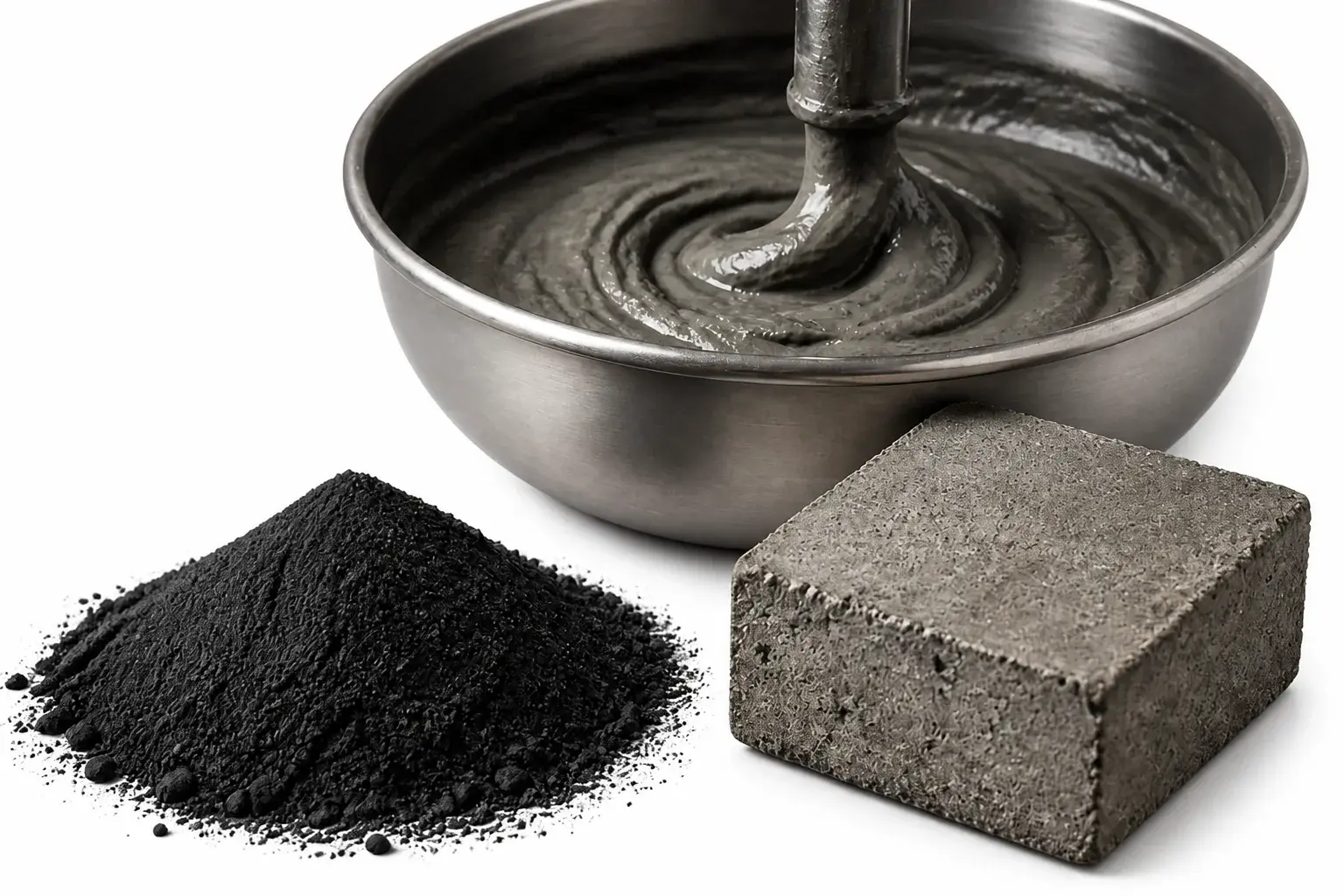
Mortar graphite additive
Cementitious mix additive
Also known as: Graphite for mortars · Carbon additive for cementitious mixes · Graphite filler for construction · Powdered graphite for mortar
[ Technical summary ]
In mortar formulations, graphite is used as an inert filler that modifies mix properties: it affects the workability of the fresh mix and, depending on dosage, the thermal or electrical behaviour of the hardened material. Being chemically inert it does not react with the cement, so its effect is physical and depends on dosage, particle size, and dispersion quality in the mix.
[ Problem it solves ]
Adjust mortar properties with an inert filler that does not react with the cement, when the change sought is physical rather than chemical.
Operating conditions
- Mortar formulation
- Construction
- Cementitious mixes
When it is suitable
- The formulation seeks to modify properties without altering cement chemistry
- The mortar needs a workability adjustment
- Thermal or electrical behaviour of the hardened mix must be modified
- The mix allows a powder filler to be incorporated and dispersed
When it may not be suitable
- The formulation requires a light colour or transparency
- The effect cannot be validated with tests on the actual formulation
- The dosage required would compromise the mechanical strength of the mortar
Process challenges
- Workability
- Mix properties
- Additive dispersion
Advantages
- Property modification by dose
- Chemically inert
- Easy incorporation as powder
Limitations
- Dose must be validated in the lab
- Does not replace mortar design
- May affect coloration
[ Critical selection variables ]
These variables define the grade and the geometry. Actual values are confirmed against the grade datasheet.
- Base matrix or resinDecisive
- Dosage and application frequencyDecisive
- Particle sizeDecisive
- Application methodRelevant
- Humidity and ambient conditionsRelevant
[ Required material properties ]
Properties that guide selection. Numerical values come from each grade's datasheet.
Critical properties
- Particle size distribution
- Dispersibility
- Chemical resistance
- Purity
Secondary properties
- Thermal conductivity
[ Related ]
[ Frequently asked questions ]
View all FAQsTechnical content reviewed by ESGRAF — Last reviewed: September 8, 2026
[ Quote ]
Need the right specification—not just material?
Tell us your application. Engineering response in under 24 hours.