
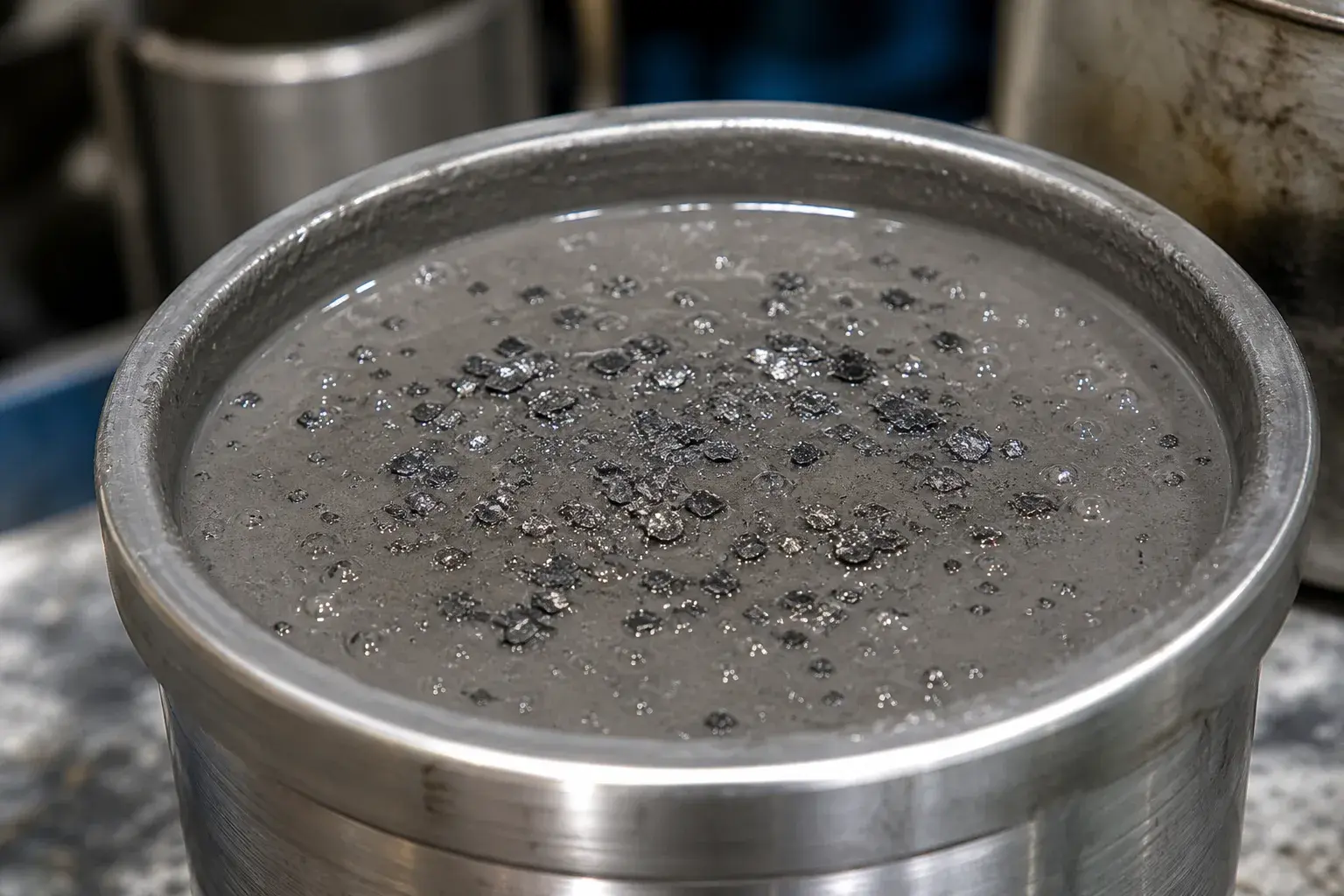
Drilling mud additive
Lubricity additive for drilling fluids
Also known as: Graphite for drilling muds · Lubricity additive for drilling fluid · Torque and drag reducer · Graphite for wellbore fluids
[ Technical summary ]
In directional drilling the string rubs against the wellbore wall over long intervals, and that friction translates into torque and drag that limit progress. Graphite is added to the mud as a lubricity additive: its particles sit at the interface between string and formation, lowering the friction coefficient. Being thermally stable, it keeps that function at bottomhole temperature.
[ Problem it solves ]
Reduce string torque and drag against the wellbore wall, which limit progress and increase tool wear in directional drilling.
Operating conditions
- Well drilling
- Mud lubrication
- Drill-string friction control
When it is suitable
- Torque and drag limit drilling progress
- The well has long directional or horizontal sections
- Bottomhole temperature degrades organic lubricity additives
- The mud system accepts a solid additive in suspension
When it may not be suitable
- The effect cannot be validated with tests on the actual formulation
- The mud system cannot tolerate additional suspended solids
- Torque comes from wellbore geometry rather than fluid friction
Process challenges
- High friction in the drill string
- Tool wear
- High torque and drag
Advantages
- Mud lubricity improvement
- Thermal stability of graphite
- Compatible with typical mud formulations
Limitations
- Does not replace drilling-fluid design
- Dose and particle size must be validated in the field
- May affect rheology if overdosed
[ Critical selection variables ]
These variables define the grade and the geometry. Actual values are confirmed against the grade datasheet.
- Carrier or formulation baseDecisive
- Dosage and application frequencyDecisive
- Particle sizeDecisive
- Operating temperatureRelevant
- Presence of abrasives or solidsRelevant
- Required purity and allowable contaminationRelevant
[ Required material properties ]
Properties that guide selection. Numerical values come from each grade's datasheet.
Critical properties
- Friction coefficient
- Thermal stability
- Particle size distribution
- Self-lubrication
Secondary properties
- Dispersibility
- Chemical resistance
[ Related ]
[ Frequently asked questions ]
View all FAQsTechnical content reviewed by ESGRAF — Last reviewed: September 8, 2026
[ Quote ]
Need the right specification—not just material?
Tell us your application. Engineering response in under 24 hours.