
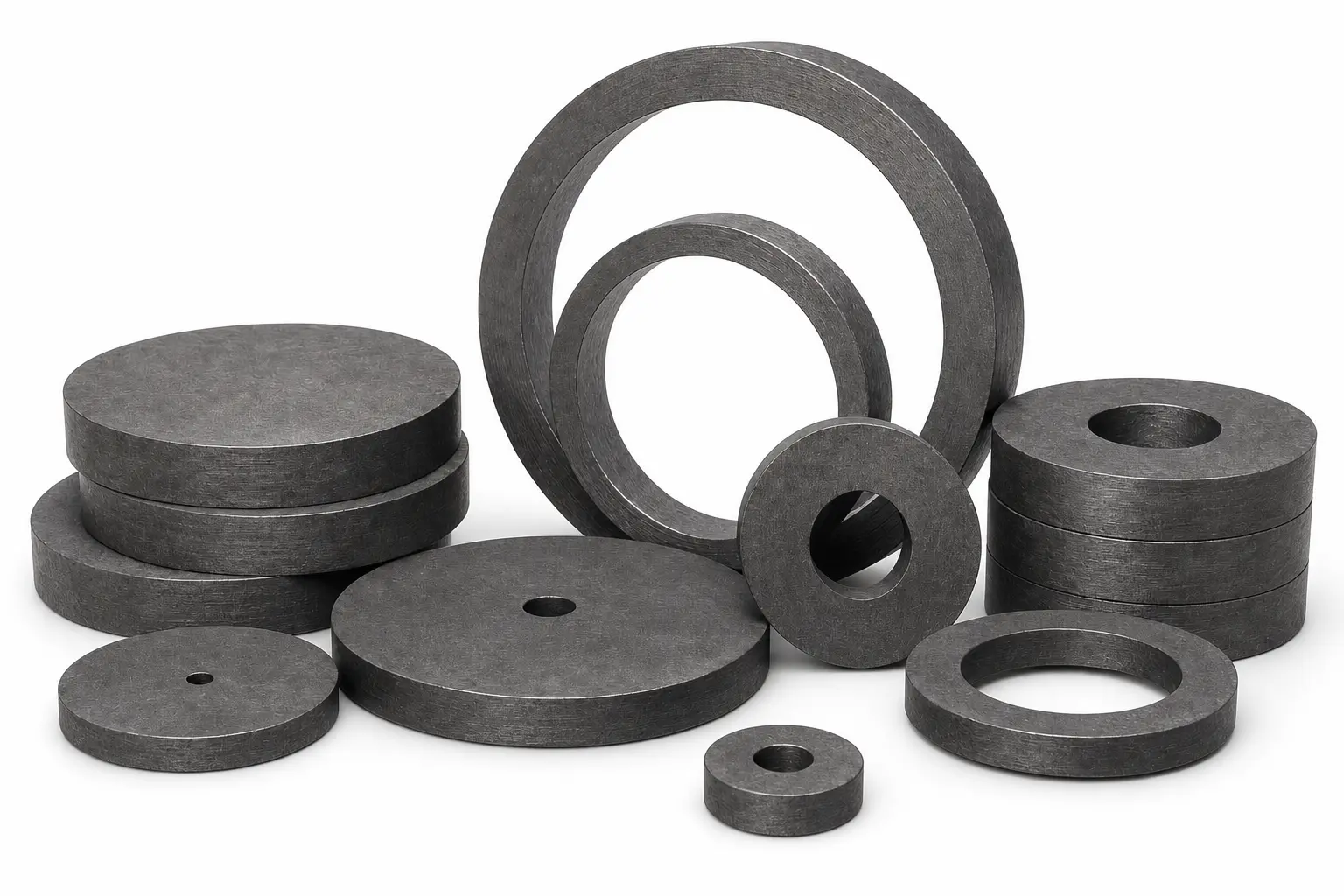
Susceptors and wafer carriers
Process component for epitaxy and CVD
Also known as: Graphite susceptors · Graphite wafer carriers · CVD boats · Epitaxy platens
Machined isostatic graphite parts that hold and heat wafers in epitaxy and CVD.
[ Technical summary ]
In epitaxy and CVD the susceptor or wafer carrier holds the substrate, transfers heat and sets deposit uniformity. Isostatic graphite is used because it combines thermal conductivity, dimensional stability at temperature and the ability to machine disc, platen or boat geometries. Grade selection follows purity, grain size and dimensional stability; an unsuitable grade introduces particles or shape drift during the cycle.
The place is an epitaxy reactor or a CVD chamber. The application is the graphite susceptor, wafer carrier or boat that holds the substrate and transfers heat.
This part is not a hot-pressing die, not a heat-treatment furnace liner, and not a mould-release coating. It is a high-purity process component, made to drawing.
ESGRAF machines susceptors, discs, platens and boats from high-purity isostatic graphite. State the process (epitaxy, CVD, LPCVD), atmosphere, temperature, geometry and purity requirement to quote.
[ Problem it solves ]
Hold and heat the wafer uniformly, without contaminating the process with impurities or particles from the tooling itself.
Processes
- Silicon or SiC epitaxy
- CVD and LPCVD
- Wafer support and heating
Operating conditions
- Vacuum or inert or reducing atmosphere
- High process temperature
- Low-contamination requirement
When it is suitable
- The process heats or deposits on a wafer in vacuum or controlled atmosphere
- A graphite platen, disc or boat with defined geometry is required
- Contamination from tooling particles or impurities is a reject criterion
- A drawing, sample or dimensions of the part to replace are available
When it may not be suitable
- The process runs in air at high temperature without a protective atmosphere
- The specification requires an SiC coating or a purified grade that available material does not meet
- The part is a pressing die, a furnace liner or a mould-release coating
Process challenges
- Wafer contamination by particles or impurities
- Dimensional drift of the susceptor with cycling
- Insufficient thermal uniformity across the substrate
Advantages
- High-purity isostatic graphite
- Geometry machined to drawing
- Dimensional stability at temperature
Limitations
- Oxidation in air at high temperature
- An SiC coating or ppm-level purification is reviewed against the available grade; it is not assumed from the catalog
- The reactor electrical and thermal design is set by the tool, not by the material alone
Selection factors
- Grade purity and ash content
- Grain size and surface finish
- Dimensional stability through the cycle
- Susceptor or boat geometry
[ Critical selection variables ]
These variables define the grade and the geometry. Actual values are confirmed against the grade datasheet.
- Process (epitaxy, CVD, LPCVD)Decisive
- Required purity and allowable contaminationDecisive
- Operating temperatureDecisive
- Atmosphere (vacuum, inert, reducing)Decisive
- Geometry and tolerancesDecisive
- Wafer diameter and number of seatsRelevant
[ Required material properties ]
Properties that guide selection. Numerical values come from each grade's datasheet.
Critical properties
- Purity
- Dimensional stability
- Thermal stability
- Ash content
Secondary properties
- Grain size
- Machinability
- Thermal shock resistance
[ Related ]
Materials
Products
Industries
Related applications
[ Frequently asked questions ]
View all FAQsTechnical content reviewed by ESGRAF — Last reviewed: October 27, 2026
[ Quote ]
Need the right specification—not just material?
Tell us your application. Engineering response in under 24 hours.