Anisotropic conductivity of graphite: conductor and insulator by direction
Published on 12/15/2020· Updated on 7/22/2026
Graphite is not a uniform dielectric: it conducts well in the basal plane and behaves like an insulator perpendicular to the layers. That anisotropy explains its role in EDM, brushes, and thermal components.

Graphite is often described as conductive, but its electrical response depends on crystal orientation. In the basal plane electrons move easily; perpendicular to that plane conductivity drops by several orders of magnitude.
It is more accurate to speak of anisotropy than of a uniformly dielectric material. Perpendicular to the basal plane graphite approaches insulating behavior; in parallel it competes with good metallic conductors.
Why does conductivity change?
The layered structure explains the difference. Each sheet forms a strong hexagonal network in plane. Between layers, weak van der Waals bonds limit charge transport vertically.
In industrial applications that dual behavior is useful: the same material can dissipate heat in one direction and insulate in another, depending on how the part is oriented in the process.
Graphite and dielectric fluid in EDM
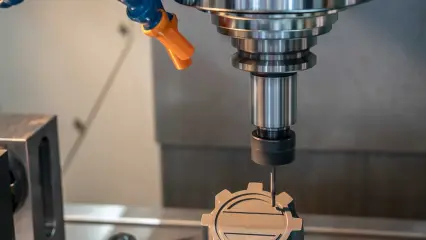
In electrical discharge machining (EDM), the dielectric fluid — typically a dielectric oil — prevents free conduction between electrode and workpiece until a controlled discharge occurs. The graphite electrode, by contrast, must conduct to channel current.
Do not confuse the roles: the oil insulates the working medium; the graphite electrode conducts the discharge. When the electrode absorbs some fluid, cut penetration may vary with dielectric viscosity, graphite porosity, and immersion time.
For EDM processes, ESGRAF supplies graphite electrodes calibrated by grade and application.
Applications that use anisotropy
- Brushes and electrical contacts: conductivity in the wear plane.
- Thermal components: dissipation or insulation depending on part orientation in furnaces or glass lines.
- EDM electrodes: high conductivity and dimensional stability under repeated discharges.
Limitations to consider
Grade, grain orientation, temperature, and atmosphere affect performance. Do not assume one graphite grade behaves like another without reviewing operating conditions.
Information needed for a quote
To guide selection or prepare a quote, ESGRAF typically needs:
- Application and operating conditions (temperature, atmosphere, load).
- Dimensions, technical drawing, or CAD file when applicable.
- Required quantity.
- Requested grade or material currently in use.
- Observed issue with the previous part or lubricant, if any.
Request a quote
ESGRAF offers solid and powder graphite for multiple industries. Share your application, dimensions, quantity, and drawings when available.
Call +52 (81) 8381 0381, +52 (81) 8381 0391, or send a message.